Ch. 1 - Trigonometric Functions
Lial - Trigonometry 12th Edition
Lial12th EditionTrigonometryISBN: 9780136552161, 9780135440780, 9780136881117, 9780135440827, 9780135924891Non è quello che usi tu?Cambia libro di testo
Capitolo 2, Problema 97

Give two positive and two negative angles that are coterminal with the given quadrantal angle. 90°

Guida verificata passo dopo passo
1
Understand that coterminal angles differ by full rotations of 360°. This means if \( \theta \) is an angle, then angles coterminal with \( \theta \) can be found by adding or subtracting multiples of 360°: \( \theta + 360°k \), where \( k \) is any integer.
Given the angle is 90°, write the general formula for coterminal angles: \( 90° + 360°k \).
To find two positive coterminal angles, choose positive integers for \( k \), such as \( k=1 \) and \( k=2 \), and substitute them into the formula.
To find two negative coterminal angles, choose negative integers for \( k \), such as \( k=-1 \) and \( k=-2 \), and substitute them into the formula.
List the resulting angles from steps 3 and 4 as your two positive and two negative coterminal angles with 90°.

Risposta video verificata per un problema simile:

Questa soluzione video è stata consigliata dai nostri tutor come utile per risolvere questo problema.
Durata del video:
2m

Concetti chiave

Ecco i concetti essenziali che devi comprendere per rispondere correttamente alla domanda.

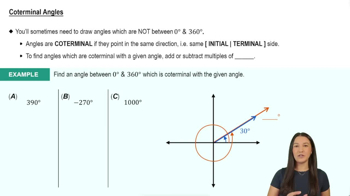
Coterminal Angles

Coterminal angles are angles that share the same initial and terminal sides but differ by full rotations of 360°. Adding or subtracting multiples of 360° to an angle results in coterminal angles, which have identical trigonometric values.
Video consigliato:
Percorso guidato
04:46
Coterminal Angles

Quadrantal Angles

Quadrantal angles are angles whose terminal sides lie along the x- or y-axis, typically 0°, 90°, 180°, 270°, or 360°. These angles are important because their trigonometric values are often simple and serve as reference points in the unit circle.
Video consigliato:
Percorso guidato
6:36
Quadratic Formula

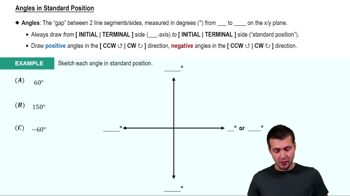
Positive and Negative Angles

Positive angles are measured counterclockwise from the positive x-axis, while negative angles are measured clockwise. Understanding this helps in finding coterminal angles by adding or subtracting 360° to generate both positive and negative equivalents.
Video consigliato:
Percorso guidato
05:50
Drawing Angles in Standard Position