Ch. 1 - Trigonometric Functions
Lial - Trigonometry 12th Edition
Lial12th EditionTrigonometryISBN: 9780136552161, 9780135440780, 9780136881117, 9780135440827, 9780135924891Non è quello che usi tu?Cambia libro di testo
Capitolo 2, Problema 98

Use trigonometric function values of quadrantal angles to evaluate each expression. [cos(―180°)]² + [sin(― 180°)]²

Guida verificata passo dopo passo
1
Recall the Pythagorean identity in trigonometry: \(\cos^2 \theta + \sin^2 \theta = 1\) for any angle \(\theta\).
Identify the angle given in the problem: \(-180^\circ\). Note that \(-180^\circ\) is a quadrantal angle, which means it lies on the x-axis or y-axis of the unit circle.
Evaluate \(\cos(-180^\circ)\) and \(\sin(-180^\circ)\) using the unit circle values for quadrantal angles. Remember that \(\cos(-\theta) = \cos \theta\) and \(\sin(-\theta) = -\sin \theta\).
Square the values obtained for \(\cos(-180^\circ)\) and \(\sin(-180^\circ)\) separately, resulting in \([\cos(-180^\circ)]^2\) and \([\sin(-180^\circ)]^2\).
Add the squared values together as per the expression: \([\cos(-180^\circ)]^2 + [\sin(-180^\circ)]^2\). Use the Pythagorean identity to confirm the result.

Risposta video verificata per un problema simile:

Questa soluzione video è stata consigliata dai nostri tutor come utile per risolvere questo problema.
Durata del video:
3m

Concetti chiave

Ecco i concetti essenziali che devi comprendere per rispondere correttamente alla domanda.

Quadrantal Angles

Quadrantal angles are angles that lie on the x- or y-axis in the coordinate plane, typically 0°, 90°, 180°, 270°, and 360°. Their sine and cosine values are either 0, 1, or -1, which simplifies calculations. Understanding these values helps evaluate trigonometric expressions involving such angles.
Video consigliato:
Percorso guidato
6:36
Quadratic Formula

Trigonometric Function Values at Specific Angles

The sine and cosine of specific angles, especially quadrantal angles, have well-known exact values. For example, cos(180°) = -1 and sin(180°) = 0. Knowing these values allows direct substitution into expressions without approximation.
Video consigliato:
Percorso guidato
6:04
Introduction to Trigonometric Functions

Pythagorean Identity

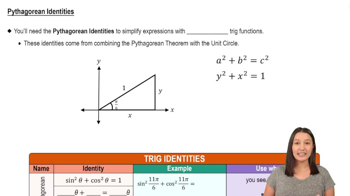
The Pythagorean identity states that for any angle θ, (cos θ)² + (sin θ)² = 1. This fundamental identity confirms that the sum of the squares of sine and cosine of the same angle always equals one, which is key to evaluating the given expression.
Video consigliato:
Percorso guidato
6:25
Pythagorean Identities