Ch. 1 - Trigonometric Functions
Lial - Trigonometry 12th Edition
Lial12th EditionTrigonometryISBN: 9780136552161, 9780135440780, 9780136881117, 9780135440827, 9780135924891Non è quello che usi tu?Cambia libro di testo
Capitolo 2, Problema 40

Identify the quadrant (or possible quadrants) of an angle θ that satisfies the given conditions. See Example 3. cos θ > 0 , sec θ > 0

Guida verificata passo dopo passo
1
Recall the definitions and relationships between cosine and secant: \(\cos \theta\) is the cosine of the angle, and \(\sec \theta\) is its reciprocal, defined as \(\sec \theta = \frac{1}{\cos \theta}\).
Given that \(\cos \theta > 0\), this means the cosine value is positive. Cosine corresponds to the x-coordinate on the unit circle, so the angle \(\theta\) lies where the x-coordinate is positive.
Since \(\sec \theta = \frac{1}{\cos \theta}\), if \(\cos \theta > 0\), then \(\sec \theta\) must also be positive. This confirms the conditions are consistent and point to the same quadrants.
Recall the signs of cosine in each quadrant: cosine is positive in Quadrant I and Quadrant IV, and negative in Quadrant II and Quadrant III.
Therefore, the angle \(\theta\) must lie in Quadrant I or Quadrant IV, where both \(\cos \theta\) and \(\sec \theta\) are positive.

Risposta video verificata per un problema simile:

Questa soluzione video è stata consigliata dai nostri tutor come utile per risolvere questo problema.
Durata del video:
3m

Concetti chiave

Ecco i concetti essenziali che devi comprendere per rispondere correttamente alla domanda.

Relationship Between Cosine and Secant

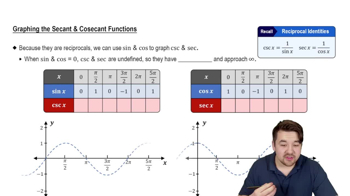
Cosine and secant are reciprocal trigonometric functions, meaning sec θ = 1/cos θ. Therefore, if cos θ > 0, sec θ must also be positive, and vice versa. Understanding this reciprocal relationship helps determine the sign of one function based on the other.
Video consigliato:
Percorso guidato
6:22
Graphs of Secant and Cosecant Functions

Signs of Trigonometric Functions in Quadrants

The signs of cosine and secant depend on the quadrant in which the angle θ lies. Cosine (and secant) is positive in the first and fourth quadrants, and negative in the second and third. Identifying the quadrant based on function signs is essential for solving the problem.
Video consigliato:
Percorso guidato
6:36
Quadratic Formula

Quadrant Identification Using Inequalities

Given inequalities like cos θ > 0 and sec θ > 0, one can deduce the possible quadrants for θ by matching these conditions with the known sign patterns of trigonometric functions in each quadrant. This method is a fundamental approach to locating angles on the unit circle.
Video consigliato:
Percorso guidato
6:36
Quadratic Formula