Ch. 1 - Trigonometric Functions
Lial - Trigonometry 12th Edition
Lial12th EditionTrigonometryISBN: 9780136552161, 9780135440780, 9780136881117, 9780135440827, 9780135924891Non è quello che usi tu?Cambia libro di testo
Capitolo 2, Problema 40

Perform each calculation. See Example 3. 75° 15' + 83° 32'

Guida verificata passo dopo passo
1
First, separate the degrees and minutes for each angle: 75° 15' and 83° 32'.
Add the minutes together: 15' + 32' = 47'.
Add the degrees together: 75° + 83° = 158°.
Since the total minutes (47') are less than 60, no need to convert minutes to degrees.
Combine the sums to get the final angle: 158° 47'.

Risposta video verificata per un problema simile:

Questa soluzione video è stata consigliata dai nostri tutor come utile per risolvere questo problema.
Durata del video:
1m

Concetti chiave

Ecco i concetti essenziali che devi comprendere per rispondere correttamente alla domanda.

Degrees and Minutes in Angle Measurement

Angles can be measured in degrees (°) and minutes ('). One degree equals 60 minutes, similar to how an hour is divided into 60 minutes. Understanding this notation is essential for performing accurate calculations involving angles.
Video consigliato:
Percorso guidato
5:31
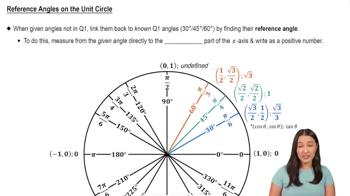
Reference Angles on the Unit Circle

Addition of Angles with Degrees and Minutes

When adding angles expressed in degrees and minutes, add the degrees and minutes separately. If the sum of minutes exceeds 60, convert the excess minutes into degrees by dividing by 60 and add this to the degrees total.
Video consigliato:
Percorso guidato
3:47
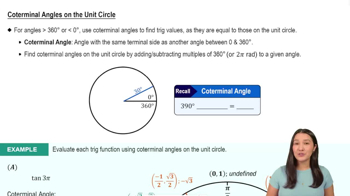
Coterminal Angles on the Unit Circle

Conversion Between Minutes and Degrees

Since 60 minutes equal 1 degree, converting minutes to degrees involves dividing the minutes by 60. This conversion is crucial when the total minutes exceed 60 during addition or subtraction, ensuring the angle is expressed correctly.
Video consigliato:
Percorso guidato
5:04
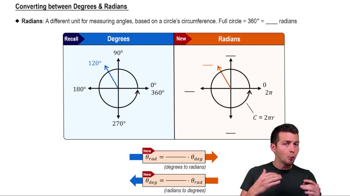
Converting between Degrees & Radians