
Ch. 2 - Acute Angles and Right Triangles
Lial - Trigonometry 12th Edition
Lial12th EditionTrigonometryISBN: 9780136552161, 9780135440780, 9780136881117, 9780135440827, 9780135924891Non è quello che usi tu?Cambia libro di testo
Capitolo 3, Problema 56

Determine whether each statement is true or false. If false, tell why. See Example 4. cos 60° = 2 cos² 30° - 1

Guida verificata passo dopo passo
1
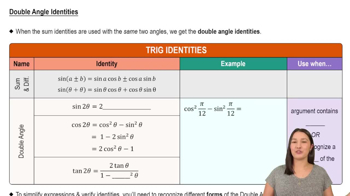
Recall the double-angle identity for cosine: \(\cos(2\theta) = 2\cos^{2}(\theta) - 1\).
Identify the angle in the problem: here, \(60^\circ\) is given, and the right side uses \(\cos^{2}(30^\circ)\).
Check if \(60^\circ\) can be expressed as \(2 \times 30^\circ\), which it can, so the identity applies with \(\theta = 30^\circ\).
Substitute \(\theta = 30^\circ\) into the identity: \(\cos(60^\circ) = 2\cos^{2}(30^\circ) - 1\).
Since this matches the given statement exactly, conclude that the statement is true based on the double-angle formula.

Risposta video verificata per un problema simile:

Questa soluzione video è stata consigliata dai nostri tutor come utile per risolvere questo problema.
Durata del video:
2m

Concetti chiave

Ecco i concetti essenziali che devi comprendere per rispondere correttamente alla domanda.

Cosine Double-Angle Identity

The cosine double-angle identity states that cos(2θ) = 2cos²(θ) - 1. This formula allows expressing the cosine of twice an angle in terms of the cosine of the original angle, which is essential for verifying or simplifying trigonometric expressions involving double angles.
Video consigliato:
Percorso guidato
05:06
Double Angle Identities

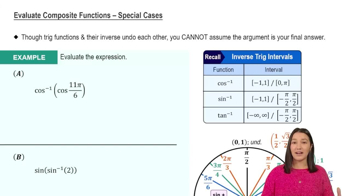
Evaluating Trigonometric Functions at Specific Angles

Knowing exact values of trigonometric functions at common angles like 30°, 60°, and 90° is crucial. For example, cos 60° = 1/2 and cos 30° = √3/2. These values help in directly substituting and verifying the truth of trigonometric statements.
Video consigliato:
Percorso guidato
3:48
Evaluate Composite Functions - Special Cases

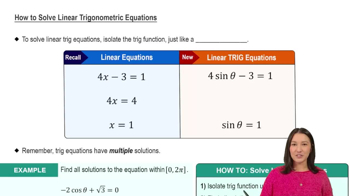
Verification of Trigonometric Equations

To determine if a trigonometric statement is true or false, substitute known values or use identities to simplify both sides. Comparing the results confirms the statement's validity or reveals why it is false, which is key in problem-solving.
Video consigliato:
Percorso guidato
4:34
How to Solve Linear Trigonometric Equations