
Ch. 2 - Acute Angles and Right Triangles
Lial - Trigonometry 12th Edition
Lial12th EditionTrigonometryISBN: 9780136552161, 9780135440780, 9780136881117, 9780135440827, 9780135924891Non è quello che usi tu?Cambia libro di testo
Capitolo 3, Problema 54

Solve each problem. (Source for Exercises 49 and 50: Parker, M., Editor, She Does Math, Mathematical Association of America.) Length of Sides of an Isosceles Triangle An isosceles triangle has a base of length 49.28 m. The angle opposite the base is 58.746°. Find the length of each of the two equal sides.

Guida verificata passo dopo passo
1
Identify the given elements of the isosceles triangle: the base length \(b = 49.28\) m and the vertex angle opposite the base \(\theta = 58.746^\circ\). The two equal sides are what we need to find.
Recall that in an isosceles triangle, the two equal sides are opposite the equal angles. The vertex angle \(\theta\) is opposite the base, so the two equal sides meet at this vertex angle.
Draw an altitude from the vertex angle to the base, which bisects the base into two equal segments of length \(\frac{b}{2} = \frac{49.28}{2}\) m and also bisects the vertex angle into two angles of \(\frac{\theta}{2} = \frac{58.746}{2}^\circ\) each.
Use the right triangle formed by the altitude, half the base, and one of the equal sides. Apply the cosine function to relate the half base and the equal side: \(\cos\left(\frac{\theta}{2}\right) = \frac{\text{adjacent side}}{\text{hypotenuse}} = \frac{\frac{b}{2}}{s}\), where \(s\) is the length of each equal side.
Rearrange the formula to solve for \(s\): \(s = \frac{\frac{b}{2}}{\cos\left(\frac{\theta}{2}\right)}\). Substitute the known values for \(b\) and \(\theta\) to find the length of each equal side.

Risposta video verificata per un problema simile:

Questa soluzione video è stata consigliata dai nostri tutor come utile per risolvere questo problema.
Durata del video:
3m

Concetti chiave

Ecco i concetti essenziali che devi comprendere per rispondere correttamente alla domanda.

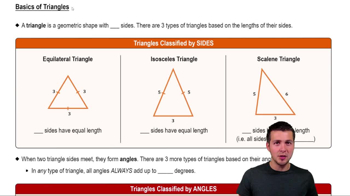
Properties of Isosceles Triangles

An isosceles triangle has two sides of equal length and two equal angles opposite those sides. Knowing the base and the angle opposite it helps determine the other sides by using symmetry and angle relationships within the triangle.
Video consigliato:
Percorso guidato
4:42
Review of Triangles

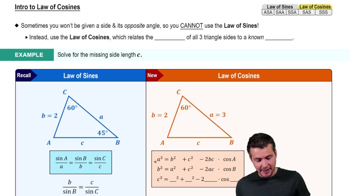
Law of Cosines

The Law of Cosines relates the lengths of sides of any triangle to the cosine of one of its angles. It is useful for finding unknown side lengths when two sides and the included angle or one side and two angles are known.
Video consigliato:
Percorso guidato
4:35
Intro to Law of Cosines

Triangle Angle Sum Property

The sum of the interior angles of any triangle is always 180°. This property helps find missing angles when some angles are known, which is essential for applying trigonometric laws correctly.
Video consigliato:
Percorso guidato
4:47
Sum and Difference of Tangent