
Suppose ABC is a right triangle with sides of lengths a, b, and c and right angle at C. Use the Pythagorean theorem to find the unknown side length. Then find exact values of the six trigonometric functions for angle B. Rationalize denominators when applicable. See Example 1. b = 8, c = 11
Ch. 2 - Acute Angles and Right Triangles
Lial12th EditionTrigonometryISBN: 9780136552161, 9780135440780, 9780136881117, 9780135440827, 9780135924891Non è quello che usi tu?Cambia libro di testo
Capitolo 3, Problema 17
Find all values of θ, if θ is in the interval [0°, 360°) and has the given function value. cos θ = -½
Guida verificata passo dopo passo1
Recall that the cosine function corresponds to the x-coordinate on the unit circle for an angle \( \theta \). We are given \( \cos \theta = -\frac{1}{2} \), and we need to find all \( \theta \) in the interval \( [0^\circ, 360^\circ) \) that satisfy this.
Identify the reference angle where \( \cos \theta = \frac{1}{2} \). Since cosine is positive in the first quadrant, find the acute angle \( \alpha \) such that \( \cos \alpha = \frac{1}{2} \). This reference angle \( \alpha \) is \( 60^\circ \) because \( \cos 60^\circ = \frac{1}{2} \).
Since the cosine value is negative, \( \theta \) must lie in the quadrants where cosine is negative. Cosine is negative in the second and third quadrants.
Use the reference angle to find the solutions in the second and third quadrants:
- In the second quadrant, \( \theta = 180^\circ - \alpha \).
- In the third quadrant, \( \theta = 180^\circ + \alpha \).
Write the general solutions explicitly using the reference angle \( 60^\circ \):
- \( \theta = 180^\circ - 60^\circ \)
- \( \theta = 180^\circ + 60^\circ \)
These are the values of \( \theta \) in the interval \( [0^\circ, 360^\circ) \) where \( \cos \theta = -\frac{1}{2} \).

Risposta video verificata per un problema simile:
Questa soluzione video è stata consigliata dai nostri tutor come utile per risolvere questo problema.
Durata del video:
4mConcetti chiave
Ecco i concetti essenziali che devi comprendere per rispondere correttamente alla domanda.
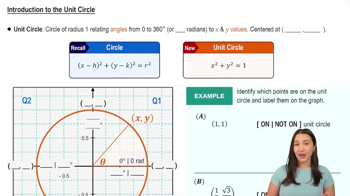
Unit Circle and Angle Measurement
The unit circle is a circle with radius 1 centered at the origin of the coordinate plane. Angles in trigonometry are often measured in degrees or radians on this circle, where the cosine of an angle corresponds to the x-coordinate of the point on the circle. Understanding the unit circle helps identify where cosine values are positive or negative.
Video consigliato:
Percorso guidato
Introduction to the Unit Circle
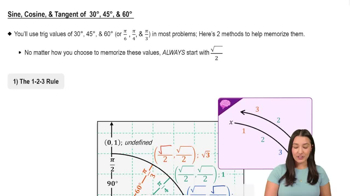
Cosine Function and Its Values
The cosine function relates an angle to the ratio of the adjacent side over the hypotenuse in a right triangle, or equivalently, the x-coordinate on the unit circle. Knowing that cos θ = -½ means finding angles where the x-coordinate is -0.5, which occurs in specific quadrants where cosine is negative.
Video consigliato:
Percorso guidato
Sine, Cosine, & Tangent of 30°, 45°, & 60°
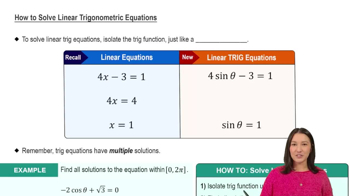
Solving Trigonometric Equations in a Given Interval
To solve cos θ = -½ within [0°, 360°), identify all angles in this range where the cosine equals -½. Since cosine is negative in the second and third quadrants, use reference angles and symmetry properties to find all solutions within the specified interval.
Video consigliato:
Percorso guidato
How to Solve Linear Trigonometric Equations
Pratica correlata
Domanda del libro di testo
872
views
Domanda del libro di testo
Find exact values of the six trigonometric functions of each angle. Rationalize denominators when applicable. See Examples 2, 3, and 5. 300°
650
views
Domanda del libro di testo
Solve each right triangle. When two sides are given, give angles in degrees and minutes.
512
views
Domanda del libro di testo
Find exact values of the six trigonometric functions for each angle. Do not use a calculator. Rationalize denominators when applicable. 120°
744
views
Domanda del libro di testo
Solve each right triangle. When two sides are given, give angles in degrees and minutes.
529
views
Domanda del libro di testo
Suppose ABC is a right triangle with sides of lengths a, b, and c and right angle at C. Use the Pythagorean theorem to find the unknown side length. Then find exact values of the six trigonometric functions for angle B. Rationalize denominators when applicable. See Example 1. a = √2, c = 2
860
views
