
Domanda del libro di testo
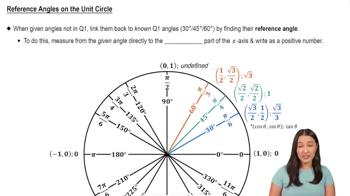
Find all values of θ, if θ is in the interval [0°, 360°) and has the given function value. cos θ = -½
667
views

 Guida verificata passo dopo passo
 5:31
5:31
 6:04
6:04 2:58
2:58Find all values of θ, if θ is in the interval [0°, 360°) and has the given function value. cos θ = -½
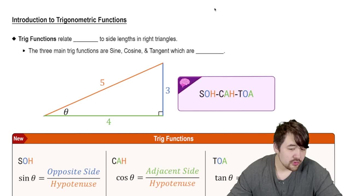
Suppose ABC is a right triangle with sides of lengths a, b, and c and right angle at C. Use the Pythagorean theorem to find the unknown side length. Then find exact values of the six trigonometric functions for angle B. Rationalize denominators when applicable. See Example 1. b = 8, c = 11
Suppose ABC is a right triangle with sides of lengths a, b, and c and right angle at C. Use the Pythagorean theorem to find the unknown side length. Then find exact values of the six trigonometric functions for angle B. Rationalize denominators when applicable. See Example 1. a = 6, c = 7
Solve each right triangle. When two sides are given, give angles in degrees and minutes. See Examples 1 and 2.
Solve each right triangle. When two sides are given, give angles in degrees and minutes.
Suppose ABC is a right triangle with sides of lengths a, b, and c and right angle at C. Use the Pythagorean theorem to find the unknown side length. Then find exact values of the six trigonometric functions for angle B. Rationalize denominators when applicable. See Example 1.
a = 5, b = 12