Find one solution for each equation. Assume all angles involved are acute angles. See Example 3. cos(2θ + 50°) = sin(2θ - 20°)
Ch. 2 - Acute Angles and Right Triangles
Lial12th EditionTrigonometryISBN: 9780136552161, 9780135440780, 9780136881117, 9780135440827, 9780135924891Non è quello che usi tu?Cambia libro di testo
Capitolo 3, Problema 40
Find one solution for each equation. Assume all angles involved are acute angles. See Example 3. csc(β + 40°) = sec(β - 20°)
Guida verificata passo dopo passo1
Recall the definitions of the cosecant and secant functions: \(\csc \theta = \frac{1}{\sin \theta}\) and \(\sec \theta = \frac{1}{\cos \theta}\). Rewrite the given equation \(\csc(\beta + 40^\circ) = \sec(\beta - 20^\circ)\) as \(\frac{1}{\sin(\beta + 40^\circ)} = \frac{1}{\cos(\beta - 20^\circ)}\).
Cross-multiply to eliminate the fractions, giving \(\cos(\beta - 20^\circ) = \sin(\beta + 40^\circ)\).
Use the co-function identity \(\sin \theta = \cos(90^\circ - \theta)\) to rewrite the right side: \(\sin(\beta + 40^\circ) = \cos(90^\circ - (\beta + 40^\circ)) = \cos(50^\circ - \beta)\).
Set the two cosine expressions equal: \(\cos(\beta - 20^\circ) = \cos(50^\circ - \beta)\). Recall that if \(\cos A = \cos B\), then either \(A = B\) or \(A = 360^\circ - B\) (or in degrees, \(A = B + 360^\circ k\) or \(A = -B + 360^\circ k\) for integer \(k\)). Since angles are acute, focus on the principal solutions.
Solve the equations \(\beta - 20^\circ = 50^\circ - \beta\) and \(\beta - 20^\circ = -(50^\circ - \beta)\) for \(\beta\), then check which solutions are acute angles (between \(0^\circ\) and \(90^\circ\)).

Risposta video verificata per un problema simile:
Questa soluzione video è stata consigliata dai nostri tutor come utile per risolvere questo problema.
Concetti chiave
Ecco i concetti essenziali che devi comprendere per rispondere correttamente alla domanda.
Reciprocal Trigonometric Functions
Cosecant (csc) and secant (sec) are reciprocal functions of sine and cosine, respectively. Specifically, csc(θ) = 1/sin(θ) and sec(θ) = 1/cos(θ). Understanding these relationships allows rewriting the equation in terms of sine and cosine for easier manipulation.
Video consigliato:
Percorso guidato
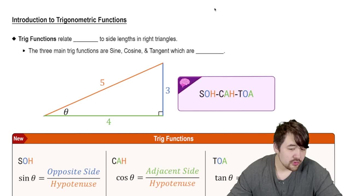
Introduction to Trigonometric Functions
Trigonometric Equation Solving
Solving trigonometric equations often involves rewriting expressions, using identities, and isolating the variable. Here, equating csc(β + 40°) to sec(β - 20°) requires converting to sine and cosine, then finding β that satisfies the resulting equation within the given domain.
Video consigliato:
Percorso guidato
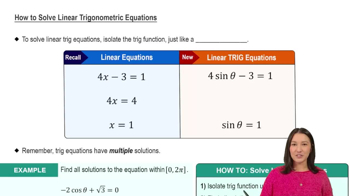
How to Solve Linear Trigonometric Equations
Domain Restrictions and Acute Angles
The problem specifies that all angles are acute, meaning they lie between 0° and 90°. This restriction limits possible solutions and helps in selecting the correct angle values after solving the equation, ensuring the solution is valid within the given context.
Video consigliato:
Percorso guidato
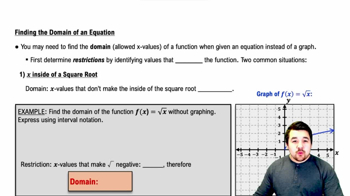
Finding the Domain of an Equation
Pratica correlata
Domanda del libro di testo
585
views
Domanda del libro di testo
Find the exact value of each expression. See Example 3. sec(-495°)
597
views
Domanda del libro di testo
Determine whether each statement is true or false. See Example 4. tan 28° ≤ tan 40°
575
views
Domanda del libro di testo
Find one solution for each equation. Assume all angles involved are acute angles. See Example 3. sec(3β + 10°) = csc(β + 8°)
726
views
Domanda del libro di testo
Find the exact value of each expression. See Example 3. tan(-1020°)
597
views
Domanda del libro di testo
Solve each right triangle. In each case, C = 90°. If angle information is given in degrees and minutes, give answers in the same way. If angle information is given in decimal degrees, do likewise in answers. When two sides are given, give angles in degrees and minutes. See Examples 1 and 2. B = 39°09', c = 0.6231 m
579
views