Ch. 2 - Acute Angles and Right Triangles
Lial - Trigonometry 12th Edition
Lial12th EditionTrigonometryISBN: 9780136552161, 9780135440780, 9780136881117, 9780135440827, 9780135924891Non è quello che usi tu?Cambia libro di testo
Capitolo 3, Problema 79

Suppose θ is in the interval (90°, 180°). Find the sign of each of the following. sec(θ + 180°)

Guida verificata passo dopo passo
1
Recall the definition of the secant function: \(\sec(\alpha) = \frac{1}{\cos(\alpha)}\). To determine the sign of \(\sec(\theta + 180^\circ)\), we need to analyze the sign of \(\cos(\theta + 180^\circ)\).
Use the cosine angle addition identity for a shift by \(180^\circ\): \(\cos(\theta + 180^\circ) = -\cos(\theta)\).
Since \(\theta\) is in the interval \((90^\circ, 180^\circ)\), determine the sign of \(\cos(\theta)\) in this interval. Recall that cosine is negative in the second quadrant (between \(90^\circ\) and \(180^\circ\)).
Given that \(\cos(\theta)\) is negative in this interval, substitute back into the expression \(\cos(\theta + 180^\circ) = -\cos(\theta)\) to find its sign. Since \(\cos(\theta)\) is negative, \(-\cos(\theta)\) will be positive.
Finally, since \(\sec(\theta + 180^\circ) = \frac{1}{\cos(\theta + 180^\circ)}\), and \(\cos(\theta + 180^\circ)\) is positive, conclude that \(\sec(\theta + 180^\circ)\) is positive.

Risposta video verificata per un problema simile:

Questa soluzione video è stata consigliata dai nostri tutor come utile per risolvere questo problema.

Concetti chiave

Ecco i concetti essenziali che devi comprendere per rispondere correttamente alla domanda.

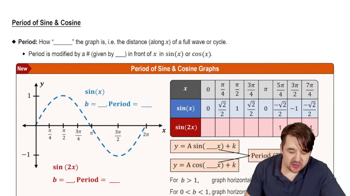
Trigonometric Function Periodicity

Trigonometric functions repeat their values in regular intervals called periods. For secant, which is the reciprocal of cosine, the period is 360°. This means sec(θ + 360°) = sec(θ), and understanding this helps simplify expressions involving angle shifts.
Video consigliato:
Percorso guidato
5:33
Period of Sine and Cosine Functions

Angle Addition and Quadrant Analysis

Adding angles shifts the position of the terminal side on the unit circle. Since θ is in (90°, 180°), adding 180° moves the angle to (270°, 360°). Knowing which quadrant the new angle lies in is essential to determine the sign of trigonometric functions.
Video consigliato:
Percorso guidato
6:36
Quadratic Formula

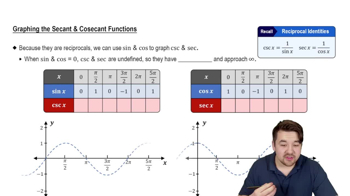
Sign of Secant Function in Different Quadrants

Secant is the reciprocal of cosine, so its sign depends on the cosine value. Cosine is negative in the second and third quadrants and positive in the first and fourth. Therefore, secant is negative where cosine is negative and positive where cosine is positive.
Video consigliato:
Percorso guidato
6:22
Graphs of Secant and Cosecant Functions