Ch. 4 - Graphs of the Circular Functions
Lial - Trigonometry 12th Edition
Lial12th EditionTrigonometryISBN: 9780136552161, 9780135440780, 9780136881117, 9780135440827, 9780135924891Non è quello che usi tu?Cambia libro di testo
Capitolo 5, Problema 25

Each function graphed is of the form y = c + cos x, y = c + sin x, y = cos(x - d), or y = sin(x - d), where d is the least possible positive value. Determine an equation of the graph.


<IMAGE>

Guida verificata passo dopo passo
1
Identify the key features of the graph such as amplitude, vertical shift, and phase shift. Since the functions are of the form \(y = c + \cos x\), \(y = c + \sin x\), \(y = \cos(x - d)\), or \(y = \sin(x - d)\), start by determining the vertical shift \(c\) by finding the midline of the graph (the average of the maximum and minimum values).
Determine the amplitude of the graph by calculating half the distance between the maximum and minimum values. This amplitude corresponds to the coefficient in front of the sine or cosine function, which in this problem is 1, so confirm if the graph matches this amplitude.
Next, decide whether the graph resembles a sine or cosine function by looking at the starting point (at \(x=0\)). If the graph starts at a maximum or minimum, it is likely a cosine function; if it starts at the midline going upward or downward, it is likely a sine function.
Find the phase shift \(d\) by identifying the horizontal shift of the graph compared to the standard sine or cosine graph. The phase shift is the smallest positive value such that the function matches the graph, so measure how far the graph is shifted horizontally from the usual \(x=0\) position.
Write the equation by combining the vertical shift \(c\), the function type (sine or cosine), and the phase shift \(d\) in the form \(y = c + \cos(x - d)\) or \(y = c + \sin(x - d)\), using the values you have determined.

Risposta video verificata per un problema simile:

Questa soluzione video è stata consigliata dai nostri tutor come utile per risolvere questo problema.

Concetti chiave

Ecco i concetti essenziali che devi comprendere per rispondere correttamente alla domanda.

Amplitude and Vertical Shift in Trigonometric Functions

The amplitude of sine and cosine functions determines the height of their peaks and troughs, while the vertical shift (represented by c) moves the entire graph up or down. Understanding these helps identify the constant c in equations like y = c + sin x or y = c + cos x.
Video consigliato:
Percorso guidato
5:34
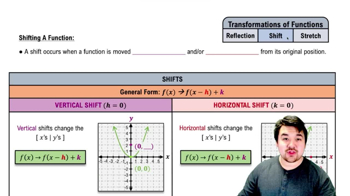
Shifting A Functions

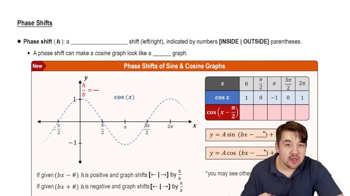
Phase Shift in Sine and Cosine Functions

Phase shift refers to the horizontal translation of the graph, represented by d in expressions like y = sin(x - d) or y = cos(x - d). The least positive value of d shifts the graph rightward, affecting where the function starts its cycle, crucial for matching the given graph.
Video consigliato:

Identifying Function Type from Graph Shape

Recognizing whether the graph corresponds to a sine or cosine function depends on its starting point and shape. Cosine graphs start at a maximum when x=0, while sine graphs start at zero. This distinction aids in selecting the correct base function before applying shifts.
Video consigliato:
Percorso guidato
6:22
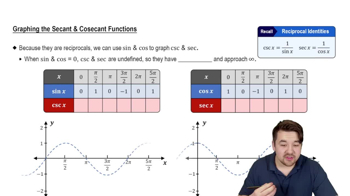
Graphs of Secant and Cosecant Functions