Ch. 4 - Graphs of the Circular Functions
Lial - Trigonometry 12th Edition
Lial12th EditionTrigonometryISBN: 9780136552161, 9780135440780, 9780136881117, 9780135440827, 9780135924891Non è quello che usi tu?Cambia libro di testo
Capitolo 5, Problema 21

Match each function in Column I with the appropriate description in Column II.


I
y = -4 sin(3x - 2)


II
A. amplitude = 2, period = π/2, phase shift = ¾
B. amplitude = 3, period = π, phase shift = 2
C. amplitude = 4, period = 2π/3, phase shift = ⅔
D. amplitude = 2, period = 2π/3, phase shift = 4⁄3

Guida verificata passo dopo passo
1
Identify the general form of the sine function: \(y = A \sin(Bx - C)\), where \(A\) is the amplitude, \(B\) affects the period, and \(C\) affects the phase shift.
Determine the amplitude by taking the absolute value of the coefficient in front of the sine function: \(|A| = |-4| = 4\).
Calculate the period using the formula \(\text{Period} = \frac{2\pi}{|B|}\). Here, \(B = 3\), so the period is \(\frac{2\pi}{3}\).
Find the phase shift using the formula \(\text{Phase shift} = \frac{C}{B}\). Since the function is \(y = -4 \sin(3x - 2)\), rewrite the inside as \(3x - 2 = 3(x - \frac{2}{3})\), so the phase shift is \(\frac{2}{3}\).
Match the calculated values: amplitude = 4, period = \(\frac{2\pi}{3}\), phase shift = \(\frac{2}{3}\) with the options in Column II to find the correct description.

Risposta video verificata per un problema simile:

Questa soluzione video è stata consigliata dai nostri tutor come utile per risolvere questo problema.

Concetti chiave

Ecco i concetti essenziali che devi comprendere per rispondere correttamente alla domanda.

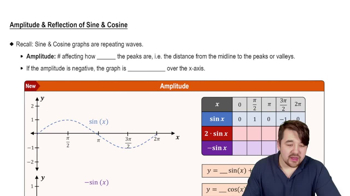
Amplitude of a Sine Function

Amplitude is the absolute value of the coefficient before the sine function and represents the maximum vertical displacement from the midline. For y = -4 sin(3x - 2), the amplitude is |−4| = 4, indicating the wave oscillates 4 units above and below the center line.
Video consigliato:
Percorso guidato
5:05
Amplitude and Reflection of Sine and Cosine

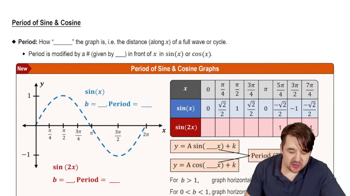
Period of a Sine Function

The period is the length of one complete cycle of the sine wave and is calculated by dividing 2π by the coefficient of x inside the function. Here, the period is 2π/3 because the coefficient of x is 3, meaning the function repeats every 2π/3 units.
Video consigliato:
Percorso guidato
5:33
Period of Sine and Cosine Functions

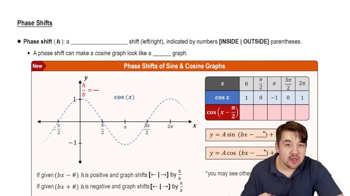
Phase Shift of a Sine Function

Phase shift is the horizontal translation of the sine curve and is found by solving the inside of the function's argument for zero: 3x - 2 = 0, so x = 2/3. This means the graph shifts right by 2/3 units, adjusting where the wave starts along the x-axis.
Video consigliato: