Ch. 5 - Trigonometric Identities
Lial - Trigonometry 12th Edition
Lial12th EditionTrigonometryISBN: 9780136552161, 9780135440780, 9780136881117, 9780135440827, 9780135924891Non è quello che usi tu?Cambia libro di testo
Capitolo 6, Problema 5.6.2

Determine whether the positive or negative square root should be selected.
cos 58° = ±√ (1 + cos 116°)/2]

Guida verificata passo dopo passo
1
Recognize that the expression given is derived from the half-angle identity for cosine: \(\cos \theta = \pm \sqrt{\frac{1 + \cos 2\theta}{2}}\). Here, \(\theta = 58^\circ\) and \(2\theta = 116^\circ\).
Understand that the \(\pm\) sign depends on the quadrant in which the angle \(\theta\) lies. Since \(\theta = 58^\circ\) is in the first quadrant (0° to 90°), where cosine values are positive, the positive root should be selected.
Confirm the quadrant by recalling that cosine is positive in the first and fourth quadrants and negative in the second and third quadrants.
Therefore, for \(\cos 58^\circ\), choose the positive square root in the half-angle formula.
Summarize: Use the positive root because \(58^\circ\) is in the first quadrant where cosine is positive.

Risposta video verificata per un problema simile:

Questa soluzione video è stata consigliata dai nostri tutor come utile per risolvere questo problema.

Concetti chiave

Ecco i concetti essenziali che devi comprendere per rispondere correttamente alla domanda.

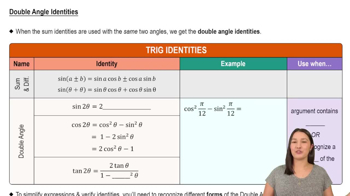
Half-Angle Identity for Cosine

The half-angle identity expresses cosine of half an angle in terms of the cosine of the full angle: cos(θ/2) = ±√[(1 + cos θ)/2]. This formula helps find cosine values for angles that are half of known angles, but requires choosing the correct sign based on the angle's quadrant.
Video consigliato:
Percorso guidato
05:06
Double Angle Identities

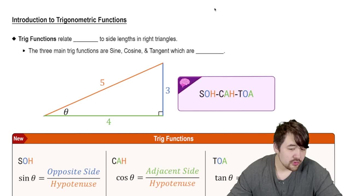
Determining the Sign of Trigonometric Functions

The sign of cosine depends on the quadrant in which the angle lies. Cosine is positive in the first and fourth quadrants and negative in the second and third. Identifying the quadrant of the half-angle (here 58°) is essential to select the correct positive or negative root.
Video consigliato:
Percorso guidato
6:04
Introduction to Trigonometric Functions

Relationship Between Angles and Their Cosine Values

Understanding how cosine values relate for angles and their multiples or halves is crucial. For example, cos 58° relates to cos 116° through the half-angle formula. Recognizing these relationships allows simplification and correct evaluation of trigonometric expressions.
Video consigliato:
Percorso guidato
04:33
Find the Angle Between Vectors