Ch. 5 - Trigonometric Identities
Lial - Trigonometry 12th Edition
Lial12th EditionTrigonometryISBN: 9780136552161, 9780135440780, 9780136881117, 9780135440827, 9780135924891Non è quello che usi tu?Cambia libro di testo
Capitolo 6, Problema 5.28

Factor each trigonometric expression.
4 tan² β + tan β - 3

Guida verificata passo dopo passo
1
Identify the expression to be factored: \(4 \tan^2 \beta + \tan \beta - 3\).
Recognize that this is a quadratic expression in terms of \(\tan \beta\).
Use the substitution \(x = \tan \beta\) to rewrite the expression as \(4x^2 + x - 3\).
Factor the quadratic expression \(4x^2 + x - 3\) using the method of your choice (e.g., trial and error, quadratic formula, or factoring by grouping).
Once factored, replace \(x\) with \(\tan \beta\) to express the factors in terms of \(\tan \beta\).

Risposta video verificata per un problema simile:

Questa soluzione video è stata consigliata dai nostri tutor come utile per risolvere questo problema.

Concetti chiave

Ecco i concetti essenziali che devi comprendere per rispondere correttamente alla domanda.

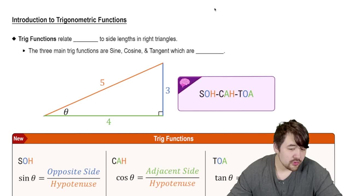
Trigonometric Functions

Trigonometric functions, such as tangent, sine, and cosine, relate angles to ratios of sides in right triangles. The tangent function, specifically, is defined as the ratio of the opposite side to the adjacent side. Understanding how to manipulate these functions is essential for factoring expressions involving them.
Video consigliato:
Percorso guidato
6:04
Introduction to Trigonometric Functions

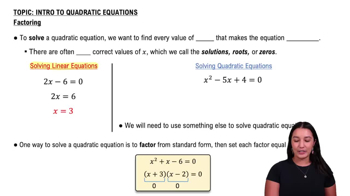
Factoring Quadratic Expressions

Factoring quadratic expressions involves rewriting them as a product of their linear factors. The general form of a quadratic is ax² + bx + c, and it can often be factored into (px + q)(rx + s). Recognizing patterns and applying techniques like the AC method or trial and error are crucial for successfully factoring expressions like 4 tan² β + tan β - 3.
Video consigliato:

Zero Product Property

The Zero Product Property states that if the product of two factors equals zero, at least one of the factors must be zero. This principle is vital when solving equations after factoring, as it allows us to set each factor equal to zero to find the possible values of the variable. In the context of trigonometric expressions, this helps in determining the angles that satisfy the equation.
Video consigliato:
Percorso guidato
05:40
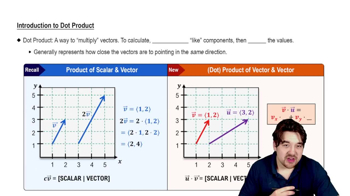
Introduction to Dot Product