Ch. 5 - Trigonometric Identities
Lial - Trigonometry 12th Edition
Lial12th EditionTrigonometryISBN: 9780136552161, 9780135440780, 9780136881117, 9780135440827, 9780135924891Non è quello che usi tu?Cambia libro di testo
Capitolo 6, Problema 5.RE.16

Work each problem.
Find the exact values of sin x, cos x, and tan x, for x = π/12 , using


a. difference identities


b. half-angle identities. 

Guida verificata passo dopo passo
1
Identify the angle \( x = \frac{\pi}{12} \) radians, which is equivalent to 15 degrees. Recognize that \( \frac{\pi}{12} = \frac{\pi}{3} - \frac{\pi}{4} \), so you can use difference identities with angles \( \frac{\pi}{3} \) and \( \frac{\pi}{4} \).
For part (a), apply the difference identities for sine, cosine, and tangent: - \( \sin(a - b) = \sin a \cos b - \cos a \sin b \) - \( \cos(a - b) = \cos a \cos b + \sin a \sin b \) - \( \tan(a - b) = \frac{\tan a - \tan b}{1 + \tan a \tan b} \) Use \( a = \frac{\pi}{3} \) and \( b = \frac{\pi}{4} \) and substitute the exact values of sine, cosine, and tangent for these standard angles.
For part (b), use the half-angle identities to find \( \sin \frac{\theta}{2} \), \( \cos \frac{\theta}{2} \), and \( \tan \frac{\theta}{2} \) where \( \theta = \frac{\pi}{6} \) because \( \frac{\pi}{12} = \frac{1}{2} \times \frac{\pi}{6} \). The half-angle formulas are: - \( \sin \frac{\theta}{2} = \pm \sqrt{\frac{1 - \cos \theta}{2}} \) - \( \cos \frac{\theta}{2} = \pm \sqrt{\frac{1 + \cos \theta}{2}} \) - \( \tan \frac{\theta}{2} = \pm \sqrt{\frac{1 - \cos \theta}{1 + \cos \theta}} \) or \( \tan \frac{\theta}{2} = \frac{\sin \theta}{1 + \cos \theta} \)
Determine the correct signs for the half-angle values based on the quadrant where \( x = \frac{\pi}{12} \) lies (first quadrant, so sine, cosine, and tangent are positive). Substitute the exact value of \( \cos \frac{\pi}{6} \) into the half-angle formulas.
Simplify the expressions under the square roots and the fractions to get the exact values of \( \sin \frac{\pi}{12} \), \( \cos \frac{\pi}{12} \), and \( \tan \frac{\pi}{12} \) using both methods, without calculating decimal approximations.

Risposta video verificata per un problema simile:

Questa soluzione video è stata consigliata dai nostri tutor come utile per risolvere questo problema.

Concetti chiave

Ecco i concetti essenziali che devi comprendere per rispondere correttamente alla domanda.

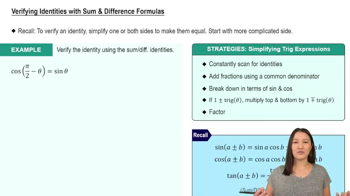
Difference Identities

Difference identities express the sine, cosine, or tangent of a difference of two angles in terms of the sines and cosines of the individual angles. For example, sin(a - b) = sin a cos b - cos a sin b. These identities allow exact evaluation of trigonometric functions for angles like π/12 by rewriting them as differences of known angles.
Video consigliato:
Percorso guidato
2:25
Verifying Identities with Sum and Difference Formulas

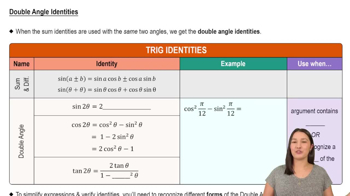
Half-Angle Identities

Half-angle identities provide formulas to find the sine, cosine, or tangent of half an angle using the cosine or sine of the original angle. For instance, sin(θ/2) = ±√((1 - cos θ)/2). These identities help compute exact trigonometric values for angles like π/12 by relating them to angles like π/6.
Video consigliato:
Percorso guidato
05:06
Double Angle Identities

Exact Values of Common Angles

Knowing the exact sine, cosine, and tangent values of standard angles such as π/6, π/4, and π/3 is essential. These values serve as building blocks when applying difference or half-angle identities to find exact values for non-standard angles like π/12.
Video consigliato:
Percorso guidato
3:47
Introduction to Common Polar Equations