Ch. 6 - Inverse Circular Functions and Trigonometric Equations
Lial - Trigonometry 12th Edition
Lial12th EditionTrigonometryISBN: 9780136552161, 9780135440780, 9780136881117, 9780135440827, 9780135924891Non è quello che usi tu?Cambia libro di testo
Capitolo 7, Problema 77

Evaluate each expression without using a calculator.
cos (tan⁻¹ (-2))

Guida verificata passo dopo passo
1
Recognize that the expression is \( \cos(\tan^{-1}(-2)) \). Here, \( \tan^{-1}(-2) \) represents an angle \( \theta \) whose tangent is \( -2 \). So, set \( \theta = \tan^{-1}(-2) \), which means \( \tan(\theta) = -2 \).
Visualize or draw a right triangle to represent the angle \( \theta \). Since \( \tan(\theta) = \frac{\text{opposite}}{\text{adjacent}} = -2 \), assign the opposite side length as \( -2 \) and the adjacent side length as \( 1 \) (the negative sign indicates direction, but for length use positive values and consider the quadrant later).
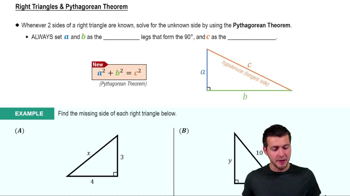
Calculate the hypotenuse \( h \) of the triangle using the Pythagorean theorem: \( h = \sqrt{(\text{opposite})^2 + (\text{adjacent})^2} = \sqrt{(-2)^2 + 1^2} = \sqrt{4 + 1} = \sqrt{5} \).
Recall that \( \cos(\theta) = \frac{\text{adjacent}}{\text{hypotenuse}} \). Using the triangle, this becomes \( \cos(\theta) = \frac{1}{\sqrt{5}} \).
Determine the sign of \( \cos(\theta) \) based on the quadrant of \( \theta \). Since \( \tan(\theta) = -2 \) is negative, \( \theta \) lies either in the second or fourth quadrant. Cosine is positive in the fourth quadrant and negative in the second. Because the tangent is negative and the angle is the inverse tangent of a negative number, \( \theta \) is in the fourth quadrant, so \( \cos(\theta) \) is positive. Therefore, \( \cos(\tan^{-1}(-2)) = \frac{1}{\sqrt{5}} \).

Risposta video verificata per un problema simile:

Questa soluzione video è stata consigliata dai nostri tutor come utile per risolvere questo problema.

Concetti chiave

Ecco i concetti essenziali che devi comprendere per rispondere correttamente alla domanda.

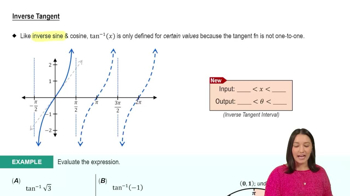
Inverse Tangent Function (tan⁻¹ or arctan)

The inverse tangent function, tan⁻¹(x), returns the angle whose tangent is x. It maps a real number to an angle typically in the range (-π/2, π/2). Understanding this helps convert the given value into an angle for further trigonometric evaluation.
Video consigliato:
Percorso guidato
3:17
Inverse Tangent

Right Triangle Interpretation of Trigonometric Ratios

Trigonometric functions can be interpreted using right triangles, where tangent is the ratio of the opposite side to the adjacent side. By representing tan⁻¹(-2) as an angle in a triangle, we can find the lengths of sides and use them to calculate cosine without a calculator.
Video consigliato:
Percorso guidato
5:19
Solving Right Triangles with the Pythagorean Theorem

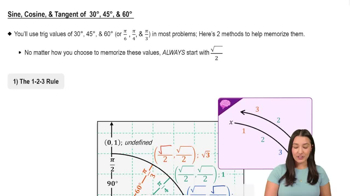
Relationship Between Sine, Cosine, and Tangent

Cosine, sine, and tangent are related by the identity tan(θ) = sin(θ)/cos(θ). Knowing tan(θ), we can express cosine in terms of tangent using the Pythagorean identity cos(θ) = ±1/√(1 + tan²(θ)). This relationship allows evaluation of cosine from a given tangent value.
Video consigliato:
Percorso guidato
5:08
Sine, Cosine, & Tangent of 30°, 45°, & 60°