Ch. 6 - Inverse Circular Functions and Trigonometric Equations
Lial - Trigonometry 12th Edition
Lial12th EditionTrigonometryISBN: 9780136552161, 9780135440780, 9780136881117, 9780135440827, 9780135924891Non è quello che usi tu?Cambia libro di testo
Capitolo 7, Problema 83

Evaluate each expression without using a calculator.
sin (2 cos⁻¹ (1/5))

Guida verificata passo dopo passo
1
Recognize that the expression involves the sine of twice an inverse cosine value: \(\sin\left(2 \cos^{-1}\left(\frac{1}{5}\right)\right)\). This suggests using the double-angle identity for sine.
Recall the double-angle identity for sine: \(\sin(2\theta) = 2 \sin\theta \cos\theta\). Here, let \(\theta = \cos^{-1}\left(\frac{1}{5}\right)\).
Since \(\theta = \cos^{-1}\left(\frac{1}{5}\right)\), we know \(\cos\theta = \frac{1}{5}\). To find \(\sin\theta\), use the Pythagorean identity: \(\sin\theta = \sqrt{1 - \cos^2\theta} = \sqrt{1 - \left(\frac{1}{5}\right)^2}\).
Substitute \(\sin\theta\) and \(\cos\theta\) into the double-angle formula: \(\sin(2\theta) = 2 \times \sin\theta \times \cos\theta = 2 \times \sqrt{1 - \left(\frac{1}{5}\right)^2} \times \frac{1}{5}\).
Simplify the expression inside the square root and multiply through to express \(\sin(2 \cos^{-1}(\frac{1}{5}))\) in simplest radical form without using a calculator.

Risposta video verificata per un problema simile:

Questa soluzione video è stata consigliata dai nostri tutor come utile per risolvere questo problema.

Concetti chiave

Ecco i concetti essenziali che devi comprendere per rispondere correttamente alla domanda.

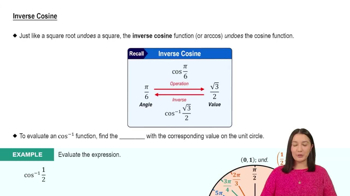
Inverse Cosine Function (cos⁻¹ or arccos)

The inverse cosine function returns the angle whose cosine is a given value. For example, cos⁻¹(1/5) gives an angle θ such that cos(θ) = 1/5. Understanding this helps convert the expression into an angle measure for further trigonometric manipulation.
Video consigliato:
Percorso guidato
4:49
Inverse Cosine

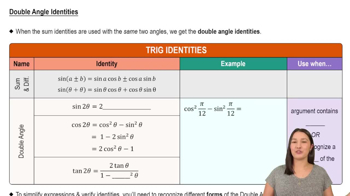
Double-Angle Identity for Sine

The double-angle identity states that sin(2θ) = 2 sin(θ) cos(θ). This formula allows us to rewrite sin(2 cos⁻¹(1/5)) as 2 sin(θ) cos(θ), where θ = cos⁻¹(1/5), facilitating evaluation without a calculator.
Video consigliato:
Percorso guidato
05:06
Double Angle Identities

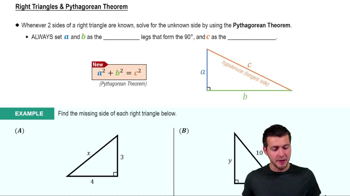
Right Triangle Interpretation for Trigonometric Values

By interpreting θ = cos⁻¹(1/5) as an angle in a right triangle with adjacent side 1 and hypotenuse 5, we can find sin(θ) using the Pythagorean theorem. This geometric approach helps compute sine and cosine values exactly without a calculator.
Video consigliato:
Percorso guidato
5:19
Solving Right Triangles with the Pythagorean Theorem