Ch. 6 - Inverse Circular Functions and Trigonometric Equations
Lial - Trigonometry 12th Edition
Lial12th EditionTrigonometryISBN: 9780136552161, 9780135440780, 9780136881117, 9780135440827, 9780135924891Non è quello che usi tu?Cambia libro di testo
Capitolo 7, Problema 89

Evaluate each expression without using a calculator.
sin (sin⁻¹ 1/2 + tan⁻¹ (-3))

Guida verificata passo dopo passo
1
Recognize that the expression is of the form \(\sin(\sin^{-1} x + \tan^{-1} y)\), where \(x = \frac{1}{2}\) and \(y = -3\). Our goal is to simplify this without a calculator.
Use the sine addition formula: \(\sin(A + B) = \sin A \cos B + \cos A \sin B\). Here, let \(A = \sin^{-1} \frac{1}{2}\) and \(B = \tan^{-1} (-3)\), so rewrite the expression as \(\sin A \cos B + \cos A \sin B\).
Find \(\sin A\) and \(\cos A\): Since \(A = \sin^{-1} \frac{1}{2}\), we know \(\sin A = \frac{1}{2}\). To find \(\cos A\), use the Pythagorean identity \(\cos A = \sqrt{1 - \sin^2 A} = \sqrt{1 - \left(\frac{1}{2}\right)^2}\).
Find \(\sin B\) and \(\cos B\): Since \(B = \tan^{-1} (-3)\), let \(\tan B = -3 = \frac{\sin B}{\cos B}\). Represent this as a right triangle with opposite side \(-3\) and adjacent side \(1\), then find the hypotenuse \(\sqrt{1^2 + (-3)^2} = \sqrt{10}\). Thus, \(\sin B = \frac{-3}{\sqrt{10}}\) and \(\cos B = \frac{1}{\sqrt{10}}\).
Substitute all values back into the sine addition formula: \(\sin A \cos B + \cos A \sin B = \left(\frac{1}{2}\right) \left(\frac{1}{\sqrt{10}}\right) + \left(\sqrt{1 - \left(\frac{1}{2}\right)^2}\right) \left(\frac{-3}{\sqrt{10}}\right)\). This expression can now be simplified step-by-step.

Risposta video verificata per un problema simile:

Questa soluzione video è stata consigliata dai nostri tutor come utile per risolvere questo problema.

Concetti chiave

Ecco i concetti essenziali che devi comprendere per rispondere correttamente alla domanda.

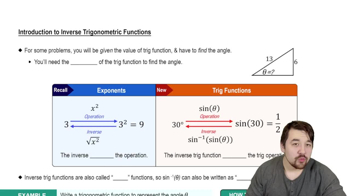
Inverse Trigonometric Functions

Inverse trigonometric functions, such as sin⁻¹ and tan⁻¹, return the angle whose trigonometric value is given. For example, sin⁻¹(1/2) gives the angle whose sine is 1/2. Understanding their ranges and outputs is essential for evaluating expressions involving these functions.
Video consigliato:
Percorso guidato
4:28
Introduction to Inverse Trig Functions

Trigonometric Addition Formulas

The sine addition formula states that sin(A + B) = sin A cos B + cos A sin B. This formula allows the evaluation of the sine of a sum of two angles, which is necessary when simplifying expressions like sin(sin⁻¹ x + tan⁻¹ y).
Video consigliato:
Percorso guidato
6:36
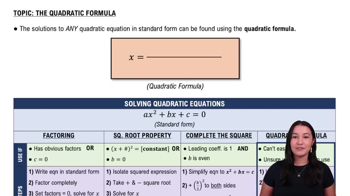
Quadratic Formula

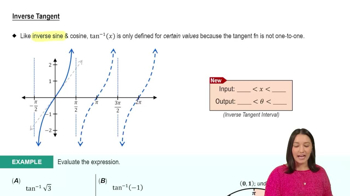
Right Triangle Interpretation of Inverse Tangent

The inverse tangent function tan⁻¹(y) can be interpreted as an angle in a right triangle where the opposite side is y and the adjacent side is 1. This helps find sin and cos of tan⁻¹(y) by using the Pythagorean theorem, facilitating the evaluation of composite trigonometric expressions.
Video consigliato:
Percorso guidato
3:17
Inverse Tangent