Ch. 6 - Inverse Circular Functions and Trigonometric Equations
Lial - Trigonometry 12th Edition
Lial12th EditionTrigonometryISBN: 9780136552161, 9780135440780, 9780136881117, 9780135440827, 9780135924891Non è quello che usi tu?Cambia libro di testo
Capitolo 7, Problema 41

Find the degree measure of θ if it exists. Do not use a calculator.
θ = arccos (-1/2)

Guida verificata passo dopo passo
1
Recall that the function \( \arccos(x) \) gives the angle \( \theta \) in the range \( 0^\circ \leq \theta \leq 180^\circ \) whose cosine is \( x \).
Identify the value given inside the arccos function: \( \cos \theta = -\frac{1}{2} \).
Think about the unit circle and the cosine values of common angles. Cosine corresponds to the x-coordinate on the unit circle.
Recall that \( \cos 60^\circ = \frac{1}{2} \), so \( \cos \theta = -\frac{1}{2} \) means \( \theta \) is an angle where the cosine is the negative of \( \frac{1}{2} \).
Since cosine is negative in the second quadrant (between \( 90^\circ \) and \( 180^\circ \)), find the angle in that range whose cosine is \( -\frac{1}{2} \). This angle is \( 180^\circ - 60^\circ \).

Risposta video verificata per un problema simile:

Questa soluzione video è stata consigliata dai nostri tutor come utile per risolvere questo problema.

Concetti chiave

Ecco i concetti essenziali che devi comprendere per rispondere correttamente alla domanda.

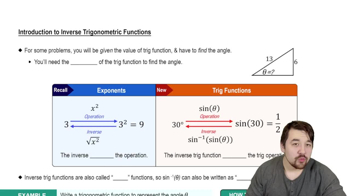
Inverse Trigonometric Functions

Inverse trigonometric functions, like arccos, return the angle whose trigonometric ratio equals a given value. For arccos(x), it gives the angle θ in the range 0° to 180° such that cos(θ) = x. Understanding this helps find the angle from a cosine value without a calculator.
Video consigliato:
Percorso guidato
4:28
Introduction to Inverse Trig Functions

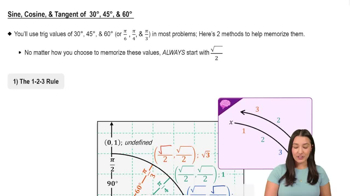
Cosine Values of Special Angles

Certain angles have well-known cosine values, such as 60° where cos(60°) = 1/2. Recognizing these special angles and their cosine values allows you to identify θ when given cos(θ) = -1/2, by considering the unit circle and symmetry.
Video consigliato:
Percorso guidato
5:08
Sine, Cosine, & Tangent of 30°, 45°, & 60°

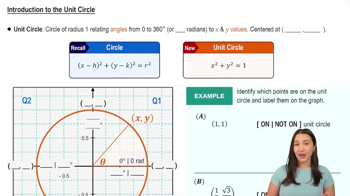
Unit Circle and Angle Quadrants

The unit circle helps determine the angle corresponding to a cosine value, considering the sign and quadrant. Since cosine is negative in the second and third quadrants, and arccos returns angles in the first and second quadrants, this guides selecting the correct angle measure for θ.
Video consigliato:
Percorso guidato
06:11
Introduction to the Unit Circle