Ch. 6 - Inverse Circular Functions and Trigonometric Equations
Lial - Trigonometry 12th Edition
Lial12th EditionTrigonometryISBN: 9780136552161, 9780135440780, 9780136881117, 9780135440827, 9780135924891Non è quello che usi tu?Cambia libro di testo
Capitolo 7, Problema 19

Solve each equation for exact solutions over the interval [0, 2π).
tan² x + 3 = 0

Guida verificata passo dopo passo
1
Start with the given equation: \(\tan^{2} x + 3 = 0\).
Isolate the \(\tan^{2} x\) term by subtracting 3 from both sides: \(\tan^{2} x = -3\).
Recall that \(\tan^{2} x\) represents the square of the tangent function, which is always greater than or equal to zero for all real \(x\) because squaring any real number cannot produce a negative result.
Since \(\tan^{2} x = -3\) implies a negative value, recognize that there are no real values of \(x\) for which this equation holds true within the interval \([0, 2\pi)\).
Conclude that the equation has no exact solutions in the interval \([0, 2\pi)\) because the square of tangent cannot be negative.

Risposta video verificata per un problema simile:

Questa soluzione video è stata consigliata dai nostri tutor come utile per risolvere questo problema.

Concetti chiave

Ecco i concetti essenziali che devi comprendere per rispondere correttamente alla domanda.

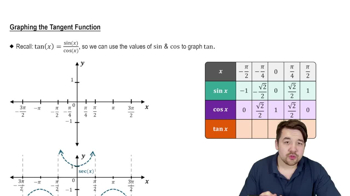
Properties of the Tangent Function

The tangent function, tan(x), is defined as sin(x)/cos(x) and has a period of π. It is undefined where cos(x) = 0, and its values can be positive or negative. Understanding its behavior and domain is essential when solving equations involving tan²(x).
Video consigliato:
Percorso guidato
5:43
Introduction to Tangent Graph

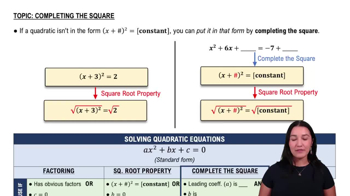
Solving Quadratic Equations in Trigonometric Functions

Equations like tan²(x) + 3 = 0 can be treated as quadratic in terms of tan(x). Solving involves isolating tan²(x) and checking for real solutions, considering that squares of real numbers are non-negative, which affects the existence of solutions.
Video consigliato:
Percorso guidato
6:24
Solving Quadratic Equations by Completing the Square

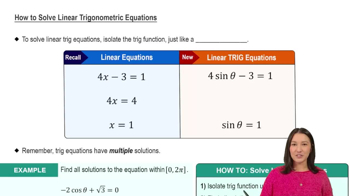
Interval and Exact Solutions in Trigonometry

Finding exact solutions over [0, 2π) requires identifying all angles within one full rotation that satisfy the equation. Solutions must be expressed in exact form (like π/4), and understanding the periodicity and symmetry of trig functions helps determine all valid solutions.
Video consigliato:
Percorso guidato
4:34
How to Solve Linear Trigonometric Equations