
Ch. 6 - Inverse Circular Functions and Trigonometric Equations
Lial - Trigonometry 12th Edition
Lial12th EditionTrigonometryISBN: 9780136552161, 9780135440780, 9780136881117, 9780135440827, 9780135924891Non è quello che usi tu?Cambia libro di testo
Capitolo 7, Problema 6.2.57

Solve each equation (x in radians and θ in degrees) for all exact solutions where appropriate. Round approximate answers in radians to four decimal places and approximate answers in degrees to the nearest tenth. Write answers using the least possible nonnegative angle measures.
sin x (3 sin x - 1) = 1

Guida verificata passo dopo passo
1
Start by rewriting the given equation: \(\sin x (3 \sin x - 1) = 1\).
Expand the left side to get a quadratic form in terms of \(\sin x\): \(3 \sin^2 x - \sin x = 1\).
Rearrange the equation to standard quadratic form: \(3 \sin^2 x - \sin x - 1 = 0\).
Use the quadratic formula to solve for \(\sin x\), where \(a = 3\), \(b = -1\), and \(c = -1\). The formula is \(\sin x = \frac{-b \pm \sqrt{b^2 - 4ac}}{2a}\).
Find all values of \(x\) (in radians and degrees) that satisfy the solutions for \(\sin x\), considering the domain of the sine function and using the least possible nonnegative angle measures. Round approximate answers as instructed.

Risposta video verificata per un problema simile:

Questa soluzione video è stata consigliata dai nostri tutor come utile per risolvere questo problema.

Concetti chiave

Ecco i concetti essenziali che devi comprendere per rispondere correttamente alla domanda.

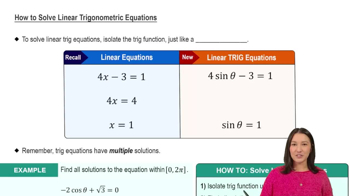
Solving Trigonometric Equations

Solving trigonometric equations involves finding all angle values that satisfy the given equation. This often requires algebraic manipulation, factoring, and using inverse trigonometric functions. Solutions must consider the periodic nature of trig functions, leading to multiple valid answers within specified intervals.
Video consigliato:
Percorso guidato
4:34
How to Solve Linear Trigonometric Equations

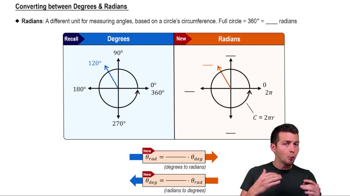
Radians and Degrees Conversion

Radians and degrees are two units for measuring angles. Understanding how to convert between them (1 radian = 180/π degrees) is essential for interpreting and expressing solutions correctly. Problems may require answers in both units, rounded appropriately as specified.
Video consigliato:
Percorso guidato
5:04
Converting between Degrees & Radians

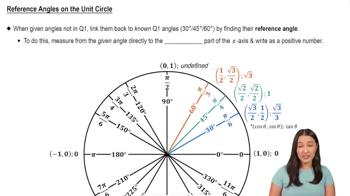
Using the Unit Circle and Reference Angles

The unit circle helps identify exact values of sine, cosine, and tangent for common angles. Reference angles allow finding all solutions within a cycle by relating angles to their acute counterparts. This is crucial for expressing solutions as least nonnegative angles and for determining all possible solutions.
Video consigliato:
Percorso guidato
5:31
Reference Angles on the Unit Circle