Ch. 7 - Applications of Trigonometry and Vectors
Lial - Trigonometry 12th Edition
Lial12th EditionTrigonometryISBN: 9780136552161, 9780135440780, 9780136881117, 9780135440827, 9780135924891Non è quello che usi tu?Cambia libro di testo
Capitolo 8, Problema 22

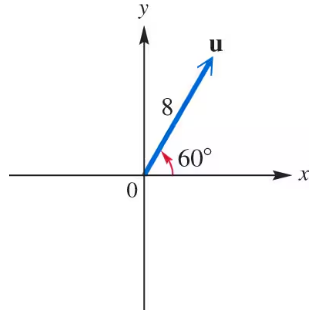
Write each vector in the form 〈a, b〉. Write answers using exact values or to four decimal places, as appropriate.


Vector u with magnitude 8 at a 60-degree angle from the positive x-axis on an xy-coordinate plane.

Guida verificata passo dopo passo
1
Identify the given vectors from the image and note their magnitudes and directions (angles) if provided.
Recall that a vector in the form \( \langle a, b \rangle \) can be expressed using its magnitude \( r \) and angle \( \theta \) as \( \langle r \cos(\theta), r \sin(\theta) \rangle \).
For each vector, use the formula \( a = r \cos(\theta) \) to find the x-component and \( b = r \sin(\theta) \) to find the y-component.
Calculate the cosine and sine values of the given angles, using exact values for special angles (like 30°, 45°, 60°) or a calculator for other angles, rounding to four decimal places if necessary.
Write each vector in the form \( \langle a, b \rangle \) using the values found for \( a \) and \( b \), ensuring to keep exact values or round appropriately.

Risposta video verificata per un problema simile:

Questa soluzione video è stata consigliata dai nostri tutor come utile per risolvere questo problema.

Concetti chiave

Ecco i concetti essenziali che devi comprendere per rispondere correttamente alla domanda.

Vector Representation in Component Form

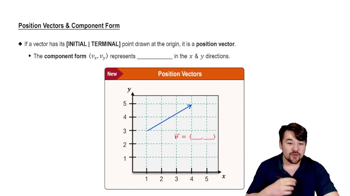
Vectors in the plane can be expressed as ordered pairs 〈a, b〉, where 'a' and 'b' represent the horizontal (x) and vertical (y) components, respectively. This form allows for easy addition, subtraction, and scalar multiplication of vectors.
Video consigliato:
Percorso guidato
03:55
Position Vectors & Component Form

Trigonometric Functions for Component Calculation

To find the components of a vector given its magnitude and direction, use sine and cosine functions: the x-component is magnitude × cos(θ), and the y-component is magnitude × sin(θ), where θ is the angle the vector makes with the positive x-axis.
Video consigliato:
Percorso guidato
03:55
Position Vectors & Component Form

Exact Values and Decimal Approximations

When calculating vector components, use exact trigonometric values (like √2/2) when possible for precision. Otherwise, round decimal results to four decimal places as specified, ensuring clarity and consistency in answers.
Video consigliato: