Ch. 7 - Applications of Trigonometry and Vectors
Lial - Trigonometry 12th Edition
Lial12th EditionTrigonometryISBN: 9780136552161, 9780135440780, 9780136881117, 9780135440827, 9780135924891Non è quello che usi tu?Cambia libro di testo
Capitolo 8, Problema 21

For each pair of vectors u and v with angle θ between them, sketch the resultant.


|u| = 20, |v| = 30, θ = 30°

Guida verificata passo dopo passo
1
Identify the given information: the magnitudes of vectors \( \mathbf{u} \) and \( \mathbf{v} \) are \( |\mathbf{u}| = 20 \) and \( |\mathbf{v}| = 30 \), and the angle between them is \( \theta = 30^\circ \).
Recall that the resultant vector \( \mathbf{r} = \mathbf{u} + \mathbf{v} \) can be found using the law of cosines for vectors, where the magnitude of \( \mathbf{r} \) is given by: \[ \\|\mathbf{r}\\\| = \sqrt{ |\mathbf{u}|^2 + |\mathbf{v}|^2 + 2 |\mathbf{u}| |\mathbf{v}| \cos(\theta) } \]
To sketch the resultant, start by drawing vector \( \mathbf{u} \) as an arrow of length 20 units in any direction.
Next, from the tip of \( \mathbf{u} \), draw vector \( \mathbf{v} \) at an angle of \( 30^\circ \) relative to \( \mathbf{u} \), with length 30 units.
The resultant vector \( \mathbf{r} \) is represented by the arrow drawn from the tail of \( \mathbf{u} \) to the tip of \( \mathbf{v} \). This completes the vector addition and visually shows the resultant.

Risposta video verificata per un problema simile:

Questa soluzione video è stata consigliata dai nostri tutor come utile per risolvere questo problema.

Concetti chiave

Ecco i concetti essenziali che devi comprendere per rispondere correttamente alla domanda.

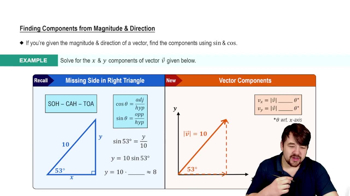
Vector Magnitude and Direction

A vector is defined by its magnitude (length) and direction. Understanding how to represent vectors graphically involves drawing arrows with lengths proportional to their magnitudes and angles corresponding to their directions. This is essential for accurately sketching vectors u and v with given magnitudes and the angle θ between them.
Video consigliato:
Percorso guidato
04:55
Finding Components from Direction and Magnitude

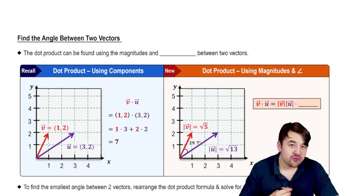
Angle Between Vectors

The angle θ between two vectors is the measure of the smallest rotation from one vector to the other. It determines how the vectors are oriented relative to each other and affects the resultant vector's magnitude and direction when the vectors are added.
Video consigliato:
Percorso guidato
04:33
Find the Angle Between Vectors

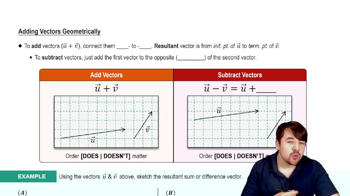
Vector Addition and Resultant Vector

The resultant vector is found by adding two vectors head-to-tail, combining their magnitudes and directions. Using the law of cosines or parallelogram method, the magnitude and direction of the resultant can be determined, which is crucial for sketching the resultant vector from u and v with a known angle θ.
Video consigliato:
Percorso guidato
05:29
Adding Vectors Geometrically