Ch. 7 - Applications of Trigonometry and Vectors
Lial - Trigonometry 12th Edition
Lial12th EditionTrigonometryISBN: 9780136552161, 9780135440780, 9780136881117, 9780135440827, 9780135924891Non è quello che usi tu?Cambia libro di testo
Capitolo 8, Problema 1

Fill in the blank(s) to correctly complete each sentence.


A triangle that is not a right triangle is a(n) _________ triangle.

Guida verificata passo dopo passo
1
Recall the classification of triangles based on their angles: a right triangle has one angle exactly equal to 90 degrees.
Understand that if a triangle does not have a right angle, it means none of its angles is 90 degrees.
Triangles without a right angle can be either acute (all angles less than 90 degrees) or obtuse (one angle greater than 90 degrees).
Therefore, a triangle that is not a right triangle is called an \(\textbf{oblique}\) triangle.
So, the blank should be filled with the word \(\textit{oblique}\) to correctly complete the sentence.

Risposta video verificata per un problema simile:

Questa soluzione video è stata consigliata dai nostri tutor come utile per risolvere questo problema.

Concetti chiave

Ecco i concetti essenziali che devi comprendere per rispondere correttamente alla domanda.

Types of Triangles Based on Angles

Triangles are classified by their angles into acute, right, and obtuse triangles. A right triangle has one 90-degree angle, while acute triangles have all angles less than 90 degrees, and obtuse triangles have one angle greater than 90 degrees.
Video consigliato:
Percorso guidato
5:35
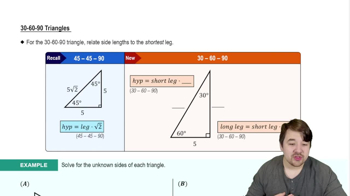
30-60-90 Triangles

Right Triangle Definition

A right triangle is defined as a triangle that contains exactly one right angle (90 degrees). This classification is fundamental in trigonometry because many formulas and theorems apply specifically to right triangles.
Video consigliato:
Percorso guidato
5:35
30-60-90 Triangles

Non-Right Triangles

Triangles that do not have a right angle are called non-right triangles, which include acute and obtuse triangles. Understanding this distinction helps in applying appropriate trigonometric methods, such as the Law of Sines or Law of Cosines.
Video consigliato:
Percorso guidato
5:35
30-60-90 Triangles