
Domanda del libro di testo
Fill in the blank(s) to correctly complete each sentence.
A triangle that is not a right triangle is a(n) _________ triangle.
785
views

 Guida verificata passo dopo passo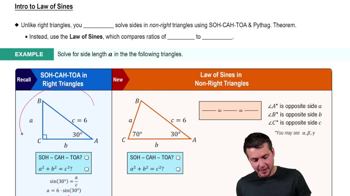
 4:27
4:27
 4:47
4:47 2:28
2:28Fill in the blank(s) to correctly complete each sentence.
A triangle that is not a right triangle is a(n) _________ triangle.
In each figure, a line segment of length L is to be drawn from the given point to the positive x-axis in order to form a triangle. For what value(s) of L can we draw the following?
c. no triangle
<IMAGE>
Use the law of sines to find the indicated part of each triangle ABC.
Find b if C = 74.2°, c = 96.3 m, B = 39.5
In each figure, a line segment of length L is to be drawn from the given point to the positive x-axis in order to form a triangle. For what value(s) of L can we draw the following?
a. two triangles
<IMAGE>
In each figure, a line segment of length L is to be drawn from the given point to the positive x-axis in order to form a triangle. For what value(s) of L can we draw the following?
b. exactly one triangle
<IMAGE>
CONCEPT PREVIEW Assume a triangle ABC has standard labeling.
a. Determine whether SAA, ASA, SSA, SAS, or SSS is given.
b. Determine whether the law of sines or the law of cosines should be used to begin solving the triangle.
a, b, and C