Ch. 7 - Applications of Trigonometry and Vectors
Lial - Trigonometry 12th Edition
Lial12th EditionTrigonometryISBN: 9780136552161, 9780135440780, 9780136881117, 9780135440827, 9780135924891Non è quello che usi tu?Cambia libro di testo
Capitolo 8, Problema 11

Find the magnitude and direction angle for each vector. Round angle measures to the nearest tenth, as necessary.
〈15, -8〉

Guida verificata passo dopo passo
1
Identify the components of the vector. Here, the vector is given as \( \langle 15, -8 \rangle \), where 15 is the x-component and -8 is the y-component.
Calculate the magnitude of the vector using the formula for the length of a vector: \( \text{magnitude} = \sqrt{x^2 + y^2} \). Substitute the values: \( \sqrt{15^2 + (-8)^2} \).
Find the direction angle \( \theta \) of the vector relative to the positive x-axis using the inverse tangent function: \( \theta = \tan^{-1} \left( \frac{y}{x} \right) \). Substitute the values: \( \tan^{-1} \left( \frac{-8}{15} \right) \).
Determine the correct quadrant for the angle. Since the x-component is positive and the y-component is negative, the vector lies in the fourth quadrant. Adjust the angle accordingly if necessary to express it as a positive angle measured counterclockwise from the positive x-axis.
Round the direction angle to the nearest tenth of a degree as required.

Risposta video verificata per un problema simile:

Questa soluzione video è stata consigliata dai nostri tutor come utile per risolvere questo problema.

Concetti chiave

Ecco i concetti essenziali che devi comprendere per rispondere correttamente alla domanda.

Vector Magnitude

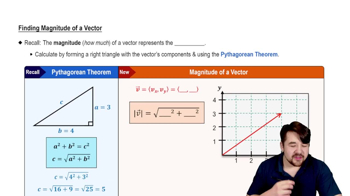
The magnitude of a vector represents its length and is calculated using the Pythagorean theorem. For a vector with components (x, y), the magnitude is √(x² + y²). This gives a non-negative scalar value indicating the vector's size.
Video consigliato:
Percorso guidato
04:44
Finding Magnitude of a Vector

Direction Angle of a Vector

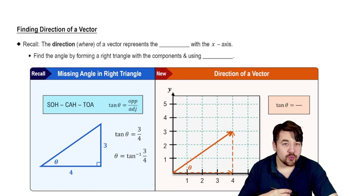
The direction angle of a vector is the angle it makes with the positive x-axis, measured counterclockwise. It can be found using the inverse tangent function: θ = arctan(y/x). Adjustments may be needed based on the vector's quadrant to get the correct angle.
Video consigliato:
Percorso guidato
05:13
Finding Direction of a Vector

Quadrant Considerations in Angle Calculation

Since arctan(y/x) only returns values between -90° and 90°, the vector's quadrant must be considered to determine the correct direction angle. For vectors in quadrants II and III, add 180°; for quadrant IV, add 360° if needed to express the angle between 0° and 360°.
Video consigliato:
Percorso guidato
6:36
Quadratic Formula