Ch. 7 - Applications of Trigonometry and Vectors
Lial - Trigonometry 12th Edition
Lial12th EditionTrigonometryISBN: 9780136552161, 9780135440780, 9780136881117, 9780135440827, 9780135924891Non è quello che usi tu?Cambia libro di testo
Capitolo 8, Problema 11

Find each angle B. Do not use a calculator.


<IMAGE>

Guida verificata passo dopo passo
1
Identify the given information from the problem, such as the sides or angles related to angle B. Since the image is not provided, assume you have either side lengths or trigonometric ratios involving angle B.
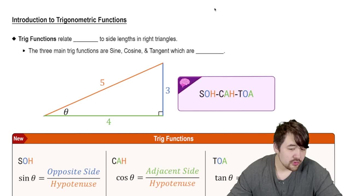
Recall the primary trigonometric ratios: sine, cosine, and tangent, which relate the angles of a right triangle to the ratios of its sides. For example, \( \sin B = \frac{\text{opposite}}{\text{hypotenuse}} \), \( \cos B = \frac{\text{adjacent}}{\text{hypotenuse}} \), and \( \tan B = \frac{\text{opposite}}{\text{adjacent}} \).
Choose the appropriate trigonometric ratio based on the sides or values given in the problem that involve angle B. Write the equation for that ratio using the known values.
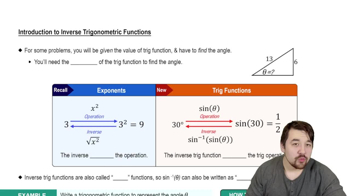
To find angle B, use the inverse trigonometric function corresponding to the ratio you set up. For example, if you used sine, then \( B = \sin^{-1}(\text{value}) \); if cosine, then \( B = \cos^{-1}(\text{value}) \); if tangent, then \( B = \tan^{-1}(\text{value}) \).
Since the problem states not to use a calculator, use known special angle values or trigonometric identities to determine angle B from the ratio. For example, recognize common ratios like \( \frac{1}{2} \), \( \frac{\sqrt{3}}{2} \), or 1, which correspond to angles like 30°, 45°, or 60°.

Risposta video verificata per un problema simile:

Questa soluzione video è stata consigliata dai nostri tutor come utile per risolvere questo problema.

Concetti chiave

Ecco i concetti essenziali che devi comprendere per rispondere correttamente alla domanda.

Basic Trigonometric Ratios

Understanding sine, cosine, and tangent ratios is essential for finding unknown angles in right triangles. These ratios relate the angles to the lengths of the sides, allowing calculation of angles when side lengths are known.
Video consigliato:
Percorso guidato
6:04
Introduction to Trigonometric Functions

Inverse Trigonometric Functions

Inverse trig functions (sin⁻¹, cos⁻¹, tan⁻¹) are used to find angles from given ratio values. Since the question prohibits calculators, recognizing common angle values and their ratios is important.
Video consigliato:
Percorso guidato
4:28
Introduction to Inverse Trig Functions

Special Right Triangles

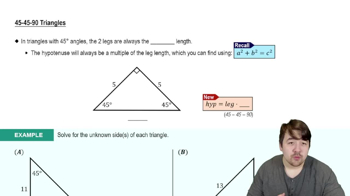
Knowledge of special right triangles (30°-60°-90° and 45°-45°-90°) helps identify angles without a calculator by recalling their side ratios. This aids in quickly determining angle B when side lengths match these patterns.
Video consigliato:
Percorso guidato
04:39
45-45-90 Triangles