Ch. 7 - Applications of Trigonometry and Vectors
Lial - Trigonometry 12th Edition
Lial12th EditionTrigonometryISBN: 9780136552161, 9780135440780, 9780136881117, 9780135440827, 9780135924891Non è quello che usi tu?Cambia libro di testo
Capitolo 8, Problema 13

Solve each triangle. Approximate values to the nearest tenth.


<IMAGE>

Guida verificata passo dopo passo
1
Identify the given elements in the triangle: note which sides and angles are provided. Typically, you will have either two sides and an included angle (SAS), two angles and a side (ASA or AAS), or all three sides (SSS).
Use the Law of Sines or Law of Cosines depending on the given information. For example, if you have two sides and an included angle (SAS), use the Law of Cosines: \[\text{c}^2 = \text{a}^2 + \text{b}^2 - 2 \cdot \text{a} \cdot \text{b} \cdot \cos(\gamma)\] where \(\gamma\) is the included angle opposite side \(c\).
If you have an angle and its opposite side and another angle or side, use the Law of Sines: \[\frac{\sin(\alpha)}{a} = \frac{\sin(\beta)}{b} = \frac{\sin(\gamma)}{c}\] to find the missing sides or angles.
After finding one missing angle using the Law of Sines or Cosines, use the fact that the sum of angles in a triangle is \(180^\circ\) to find the remaining angle: \[\alpha + \beta + \gamma = 180^\circ\].
Once all angles and sides are found, round the values to the nearest tenth as requested.

Risposta video verificata per un problema simile:

Questa soluzione video è stata consigliata dai nostri tutor come utile per risolvere questo problema.

Concetti chiave

Ecco i concetti essenziali che devi comprendere per rispondere correttamente alla domanda.

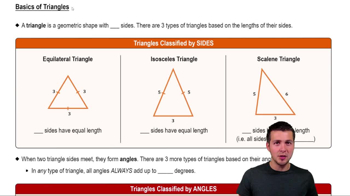
Triangle Classification and Properties

Understanding the types of triangles (right, acute, obtuse) and their properties is essential. This helps determine which trigonometric rules or formulas apply, such as the Pythagorean theorem for right triangles or the Law of Sines and Cosines for non-right triangles.
Video consigliato:
Percorso guidato
4:42
Review of Triangles

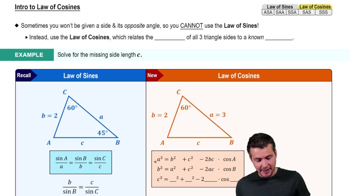
Law of Sines and Law of Cosines

These laws relate the sides and angles of any triangle, enabling the solution of unknown parts. The Law of Sines is useful when given two angles and one side or two sides and a non-included angle, while the Law of Cosines applies when two sides and the included angle or all three sides are known.
Video consigliato:
Percorso guidato
4:35
Intro to Law of Cosines

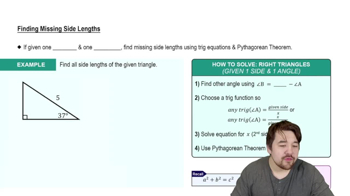
Angle and Side Approximation

After calculating angles or sides using trigonometric formulas, rounding to the nearest tenth is often required. This involves understanding significant figures and approximation techniques to present answers clearly and accurately.
Video consigliato:
Percorso guidato
4:18
Finding Missing Side Lengths