Ch. 7 - Applications of Trigonometry and Vectors
Lial - Trigonometry 12th Edition
Lial12th EditionTrigonometryISBN: 9780136552161, 9780135440780, 9780136881117, 9780135440827, 9780135924891Non è quello che usi tu?Cambia libro di testo
Capitolo 8, Problema 48

Starting at point X, a ship sails 15.5 km on a bearing of 200°, then turns and sails 2.4 km on a bearing of 320°. Find the distance of the ship from point X.

Guida verificata passo dopo passo
1
Understand the problem: The ship starts at point X, sails 15.5 km on a bearing of 200°, then sails 2.4 km on a bearing of 320°. We need to find the straight-line distance from the final position back to point X.
Convert the bearings into standard angles relative to the positive x-axis (East). Bearings are measured clockwise from North (0°). So, for a bearing \( \theta_b \), the angle from the positive x-axis is \( \theta = 90° - \theta_b \). Calculate the angles for both legs:
First leg angle: \( \theta_1 = 90° - 200° = -110° \) (which can be interpreted as 250° in standard position).
Second leg angle: \( \theta_2 = 90° - 320° = -230° \) (which can be interpreted as 130° in standard position).
Find the coordinates of the ship after each leg by converting polar coordinates to Cartesian coordinates using \( x = r \cos(\theta) \) and \( y = r \sin(\theta) \). Then, sum the vectors to find the final position relative to point X. Finally, use the distance formula \( d = \sqrt{(x_{final})^2 + (y_{final})^2} \) to find the distance from point X.

Risposta video verificata per un problema simile:

Questa soluzione video è stata consigliata dai nostri tutor come utile per risolvere questo problema.

Concetti chiave

Ecco i concetti essenziali che devi comprendere per rispondere correttamente alla domanda.

Bearings and Direction

Bearings are angles measured clockwise from the north direction to indicate direction. A bearing of 200° means the ship is sailing 20° west of due south, while 320° means 40° west of due north. Understanding bearings helps translate directional information into angles for calculations.
Video consigliato:
Percorso guidato
05:13
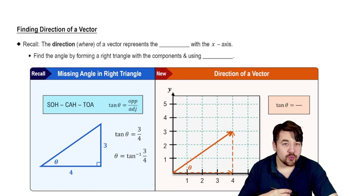
Finding Direction of a Vector

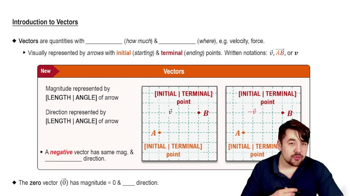
Vector Representation of Displacement

Each leg of the ship's journey can be represented as a vector with magnitude (distance sailed) and direction (bearing). Converting these vectors into components along the north-south and east-west axes allows for the calculation of the resultant displacement from the starting point.
Video consigliato:
Percorso guidato
03:48
Introduction to Vectors

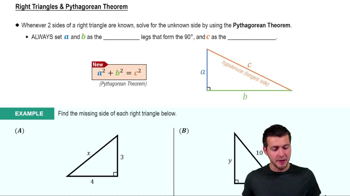
Distance Calculation Using the Pythagorean Theorem

After finding the resultant vector components, the distance from the starting point is the magnitude of this vector. The Pythagorean theorem is used to calculate this distance by taking the square root of the sum of the squares of the north-south and east-west components.
Video consigliato:
Percorso guidato
5:19
Solving Right Triangles with the Pythagorean Theorem