Ch. 7 - Applications of Trigonometry and Vectors
Lial - Trigonometry 12th Edition
Lial12th EditionTrigonometryISBN: 9780136552161, 9780135440780, 9780136881117, 9780135440827, 9780135924891Non è quello che usi tu?Cambia libro di testo
Capitolo 8, Problema 32

Two rescue vessels are pulling a broken-down motorboat toward a boathouse with forces of 840 lb and 960 lb. The angle between these forces is 24.5°. Find the direction and magnitude of the equilibrant.

Guida verificata passo dopo passo
1
Identify the two forces acting on the motorboat: \(F_1 = 840\) lb and \(F_2 = 960\) lb, with an angle \(\theta = 24.5^\circ\) between them.
Calculate the resultant force \(\vec{R}\) by using the Law of Cosines to find its magnitude: \(R = \sqrt{F_1^2 + F_2^2 + 2 F_1 F_2 \cos(\theta)}\).
Find the direction of the resultant force relative to the first force \(F_1\) using the Law of Sines or the formula: \(\alpha = \arctan\left(\frac{F_2 \sin(\theta)}{F_1 + F_2 \cos(\theta)}\right)\), where \(\alpha\) is the angle between \(F_1\) and \(\vec{R}\).
Understand that the equilibrant force \(\vec{E}\) is equal in magnitude but opposite in direction to the resultant force \(\vec{R}\), so its magnitude is the same as \(R\) and its direction is \(\alpha + 180^\circ\) (or directly opposite to \(\vec{R}\)).
Summarize the final answers: the magnitude of the equilibrant is \(R\), and its direction is \(\alpha + 180^\circ\) relative to the direction of \(F_1\).

Risposta video verificata per un problema simile:

Questa soluzione video è stata consigliata dai nostri tutor come utile per risolvere questo problema.

Concetti chiave

Ecco i concetti essenziali che devi comprendere per rispondere correttamente alla domanda.

Vector Addition of Forces

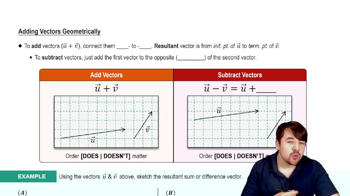
When two forces act at an angle, their combined effect is found by vector addition. This involves calculating the resultant force's magnitude and direction using the magnitudes of the individual forces and the angle between them.
Video consigliato:
Percorso guidato
05:29
Adding Vectors Geometrically

Law of Cosines

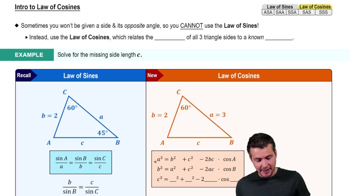
The Law of Cosines relates the lengths of sides in a triangle to the cosine of one angle. It is used here to find the magnitude of the resultant force when two forces form a known angle, by treating the forces as sides of a triangle.
Video consigliato:
Percorso guidato
4:35
Intro to Law of Cosines

Equilibrant Force

The equilibrant force is the force that balances the resultant force, having the same magnitude but opposite direction. It ensures the system is in equilibrium, meaning no net force acts on the object.
Video consigliato:
Percorso guidato
04:39
45-45-90 Triangles