Ch. 7 - Applications of Trigonometry and Vectors
Lial - Trigonometry 12th Edition
Lial12th EditionTrigonometryISBN: 9780136552161, 9780135440780, 9780136881117, 9780135440827, 9780135924891Non è quello che usi tu?Cambia libro di testo
Capitolo 8, Problema 18

Vector v has the given direction angle and magnitude. Find the horizontal and vertical components.
θ = 27° 30' |v| = 15.4

Guida verificata passo dopo passo
1
Convert the direction angle from degrees and minutes to decimal degrees. Since 1 minute is \( \frac{1}{60} \) of a degree, calculate \( 27^\circ 30' = 27 + \frac{30}{60} = 27.5^\circ \).
Recall that the horizontal component (\( v_x \)) of a vector is found by multiplying the magnitude by the cosine of the direction angle: \( v_x = |v| \cdot \cos(\theta) \).
Similarly, the vertical component (\( v_y \)) is found by multiplying the magnitude by the sine of the direction angle: \( v_y = |v| \cdot \sin(\theta) \).
Substitute the given magnitude \( |v| = 15.4 \) and the converted angle \( \theta = 27.5^\circ \) into the formulas: \( v_x = 15.4 \cdot \cos(27.5^\circ) \) and \( v_y = 15.4 \cdot \sin(27.5^\circ) \).
Use a calculator set to degree mode to evaluate the cosine and sine values, then multiply to find the horizontal and vertical components of the vector.

Risposta video verificata per un problema simile:

Questa soluzione video è stata consigliata dai nostri tutor come utile per risolvere questo problema.

Concetti chiave

Ecco i concetti essenziali che devi comprendere per rispondere correttamente alla domanda.

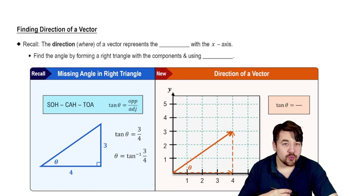
Direction Angle in Vectors

The direction angle of a vector is the angle it makes with the positive x-axis, measured counterclockwise. It determines the vector's orientation in the plane and is essential for decomposing the vector into components along the horizontal and vertical axes.
Video consigliato:
Percorso guidato
05:13
Finding Direction of a Vector

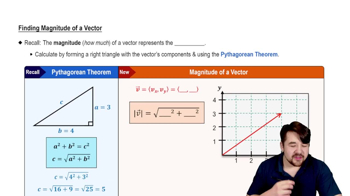
Vector Magnitude

The magnitude of a vector represents its length or size. It is a scalar quantity that, combined with the direction angle, fully describes the vector. Knowing the magnitude allows calculation of the vector's components using trigonometric functions.
Video consigliato:
Percorso guidato
04:44
Finding Magnitude of a Vector

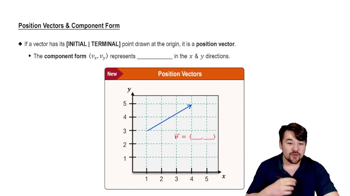
Resolving Vectors into Components

A vector can be broken down into horizontal (x) and vertical (y) components using trigonometry. The horizontal component is found by multiplying the magnitude by the cosine of the direction angle, and the vertical component by the sine of the angle, enabling easier analysis and computation.
Video consigliato:
Percorso guidato
03:55
Position Vectors & Component Form