Ch. 7 - Applications of Trigonometry and Vectors
Lial - Trigonometry 12th Edition
Lial12th EditionTrigonometryISBN: 9780136552161, 9780135440780, 9780136881117, 9780135440827, 9780135924891Non è quello che usi tu?Cambia libro di testo
Capitolo 8, Problema 19

For each pair of vectors u and v with angle θ between them, sketch the resultant.


|u| = 12, |v| = 20, θ = 27°

Guida verificata passo dopo passo
1
Identify the given information: the magnitudes of vectors \( \mathbf{u} \) and \( \mathbf{v} \) are \( |\mathbf{u}| = 12 \) and \( |\mathbf{v}| = 20 \), and the angle between them is \( \theta = 27^\circ \).
Recall that the resultant vector \( \mathbf{R} = \mathbf{u} + \mathbf{v} \) can be found using the Law of Cosines for vectors, where the magnitude of \( \mathbf{R} \) is given by: \[ |\mathbf{R}| = \sqrt{|\mathbf{u}|^2 + |\mathbf{v}|^2 + 2 |\mathbf{u}| |\mathbf{v}| \cos(\theta)} \]
To sketch the resultant, start by drawing vector \( \mathbf{u} \) with length proportional to 12 units in any direction you choose.
Next, from the tip of \( \mathbf{u} \), draw vector \( \mathbf{v} \) at an angle of \( 27^\circ \) relative to \( \mathbf{u} \), with length proportional to 20 units.
The resultant vector \( \mathbf{R} \) is then drawn from the tail of \( \mathbf{u} \) (the starting point) to the tip of \( \mathbf{v} \) (the ending point). This vector represents the sum \( \mathbf{u} + \mathbf{v} \).

Risposta video verificata per un problema simile:

Questa soluzione video è stata consigliata dai nostri tutor come utile per risolvere questo problema.

Concetti chiave

Ecco i concetti essenziali che devi comprendere per rispondere correttamente alla domanda.

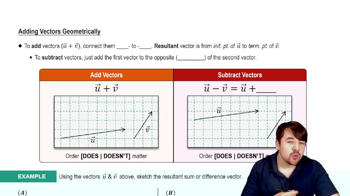
Vector Addition

Vector addition involves combining two vectors to find their resultant by placing them head-to-tail and drawing the vector from the start of the first to the end of the second. This graphical method helps visualize the resultant vector's magnitude and direction.
Video consigliato:
Percorso guidato
05:29
Adding Vectors Geometrically

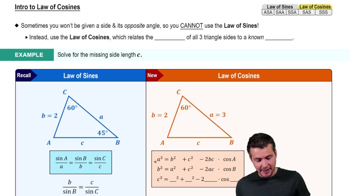
Law of Cosines for Vectors

The Law of Cosines relates the magnitudes of two vectors and the angle between them to find the magnitude of their resultant: |R| = √(|u|² + |v|² + 2|u||v|cosθ). This formula is essential for calculating the exact length of the resultant vector.
Video consigliato:
Percorso guidato
4:35
Intro to Law of Cosines

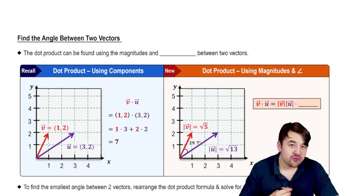
Angle Between Vectors

The angle θ between two vectors determines how they combine. It affects both the magnitude and direction of the resultant vector, influencing whether the vectors reinforce or partially cancel each other.
Video consigliato:
Percorso guidato
04:33
Find the Angle Between Vectors