Ch. 8 - Complex Numbers, Polar Equations, and Parametric Equations
Lial - Trigonometry 12th Edition
Lial12th EditionTrigonometryISBN: 9780136552161, 9780135440780, 9780136881117, 9780135440827, 9780135924891Non è quello che usi tu?Cambia libro di testo
Capitolo 9, Problema 14c

For each pair of polar coordinates, (c) give the rectangular coordinates for the point. See Examples 1 and 2(a).


(3 , 120°)

Guida verificata passo dopo passo
1
Recall the relationship between polar coordinates \((r, \theta)\) and rectangular coordinates \((x, y)\), where \(x = r \cos(\theta)\) and \(y = r \sin(\theta)\).
Identify the given polar coordinates: \(r = 3\) and \(\theta = 120^\circ\).
Convert the angle \(\theta\) from degrees to radians if necessary, or use the degree mode directly in trigonometric functions. Here, we can use \(120^\circ\) directly.
Calculate the \(x\)-coordinate using the formula \(x = 3 \times \cos(120^\circ)\).
Calculate the \(y\)-coordinate using the formula \(y = 3 \times \sin(120^\circ)\).

Risposta video verificata per un problema simile:

Questa soluzione video è stata consigliata dai nostri tutor come utile per risolvere questo problema.
Durata del video:
1m

Concetti chiave

Ecco i concetti essenziali che devi comprendere per rispondere correttamente alla domanda.

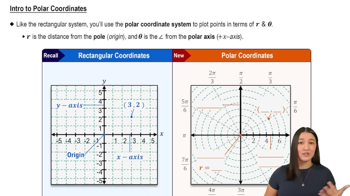
Polar Coordinates

Polar coordinates represent a point in the plane using a distance from the origin (radius r) and an angle θ measured from the positive x-axis. The pair (r, θ) specifies the location uniquely, where r ≥ 0 and θ is typically in degrees or radians.
Video consigliato:
Percorso guidato
05:32
Intro to Polar Coordinates

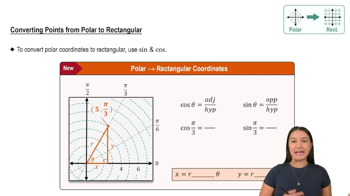
Conversion from Polar to Rectangular Coordinates

To convert polar coordinates (r, θ) to rectangular coordinates (x, y), use the formulas x = r cos θ and y = r sin θ. This transformation maps the point from a radial system to the Cartesian plane, facilitating easier computation and visualization.
Video consigliato:
Percorso guidato
06:17
Convert Points from Polar to Rectangular

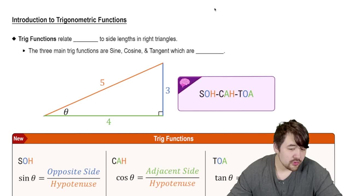
Trigonometric Functions and Angle Measurement

Understanding sine and cosine functions and how to evaluate them at specific angles (like 120°) is essential. Angles in degrees must be converted to radians if necessary, and knowledge of the unit circle helps determine the sign and value of these functions.
Video consigliato:
Percorso guidato
6:04
Introduction to Trigonometric Functions