Ch. 8 - Complex Numbers, Polar Equations, and Parametric Equations
Lial - Trigonometry 12th Edition
Lial12th EditionTrigonometryISBN: 9780136552161, 9780135440780, 9780136881117, 9780135440827, 9780135924891Non è quello che usi tu?Cambia libro di testo
Capitolo 9, Problema 8.34

Graph each plane curve defined by the parametric equations for t in [0, 2π] Then find a rectangular equation for the plane curve. See Example 3.


x = 1 + cos t , y = sin t ― 1

Guida verificata passo dopo passo
1
Step 1: Understand the parametric equations given: \(x = 1 + \cos t\) and \(y = \sin t - 1\). These equations describe a curve in the plane as the parameter \(t\) varies from 0 to \(2\pi\).
Step 2: To graph the curve, consider the range of \(t\) from 0 to \(2\pi\). For each value of \(t\), calculate the corresponding \(x\) and \(y\) values using the parametric equations, and plot these points on the Cartesian plane.
Step 3: To find a rectangular equation, eliminate the parameter \(t\). Start by expressing \(\cos t\) and \(\sin t\) in terms of \(x\) and \(y\). From \(x = 1 + \cos t\), we have \(\cos t = x - 1\). From \(y = \sin t - 1\), we have \(\sin t = y + 1\).
Step 4: Use the Pythagorean identity \(\cos^2 t + \sin^2 t = 1\) to combine these expressions: \((x - 1)^2 + (y + 1)^2 = 1\). This equation represents a circle centered at \((1, -1)\) with a radius of 1.
Step 5: Verify the rectangular equation by checking that it satisfies the original parametric equations for various values of \(t\) within the given range. This ensures that the transformation from parametric to rectangular form is correct.

Risposta video verificata per un problema simile:

Questa soluzione video è stata consigliata dai nostri tutor come utile per risolvere questo problema.
Durata del video:
5m

Concetti chiave

Ecco i concetti essenziali che devi comprendere per rispondere correttamente alla domanda.

Parametric Equations

Parametric equations express the coordinates of points on a curve as functions of a variable, typically denoted as 't'. In this case, x and y are defined in terms of the parameter t, which varies over a specified interval. Understanding how to interpret and manipulate these equations is crucial for graphing the curve and converting it to a rectangular form.
Video consigliato:
Percorso guidato
08:02
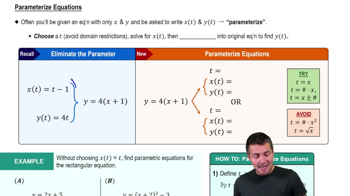
Parameterizing Equations

Graphing Parametric Curves

Graphing parametric curves involves plotting points defined by the parametric equations over the given interval for t. This requires evaluating the equations for various values of t, which helps visualize the shape of the curve. Familiarity with the coordinate system and how to represent the relationship between x and y is essential for accurate graphing.
Video consigliato:
Percorso guidato
04:47
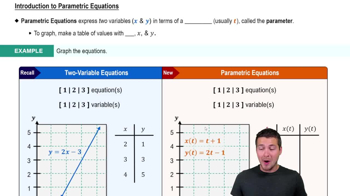
Introduction to Parametric Equations

Rectangular Equation

A rectangular equation eliminates the parameter t to express the relationship between x and y directly. This is often achieved by solving one of the parametric equations for t and substituting it into the other. Converting to a rectangular equation can simplify analysis and provide insights into the geometric properties of the curve.
Video consigliato:
Percorso guidato
3:37
Convert Equations from Rectangular to Polar