 뒤로
Anatomy & Physiology Study Guide: Blood Flow, Pressure, and Vascular Physiology
스터디 가이드 - 스마트 노트
 자료에 맞춘 맞춤형 노트, 핵심 정의, 예시, 맥락을 확장해 제공합니다.
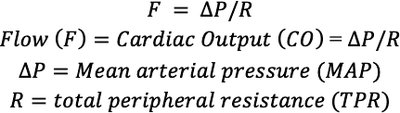
Q1. What is the equation for blood flow through vessels, and what do the terms ΔP and R represent?
Background
Topic: Cardiovascular Physiology – Blood Flow and Pressure
This question tests your understanding of the physical laws governing blood flow, specifically how pressure gradients and resistance affect flow in blood vessels.
Key Terms and Formulas:
Blood Flow (): The movement of blood through vessels.
Pressure Gradient (): The difference in pressure between two points in a vessel, driving blood flow.
Resistance (): The opposition to blood flow, determined by vessel diameter, length, and blood viscosity.
Key formula:
Step-by-Step Guidance
Identify the variables in the equation: (flow), (pressure gradient), and (resistance).
Understand that represents the driving force for blood flow, typically the difference between mean arterial pressure (MAP) and central venous pressure (CVP).
Recognize that is influenced by vessel diameter, length, and blood viscosity.
Note that flow is directly proportional to the pressure gradient and inversely proportional to resistance.
Set up the equation using the values for MAP, CVP, and TPR if provided.
Try solving on your own before revealing the answer!
Final Answer:
The equation for blood flow is , where is the pressure gradient (MAP - CVP) and is total peripheral resistance (TPR). This relationship shows that increasing the pressure gradient increases flow, while increasing resistance decreases flow.
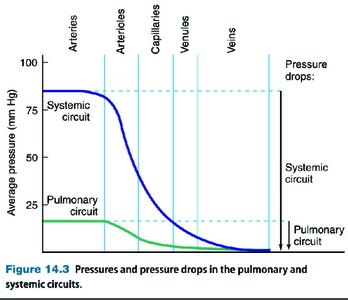
Q2. How is resistance through the pulmonary circuit different than resistance through the systemic circuit?
Background
Topic: Circulatory System – Pulmonary vs. Systemic Circuits
This question examines the differences in resistance between the two main circuits of the cardiovascular system.
Key Terms:
Pulmonary Circuit: The pathway of blood from the heart to the lungs and back.
Systemic Circuit: The pathway of blood from the heart to the rest of the body and back.
Resistance: The opposition to blood flow, mainly determined by vessel diameter and length.
Step-by-Step Guidance
Recall that both circuits receive the same volume of blood per minute (cardiac output).
Observe from the graph that the pressure in the systemic circuit is much higher than in the pulmonary circuit.
Understand that the lower pressure in the pulmonary circuit is due to lower resistance.
Consider the anatomical differences: pulmonary vessels are shorter and wider, contributing to lower resistance.
Try solving on your own before revealing the answer!
Final Answer:
Resistance in the pulmonary circuit is much lower than in the systemic circuit, which allows both circuits to have equal blood flow despite the lower pressure in the pulmonary circuit. This is due to the shorter and wider vessels in the lungs.
Q3. Distinguish between mean arterial pressure (MAP) and central venous pressure (CVP). Which one is larger?
Background
Topic: Blood Pressure – MAP vs. CVP
This question tests your understanding of the two main pressures in the systemic circuit and their roles in driving blood flow.
Key Terms:
Mean Arterial Pressure (MAP): The average pressure in the arteries during one cardiac cycle.
Central Venous Pressure (CVP): The pressure in the thoracic vena cava near the right atrium.
Step-by-Step Guidance
Recall that MAP is the driving force for blood flow through the systemic circuit.
CVP is the pressure at the end of the circuit, near the heart.
Compare the typical values: MAP is much higher than CVP.
Understand that the pressure gradient (MAP - CVP) drives blood flow.
Try solving on your own before revealing the answer!
Final Answer:
Mean arterial pressure (MAP) is much larger than central venous pressure (CVP). MAP is the main driving force for blood flow, while CVP is very low.
Q4. What is the relationship between cardiac output (CO), mean arterial pressure (MAP), and total peripheral resistance (TPR)? Express this relationship as an equation.
Background
Topic: Hemodynamics – Cardiac Output, Pressure, and Resistance
This question tests your ability to relate the main variables that determine blood flow and pressure in the systemic circuit.
Key Terms and Formulas:
Cardiac Output (CO): The volume of blood pumped by the heart per minute.
Mean Arterial Pressure (MAP): The average arterial pressure during a cardiac cycle.
Total Peripheral Resistance (TPR): The resistance to blood flow in the systemic circuit.
Key formula:
Or rearranged:
Step-by-Step Guidance
Start with the basic flow equation: .
Recognize that in the systemic circuit, flow () is equivalent to cardiac output (), is MAP, and is TPR.
Substitute these terms into the equation: .
Rearrange to show how MAP depends on CO and TPR: .
Think about how changes in CO or TPR affect MAP.
Try solving on your own before revealing the answer!
Final Answer:
The relationship is . This means that mean arterial pressure increases if either cardiac output or total peripheral resistance increases.
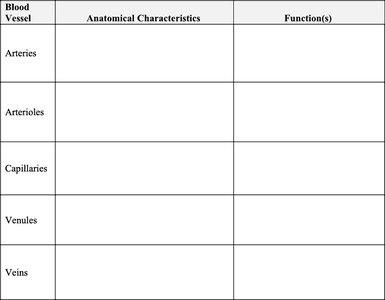
Q5. Compare and contrast the anatomical characteristics and functions of arteries, arterioles, capillaries, venules, and veins.
Background
Topic: Vascular Anatomy and Physiology
This question tests your knowledge of the structure and function of different types of blood vessels.
Key Terms:
Arteries: Thick-walled, high-pressure vessels.
Arterioles: Small arteries, major site of resistance regulation.
Capillaries: Thin-walled, site of exchange.
Venules: Small veins, collect blood from capillaries.
Veins: Thin-walled, low-pressure, high compliance.
Step-by-Step Guidance
Fill in the table for each vessel type: note wall thickness, tissue types, lumen diameter, and function.
Compare how these features affect pressure, blood volume, resistance, permeability, and compliance.
Think about which vessels are best for exchange, resistance regulation, and blood storage.
Use the table to organize your answers for each vessel.
Try solving on your own before revealing the answer!
Final Answer:
Arteries: Thick, elastic walls; high pressure; function as pressure reservoirs. Arterioles: Muscular walls; regulate resistance and blood flow. Capillaries: Thin, single-cell walls; site of exchange; highly permeable. Venules: Thin walls; collect blood from capillaries. Veins: Thin, compliant walls; low pressure; function as volume reservoirs.
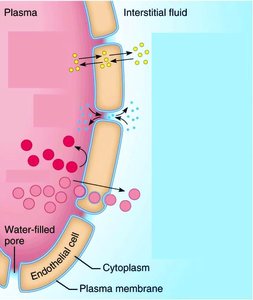
Q6. Describe the mechanisms of exchange across capillary walls and identify which materials use each mechanism.
Background
Topic: Capillary Exchange – Transport Mechanisms
This question tests your understanding of how substances move between blood and interstitial fluid.
Key Terms:
Diffusion: Movement of small molecules (e.g., gases, ions) down their concentration gradient.
Transcytosis: Transport of larger molecules (e.g., proteins) via vesicles.
Mediated Transport: Transport via carrier proteins.
Step-by-Step Guidance
Identify the main mechanisms: diffusion, transcytosis, and mediated transport.
Determine which materials use each mechanism (e.g., gases use diffusion, proteins use transcytosis).
Relate the structure of capillary walls to their permeability for each mechanism.
Label the diagram with the types of transport and materials involved.
Try solving on your own before revealing the answer!
Final Answer:
Small, water-soluble substances use diffusion; proteins use transcytosis; ions and glucose may use mediated transport. The diagram shows these mechanisms in action.
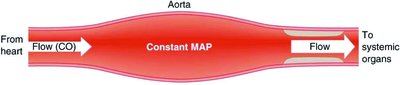
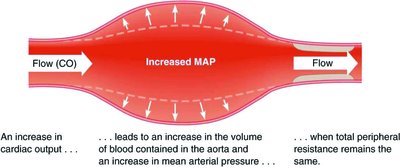
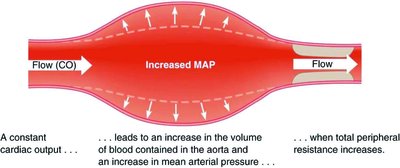
Q7. Explain how changes in cardiac output (CO) and total peripheral resistance (TPR) affect mean arterial pressure (MAP).
Background
Topic: Regulation of Blood Pressure
This question tests your understanding of how physiological changes impact blood pressure.
Key Terms and Formulas:
Cardiac Output (CO): Blood volume pumped per minute.
Total Peripheral Resistance (TPR): Resistance in systemic circulation.
Mean Arterial Pressure (MAP): Average arterial pressure.
Key formula:
Step-by-Step Guidance
Start with the equation .
Consider what happens if CO increases while TPR stays constant.
Consider what happens if TPR increases while CO stays constant.
Use the images to visualize how MAP changes in each scenario.
Think about the physiological consequences of these changes.
Try solving on your own before revealing the answer!
Final Answer:
Increasing CO or TPR increases MAP. If both stay constant, MAP stays the same. The images show how MAP responds to changes in CO and TPR.
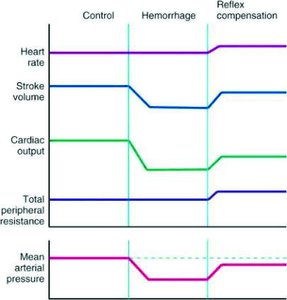
Q8. What happens to heart rate, stroke volume, cardiac output, total peripheral resistance, and mean arterial pressure during hemorrhage and reflex compensation?
Background
Topic: Cardiovascular Reflexes – Hemorrhage Response
This question tests your understanding of how the body compensates for blood loss.
Key Terms:
Hemorrhage: Loss of blood volume.
Reflex Compensation: Physiological adjustments to restore blood pressure.
Step-by-Step Guidance
Observe the changes in heart rate, stroke volume, cardiac output, TPR, and MAP during hemorrhage.
Note the initial drop in stroke volume and cardiac output.
See how reflex compensation increases heart rate and TPR to restore MAP.
Analyze the sequence of events and their effects on blood pressure.
Try solving on your own before revealing the answer!
Final Answer:
During hemorrhage, stroke volume and cardiac output decrease, MAP drops. Reflex compensation increases heart rate and TPR, helping to restore MAP.
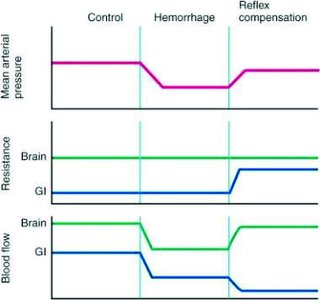
Q9. How does blood flow and resistance change in the brain and GI tract during hemorrhage and reflex compensation?
Background
Topic: Blood Flow Redistribution – Hemorrhage
This question tests your understanding of how the body prioritizes blood flow during emergencies.
Key Terms:
Resistance: Opposition to blood flow.
Blood Flow: Volume of blood delivered to tissues.
Step-by-Step Guidance
Observe the changes in resistance and blood flow in the brain and GI tract during hemorrhage.
Note that resistance in the GI tract increases, reducing blood flow.
Blood flow to the brain is maintained or increased.
Understand the physiological importance of prioritizing blood flow to vital organs.
Try solving on your own before revealing the answer!
Final Answer:
During hemorrhage, resistance in the GI tract increases and blood flow decreases, while blood flow to the brain is maintained or increased to prioritize vital organs.
Q10. What is the chemical equation for the conversion of carbon dioxide to bicarbonate, and what enzyme is required?
Background
Topic: Blood Chemistry – Carbon Dioxide Transport
This question tests your understanding of how CO2 is transported in the blood and the role of enzymes in this process.
Key Terms and Formulas:
Carbonic Anhydrase: Enzyme that catalyzes the conversion of CO2 and water to carbonic acid.
Bicarbonate: Major buffer in blood.

Key formula:
Step-by-Step Guidance
Write the chemical equation for CO2 conversion.
Identify the enzyme carbonic anhydrase as necessary for the reaction.
Recognize the products: carbonic acid, hydrogen ion, and bicarbonate.
Understand the physiological importance of this reaction in CO2 transport and pH regulation.
Try solving on your own before revealing the answer!
Final Answer:
The equation is . Carbonic anhydrase is required for this conversion.
Q11. What is special about the shape and properties of a red blood cell?
Background
Topic: Hematology – Red Blood Cell Structure
This question tests your understanding of the functional anatomy of erythrocytes.
Key Terms:
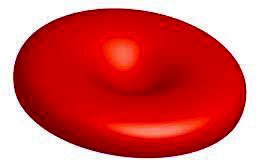
Biconcave Shape: Increases surface area for gas exchange.
Flexibility: Allows passage through capillaries.
Step-by-Step Guidance
Describe the biconcave shape and its advantages for gas exchange.
Explain how flexibility helps RBCs move through narrow capillaries.
Relate the lack of nucleus and organelles to increased space for hemoglobin.
Try solving on your own before revealing the answer!
Final Answer:
The red blood cell has a biconcave shape, which increases surface area for gas exchange and allows flexibility for passage through capillaries. This shape is essential for efficient oxygen transport.
