 뒤로
Anatomy & Physiology Syllabus and Course Policies (2026-2027)
스터디 가이드 - 스마트 노트
 자료에 맞춘 맞춤형 노트, 핵심 정의, 예시, 맥락을 확장해 제공합니다.
Anatomy & Physiology Syllabus Overview
This syllabus outlines the structure, expectations, and academic policies for the Anatomy & Physiology course at South Kent School for the 2026-2027 academic year. The course is designed to provide a comprehensive foundation in human anatomy and physiology, preparing students for advanced studies in health and science fields.
Course Description
Focus: In-depth study of the human body, including cellular biology, organ systems, and physiological processes.
Approach: Emphasizes conceptual understanding through laboratory work, dissections, and case studies.
Prerequisites: Completion of biology (chemistry recommended but not required).
Target Audience: Upperform students interested in pre-med or health-related college tracks.
Textbook: E-text available through Pearson+.
Course Outline
The course is divided into five major units, each covering essential topics in anatomy and physiology:
Unit 1: Organization & Tissues
Structural hierarchy of the human body
Anatomical terminology
Basic biochemistry and cellular transport
Histology (study of tissues)
Unit 2: Support & Movement
Integumentary system (skin and related structures)
Skeletal system (bones and joints)
Muscular system (muscle tissue and movement)
Unit 3: Integration & Control
Nervous system (central and peripheral)
Endocrine system (hormonal regulation)
Coordination of body responses to environmental changes
Unit 4: Circulation & Maintenance
Cardiovascular system (heart and blood vessels)
Lymphatic and immune systems (defense and fluid balance)
Respiratory, digestive, and urinary systems (material transport and homeostasis)
Unit 5: Reproduction
Male and female reproductive systems
Gamete production
Hormonal regulation of reproduction and development
Grading Policy
Assignment Type | Weight (%) |
|---|---|
Exam | 40 |
Lab | 25 |
Quiz | 20 |
Homework | 10 |
Do Now | 5 |
Exams and labs form the core of assessment, emphasizing both theoretical understanding and practical skills.
Course Policies
Tardiness: Students must arrive on time; repeated tardiness leads to disciplinary action and may affect attendance records.
Unexcused Absence: Missing 20% or more of the course without valid reason may result in loss of course credit.
Academic Eligibility for Athletics: Students with multiple missing assignments or grades below C- may be placed in study hall and barred from athletic participation.
Honors Designation: Available through independent projects or enhanced assessments, requiring consistent high performance and initiative.
Late and/or Missing Work: Late assignments may receive a zero and may not be eligible for revision, except in cases of excused absences.
Revision Policy: Only summative assessments submitted on time and scoring below an A (93-100) are eligible for one revision, with up to 50% points recovered.
Technology Use: Technology is allowed only as directed by the instructor; phones are collected at the start of class to minimize distractions.
Academic Integrity: Plagiarism and cheating are strictly prohibited. Violations result in escalating consequences, including warnings, grade penalties, and possible suspension or dismissal.
Artificial Intelligence (AI) Policy: AI use is fully prohibited unless explicitly authorized. Any use must be disclosed and properly cited according to academic standards.
Use of Class Materials: Class materials are for personal use only and may not be shared without permission.
Food and Drink: No food allowed; drinks must be sealed and are not permitted during lab periods.
Artificial Intelligence Assessment Scale (AIAS)
The AI Assessment Scale provides a framework for ethical integration of generative AI in educational assessment. For this course, AI use is prohibited unless prior authorization is granted. The scale is included for reference and transparency.
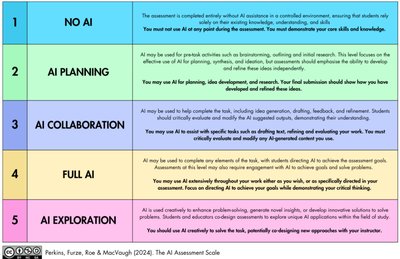
Summary Table: AI Assessment Scale Levels
Level | Description |
|---|---|
1. NO AI | Assessment completed entirely without AI assistance. |
2. AI PLANNING | AI may be used for idea development and research planning, but not for content generation. |
3. AI COLLABORATION | AI may help with tasks like idea generation and feedback, but students must critically interpret and edit outputs. |
4. FULL AI | AI is used extensively to achieve assessment goals, with students directing and evaluating AI outputs. |
5. AI EXPLORATION | AI is used creatively for problem-solving and innovation, with students designing new approaches. |
Additional info: The AI Assessment Scale is referenced to clarify expectations for academic honesty and transparency regarding AI use in coursework.
Academic Integrity: Key Definitions
Plagiarism: Copying or rewording content from any source without proper citation is prohibited. All sources, including AI-generated text, must be credited.
Cheating: Presenting another person's work as your own, or submitting the same assignment in multiple classes without permission, is not allowed.
Consequences: First offenses result in a warning and opportunity to redo the assignment; repeated offenses lead to grade penalties and possible disciplinary action.
Student Responsibilities
Arrive on time and prepared for class.
Submit all assignments in the required format and by the due date.
Engage actively in laboratory and class activities.
Uphold academic integrity and follow all course policies.
