 뒤로
Anatomy & Physiology Syllabus and Course Policies (2026-2027)
스터디 가이드 - 스마트 노트
 자료에 맞춘 맞춤형 노트, 핵심 정의, 예시, 맥락을 확장해 제공합니다.
Anatomy & Physiology Syllabus Overview
This syllabus outlines the structure, expectations, and academic policies for the Anatomy & Physiology course at South Kent School for the 2026-2027 academic year. The course is designed to provide students with a comprehensive understanding of the human body, its systems, and physiological processes, preparing them for advanced studies in health and science fields.
Course Description
Focus: In-depth study of human anatomy and physiology, emphasizing conceptual understanding over advanced mathematics.
Target Students: Upperform students with prior biology (and typically chemistry) experience, especially those interested in pre-med or health-related fields.
Learning Methods: Laboratory work, dissections, case studies, and applied learning.
Goal: Develop foundational knowledge for advanced science coursework and health professions.
Required Texts/Materials
E-text available through Pearson+
Course Outline
The course is organized into five major units, each covering essential topics in human anatomy and physiology:
Unit 1: Organization & Tissues
Structural hierarchy of the human body
Anatomical terminology
Basic biochemistry and cellular transport
Histology (study of tissues)
Unit 2: Support & Movement
Integumentary system (skin and related structures)
Skeletal system (bones and joints)
Muscular system (muscle tissue and movement)
Unit 3: Integration & Control
Nervous system (central and peripheral)
Endocrine system (hormonal regulation)
Mechanisms for sensing, processing, and responding to environmental changes
Unit 4: Circulation & Maintenance
Cardiovascular system (heart and blood vessels)
Lymphatic and immune systems (defense and fluid balance)
Respiratory, digestive, and urinary systems (material transport and homeostasis)
Unit 5: Reproduction
Male and female reproductive systems
Gamete production
Hormonal regulation of reproduction and development
Grading Breakdown
Assignment Type | Weight (%) |
|---|---|
Exam | 40 |
Lab | 25 |
Quiz | 20 |
Homework | 10 |
Do Now | 5 |
Course Policies
Tardiness and Attendance
Timeliness is essential; students must arrive on time.
Three tardies equal one unexcused absence; 20+ minutes late is an unexcused absence.
Unexcused absences over 20% may result in loss of course credit.
Academic Eligibility for Athletics
Students missing assignments or falling below a C- may be placed in study hall and barred from athletic participation for at least one week.
Honors Designation
Two pathways: Independent Project or Adjusted Assessments (honors-level work with an average of 85%+).
Contact the classroom teacher and Dean of Faculty for more information.
Late and Missing Work
Assignments must be submitted on time; late work may receive a zero and may not be eligible for revision.
Excused absences may allow for adjusted deadlines.
Revision Policy
Only summative assessments submitted on time and earning less than an A (93-100) can be revised (one revision per assignment).
Students must demonstrate effort (office hours, remedial instruction, reflection).
Corrections can earn up to 50% of lost points back.
Technology in the Classroom
Technology use is at the instructor's discretion; phones are collected at the start of class.
Exceptions for emergencies or learning purposes only.
Academic Integrity
All work must be original; plagiarism and cheating are strictly prohibited.
Plagiarism includes copying or rewording without citation, including AI-generated text.
Cheating includes unauthorized collaboration or submitting the same work for multiple classes without permission.
Violations are reported and carry escalating consequences, from warnings to possible suspension or dismissal.
Artificial Intelligence (AI) Policy
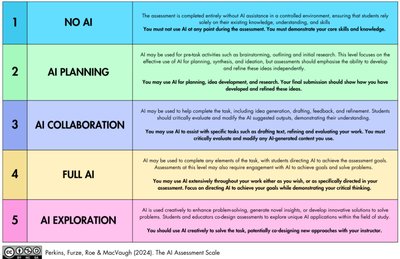
AI use is fully prohibited unless prior authorization is given by the instructor.
If AI is used, it must be disclosed and cited according to MLA, APA, or Chicago style guidelines.
Use of Class Materials and Recordings
Class materials are the intellectual property of the instructor and may not be shared without permission.
Food and Drink Policy
No food allowed in STEM classrooms; drinks must be securely sealed and are not allowed during lab periods.
Summary Table: Course Units and Major Topics
Unit | Main Topics |
|---|---|
1. Organization & Tissues | Structural hierarchy, anatomical language, biochemistry, cellular transport, histology |
2. Support & Movement | Integumentary, skeletal, muscular systems |
3. Integration & Control | Nervous and endocrine systems, sensory and response mechanisms |
4. Circulation & Maintenance | Cardiovascular, lymphatic, immune, respiratory, digestive, urinary systems |
5. Reproduction | Male and female reproductive systems, gamete production, hormonal regulation |
Additional info: This syllabus provides a comprehensive framework for the study of human anatomy and physiology, aligning with standard college-level introductory courses and preparing students for further study in biological and health sciences.
