 뒤로
뒤로Anatomy & Physiology: The Integumentary System Study Guide
스터디 가이드 - 스마트 노트
 자료에 맞춘 맞춤형 노트, 핵심 정의, 예시, 맥락을 확장해 제공합니다.
Q1. Label the two layers of skin.
Background
Topic: Structure of the Skin
This question tests your understanding of the basic anatomy of the skin, specifically the identification of its two main layers.
Key Terms:
Epidermis: The outermost layer of the skin, composed mainly of epithelial cells.
Dermis: The deeper layer beneath the epidermis, containing connective tissue, blood vessels, and nerves.
Step-by-Step Guidance
Examine a cross-section of the skin and identify the outermost and the underlying layers.
Label the top layer as the one exposed to the environment, and the deeper layer as the one containing structures like hair follicles and glands.
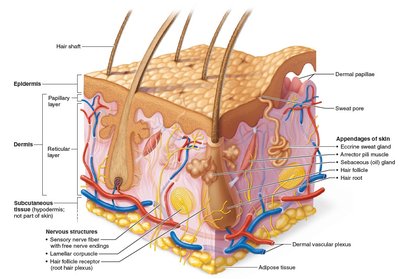
Try solving on your own before revealing the answer!
Final Answer:
The two layers of the skin are the epidermis (outer layer) and the dermis (inner layer).
Q2. Which of these two layers of the skin is vascularized?
Background
Topic: Skin Vascularization
This question checks your knowledge of which skin layer contains blood vessels.
Key Terms:
Vascularized: Having blood vessels present.
Step-by-Step Guidance
Recall that the epidermis is made of epithelial tissue, which typically lacks blood vessels.
Consider the functions of the dermis and what structures it contains.
Try solving on your own before revealing the answer!
Final Answer:
The dermis is the vascularized layer of the skin.
Q3. Deep to the skin, the subcutaneous tissue consists mostly of which tissue type?
Background
Topic: Subcutaneous Tissue (Hypodermis)
This question focuses on the composition of the tissue layer beneath the skin.
Key Terms:
Subcutaneous tissue (Hypodermis): The layer beneath the dermis, not technically part of the skin but closely associated with it.
Adipose tissue: A type of connective tissue specialized for fat storage.
Step-by-Step Guidance
Think about the main function of the subcutaneous layer (energy storage, insulation, cushioning).
Identify the tissue type that best matches these functions.
Try solving on your own before revealing the answer!
Final Answer:
The subcutaneous tissue consists mostly of adipose tissue.
Q4. What tissue type makes up the epidermis of the skin?
Background
Topic: Epidermal Tissue Composition
This question tests your knowledge of the specific epithelial tissue forming the epidermis.
Key Terms:
Keratinized stratified squamous epithelium: A multi-layered epithelial tissue with surface cells filled with keratin, providing protection.
Step-by-Step Guidance
Recall the main function of the epidermis (protection) and the type of cells it contains.
Identify the specific epithelial tissue that is both stratified and keratinized.
Try solving on your own before revealing the answer!
Final Answer:
The epidermis is made up of keratinized stratified squamous epithelium.
Q5. Match each description with its corresponding layer of the epidermis.
Background
Topic: Layers of the Epidermis
This question assesses your understanding of the structure and function of each epidermal layer.
Key Terms:
Stratum basale, stratum spinosum, stratum granulosum, stratum lucidum, stratum corneum: The five layers of the epidermis (from deep to superficial in thick skin).
Step-by-Step Guidance
Review the characteristics of each epidermal layer (e.g., cell division, keratinization, presence in thick skin).
Match each description to the correct layer based on its unique features.
Remember that not all layers are present in both thick and thin skin.
Try solving on your own before revealing the answer!
Final Answer:
Descriptions matched to layers: - Only found in thick skin: Stratum lucidum - Continually sloughs off dead cells: Stratum corneum - Where keratinization begins: Stratum granulosum - Where keratinocytes accumulate two types of granules: Stratum granulosum - Source of new cells for epidermal growth: Stratum basale - Contains melanocytes: Stratum basale - Layer where dendritic cells are most abundant: Stratum spinosum - Contains the oldest keratinocytes: Stratum corneum
Q6. Select the correct order of epidermal layers for thin skin (from the superficial skin surface to the junction with the dermis).
Background
Topic: Epidermal Layer Sequence
This question tests your ability to recall the order of layers in thin skin, which lacks the stratum lucidum.
Key Terms:
Thin skin: Covers most of the body and has four layers (no stratum lucidum).
Step-by-Step Guidance
List the layers of the epidermis from superficial to deep for thin skin.
Compare the options given and select the one that matches the correct order.
Try solving on your own before revealing the answer!
Final Answer:
The correct order is: Stratum corneum, stratum granulosum, stratum spinosum, stratum basale (Option d).
Q7. Which areas of the body are covered by thick skin (epidermis has 5 layers)?
Background
Topic: Distribution of Thick Skin
This question asks you to identify where thick skin is found on the body.
Key Terms:
Thick skin: Found only in specific areas, contains all five epidermal layers including the stratum lucidum.
Step-by-Step Guidance
Recall which body regions are subject to the most abrasion and require extra protection.
List these regions as your answer.
Try solving on your own before revealing the answer!
Final Answer:
Thick skin is found on the palms of the hands and the soles of the feet.
