뒤로
Anatomy of the Respiratory System: Key Structures and Pathways
스터디 가이드 - 스마트 노트
 자료에 맞춘 맞춤형 노트, 핵심 정의, 예시, 맥락을 확장해 제공합니다.
Anatomy of the Respiratory System
Overview of Respiratory Pathways
The respiratory system is responsible for the intake of oxygen and the removal of carbon dioxide. It consists of a series of anatomical structures that facilitate the movement of air from the external environment to the alveoli, where gas exchange occurs.
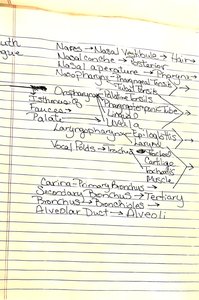
Nares: Also known as nostrils, these are the external openings of the nose that allow air to enter the nasal cavity.
Nasal Vestibule: The area just inside the nostrils, lined with hairs that filter large particles from inhaled air.
Nasal Aperture: The opening leading from the nasal vestibule into the nasal cavity.
Nasal Cavity: The space inside the nose where air is warmed, humidified, and filtered.
Nasopharynx: The upper part of the pharynx, connecting the nasal cavity to the oropharynx.
Oropharynx: The middle part of the pharynx, located behind the oral cavity.
Laryngopharynx: The lower part of the pharynx, leading to the larynx and esophagus.
Larynx: Also known as the voice box, it houses the vocal folds and is involved in sound production and protecting the airway during swallowing.
Epiglottis: A flap of cartilage that covers the larynx during swallowing, preventing food from entering the airway.
Vocal Folds: Also called vocal cords, these are responsible for sound production.
Trachea: The windpipe, a tube that conducts air from the larynx to the bronchi.
Carina: The ridge at the base of the trachea where it divides into the primary bronchi.
Primary Bronchus: The first branches of the trachea, leading into each lung.
Secondary Bronchus: Branches of the primary bronchi that lead to each lobe of the lungs.
Tertiary Bronchus: Smaller branches of the secondary bronchi, supplying air to specific segments of the lungs.
Bronchioles: The smallest branches of the bronchial tree, leading to the alveolar ducts.
Alveolar Duct: Small passages that connect bronchioles to alveolar sacs.
Alveoli: Tiny air sacs where gas exchange occurs between air and blood.
Key Functions and Examples
Filtration: Nasal hairs and mucosa filter dust and pathogens from inhaled air.
Humidification: The nasal cavity adds moisture to the air, protecting delicate lung tissues.
Protection: The epiglottis prevents food from entering the airway during swallowing.
Gas Exchange: Occurs in the alveoli, where oxygen diffuses into the blood and carbon dioxide is expelled.
Additional info:
The respiratory tract is divided into the upper (nose, pharynx, larynx) and lower (trachea, bronchi, bronchioles, alveoli) respiratory tracts.
Each bronchus further divides into smaller bronchioles, increasing surface area for gas exchange.