 뒤로
Blood Flow and the Control of Blood Pressure
스터디 가이드 - 스마트 노트
 자료에 맞춘 맞춤형 노트, 핵심 정의, 예시, 맥락을 확장해 제공합니다.
Blood Flow and the Control of Blood Pressure
Introduction
This chapter explores the structure and function of blood vessels, the regulation of blood pressure, and the physiological mechanisms that ensure efficient blood flow throughout the body. Understanding these concepts is essential for comprehending cardiovascular health and disease.
Blood Vessel Structure and Function
Types of Blood Vessels
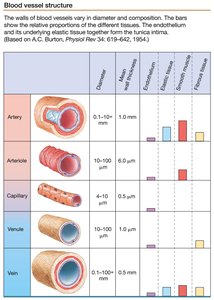
Arteries: Thick-walled vessels that act as pressure reservoirs, carrying blood away from the heart. They contain abundant smooth muscle and elastic tissue.
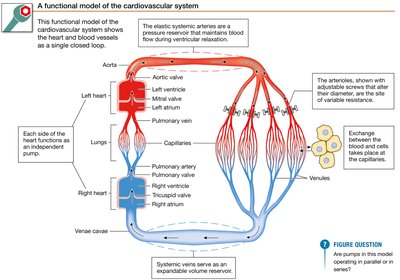
Arterioles: Smaller branches of arteries, serving as sites of variable resistance and regulating blood flow into capillary beds.
Capillaries: The smallest blood vessels, consisting of a single layer of endothelium. They are the primary site for exchange between blood and interstitial fluid.
Venules: Small vessels that receive blood from capillaries and begin the return flow to the heart.
Veins: Thin-walled vessels that act as volume reservoirs, returning blood to the heart. They contain one-way valves to prevent backflow.
Blood Vessel Wall Composition
Endothelium: The innermost layer, secreting paracrine factors and regulating vessel growth and absorption.
Vascular Smooth Muscle: Arranged in circular or spiral layers, responsible for vasoconstriction and vasodilation.
Connective Tissue: Provides elasticity and strength, varying in amount depending on vessel type.
Functional Model of the Cardiovascular System
The cardiovascular system operates as a closed loop, with the heart functioning as a dual pump (right and left sides). Arteries distribute blood under high pressure, arterioles regulate flow, capillaries facilitate exchange, and veins return blood to the heart.
Capillary Beds and Microcirculation
Precapillary Sphincters: Regulate blood flow into capillaries based on local signals.
Metarterioles: Allow blood to bypass capillaries when sphincters are closed.

Venous Return and Valves
Veins contain one-way valves to prevent backflow.
Skeletal muscle contraction aids venous return (muscle pump).

Angiogenesis
Definition: Formation of new blood vessels, essential for growth, wound healing, and tissue repair.
Regulation: Controlled by cytokines such as VEGF (promotes) and angiostatin (inhibits).
Clinical Relevance: Targeted in cancer therapy and cardiovascular disease management.
Blood Pressure
Blood Pressure Gradients
Blood pressure is highest in arteries and lowest in veins.
Pulse pressure is the difference between systolic and diastolic pressure.
Mean Arterial Pressure (MAP) is the average pressure driving blood flow.
Formulas:
Pulse Pressure:
Mean Arterial Pressure:

Measuring Blood Pressure
Blood pressure is measured using a sphygmomanometer and stethoscope.
Korotkoff sounds indicate systolic and diastolic pressures.

Determinants of Mean Arterial Pressure (MAP)
MAP is determined by cardiac output and peripheral resistance.
Changes in blood volume, regulated by the kidneys, affect MAP.
Formula:


Resistance in the Arterioles
Factors Affecting Arteriolar Resistance
Local control (e.g., nitric oxide, kinins, histamine)
Sympathetic reflexes (norepinephrine, epinephrine)
Hormones (ANP, angiotensin II)
Sympathetic Control of Vascular Smooth Muscle
Norepinephrine binds to α-receptors causing vasoconstriction.
Epinephrine binds to β2-receptors in heart, liver, and skeletal muscle arterioles causing vasodilation.

Regulation of Cardiovascular Function
Cardiovascular Control Center (CVCC)
Located in the brainstem, integrates sensory input and coordinates cardiovascular responses.
Baroreceptor Reflex
Baroreceptors in carotid arteries and aorta detect changes in blood pressure and adjust heart rate and vessel diameter accordingly.
Orthostatic hypotension triggers this reflex to maintain cerebral perfusion during postural changes.

Other Regulatory Systems
Arterial chemoreceptors respond to changes in blood gases.
Respiratory, renal, and nervous systems interact to maintain cardiovascular homeostasis.
Distribution of Blood to the Tissues
Local and Systemic Regulation
Blood flow is matched to tissue metabolic needs via local autoregulation and systemic reflexes.
Myogenic autoregulation: Vascular smooth muscle responds to stretch by contracting or relaxing.
Active hyperemia: Increased blood flow in response to increased metabolic activity.
Reactive hyperemia: Increased blood flow following a period of reduced blood supply.
Exchange at the Capillaries
Capillary Structure and Types
Continuous capillaries: Most common, with uninterrupted endothelial lining.
Fenestrated capillaries: Have pores, found in kidneys and intestines.
Sinusoids: Large, leaky capillaries in liver, bone marrow, and spleen.
Mechanisms of Capillary Exchange
Diffusion: Movement of small solutes and gases along concentration gradients.
Transcytosis: Vesicular transport of larger molecules and proteins.
Bulk flow: Mass movement of fluid driven by hydrostatic and osmotic pressures.
Filtration: Fluid movement out of capillaries due to hydrostatic pressure. Absorption: Fluid movement into capillaries due to colloid osmotic (oncotic) pressure.
Net Pressure Formula:
The Lymphatic Circulation
Returns excess fluid and proteins from interstitial spaces to the circulatory system.
Transports absorbed fats and serves as a filter for pathogens.
Lymphatic vessels are blind-ended and contain valves to ensure one-way flow.
Edema results from inadequate lymph drainage or excessive filtration.
Cardiovascular Disease
Risk Factors
Non-modifiable: Age, sex, family history.
Modifiable: Smoking, obesity, sedentary lifestyle, hypertension, diabetes mellitus.
Atherosclerosis
Inflammatory process involving cholesterol and triglyceride deposition in arterial walls.
High-density lipoprotein (HDL-C) is protective; low-density lipoprotein (LDL-C) is atherogenic.
Hypertension
Primary (essential) hypertension: No identifiable cause, associated with increased peripheral resistance.
Secondary hypertension: Due to identifiable pathology (e.g., kidney disease).
Chronic hypertension increases risk for atherosclerosis, heart failure, and stroke.
Treatments include lifestyle modification and medications (diuretics, beta-blockers, ACE inhibitors).
Summary Table: Pressure, Flow, and Resistance in the Cardiovascular System
Principle | Description |
|---|---|
Flow | Blood flows if a pressure gradient (ΔP) is present; flows from high to low pressure. |
Resistance | Opposes blood flow; determined by vessel radius, length, and blood viscosity. |
Velocity | Determined by total cross-sectional area; slowest in capillaries, fastest in arteries. |
