 뒤로
Blood Gas Transport and Neural Control of Ventilation: Study Notes
스터디 가이드 - 스마트 노트
 자료에 맞춘 맞춤형 노트, 핵심 정의, 예시, 맥락을 확장해 제공합니다.
Blood Gas Transport
Oxygen Transport
Oxygen is transported in the blood primarily by hemoglobin within red blood cells, with a small fraction dissolved directly in plasma. The efficiency of oxygen transport and release is crucial for cellular respiration and tissue function.
Dissolved Oxygen: About 1.5% of O2 is dissolved in plasma, contributing to the partial pressure of oxygen.
Hemoglobin-Bound Oxygen: Approximately 98.5% of O2 is carried by hemoglobin (Hb) in red blood cells. The reaction is: Reduced hemoglobin (HHb) binds oxygen to form oxyhemoglobin (Hb(O2)4).
Oxygen Delivery: Under normal conditions, tissues receive only about 25% of the O2 delivered by HbO2.
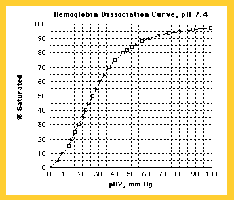
Hemoglobin-Oxygen Dissociation Curve
The Hb-O2 dissociation curve illustrates the relationship between partial pressure of oxygen (pO2) and hemoglobin saturation. It is sigmoidal, reflecting cooperative binding of O2 to hemoglobin.
Arterial Blood: High pO2 leads to high % saturation.
Venous Blood: Lower pO2 results in reduced % saturation.
Physiological Relevance: The curve shows that hemoglobin releases O2 efficiently in tissues where pO2 is low.
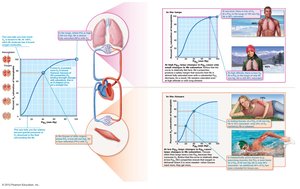
Factors Affecting Hemoglobin Affinity for Oxygen
Hemoglobin's affinity for oxygen is influenced by several physiological factors, which shift the dissociation curve and affect O2 delivery to tissues.
Temperature: High temperature decreases Hb-O2 affinity, favoring O2 release; low temperature increases affinity.
pH (Bohr Effect): Low pH (acidic conditions) weakens the Hb-O2 bond, promoting O2 dissociation.
pCO2: High pCO2 decreases affinity; low pCO2 increases affinity.
BPG (2,3-bisphosphoglycerate): Produced during glycolysis in RBCs, high BPG decreases affinity.
Favors HbO2 Association | Favors HbO2 Dissociation |
|---|---|
Low temperature | High temperature |
High pO2 | Low pO2 |
Low pCO2 | High pCO2 |
High blood pH | Low blood pH |
Low BPG | High BPG |
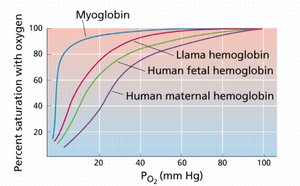
Comparison of Hemoglobin Affinity
Different types of hemoglobin (e.g., fetal, maternal, animal) have varying affinities for oxygen, which is important for physiological adaptation.
Fetal Hemoglobin: Has higher affinity for O2 than adult hemoglobin, facilitating O2 transfer from mother to fetus.
Myoglobin: Found in muscle, has even higher affinity for O2.
Blood Gas Transport – Carbon Dioxide
Carbon dioxide is transported in the blood in three main forms, each contributing to the regulation of blood pH and gas exchange.
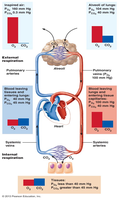
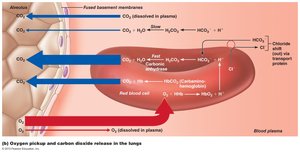
Dissolved CO2: 7-10% is dissolved in plasma, exerting partial pressure.
Carbaminohemoglobin: 20-30% binds to hemoglobin: Carbaminohemoglobin is formed.
Bicarbonate: 60-70% is converted to HCO3- in RBCs and carried in plasma: This reaction is catalyzed by carbonic anhydrase.
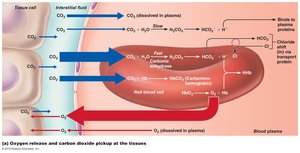
CO2 Transport and the Haldane Effect
The amount of CO2 transported by blood is influenced by the oxygenation state of hemoglobin. The Haldane Effect describes how oxygenation of blood in the lungs promotes CO2 release, while deoxygenation in tissues promotes CO2 uptake.
At Cells: High pCO2 and low pH favor O2 dissociation (Bohr Effect).
At Lungs: High pO2 favors O2 binding and CO2 release (Haldane Effect).
Summary Table: Blood Gas Transport
Gas | Transport Form | % of Total |
|---|---|---|
O2 | Dissolved in plasma | 1.5% |
O2 | Bound to hemoglobin | 98.5% |
CO2 | Dissolved in plasma | 7-10% |
CO2 | Bound to hemoglobin | 20-30% |
CO2 | As bicarbonate | 60-70% |
Neural Control of Ventilation
Respiratory Centers in the Brain
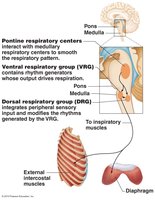
Ventilation is regulated by clusters of neurons in the medulla and pons, which coordinate the rhythm and rate of breathing.
Ventral Respiratory Group (VRG): Sets the basic ventilation rate; contains inspiratory and expiratory neurons.
Dorsal Respiratory Group (DRG): Integrates input from peripheral stretch receptors and chemoreceptors, modifying the basic rate.
Pontine Respiratory Center: Modifies rhythm during activities such as sleep, exercise, and vocalization; assists in transitions between inspiration and expiration.
Factors Modifying Ventilation Rate
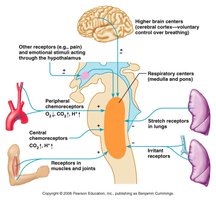
Ventilation rate is influenced by blood levels of CO2, O2, and pH, detected by chemoreceptors.
pCO2: Increased pCO2 stimulates hyperventilation; decreased pCO2 causes hypoventilation.
pO2: Increased pO2 leads to hypoventilation; decreased pO2 stimulates hyperventilation. Ventilation is less sensitive to pO2 than pCO2.
pH: Decreased arterial pH (from lactic acid or ketone bodies) stimulates hyperventilation, even if pO2 and pCO2 are normal.
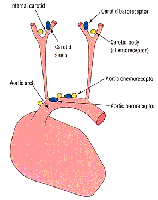
Central and Peripheral Chemoreceptors
Central chemoreceptors in the medulla respond to changes in CO2 and pH in cerebrospinal fluid, while peripheral chemoreceptors in the carotid and aortic bodies respond to changes in blood pO2, pCO2, and pH.
Central Chemoreceptors: CO2 diffuses into CSF, generating H+ and lowering pH, which stimulates hyperventilation.
Peripheral Chemoreceptors: Detect changes in arterial pH, pO2, and pCO2.
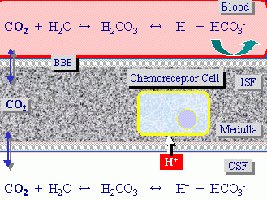
Disorders Associated With Respiration
Emphysema
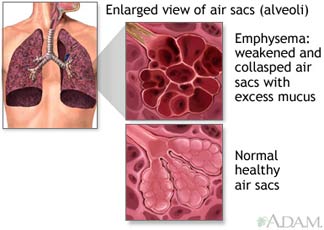
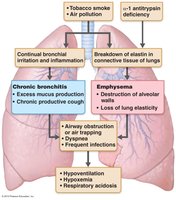
Emphysema is a chronic respiratory disorder characterized by permanent enlargement of air spaces and destruction of alveolar walls, leading to reduced gas exchange and loss of lung elasticity.
Causes: Decreased α-antitrypsin activity, increased elastase activity, smoking, pollution, aging, and COPD.
Characteristics: Permanent enlargement of bronchioles, alveolar ducts, and alveoli; destruction of alveolar walls; loss of elasticity.
Asthma
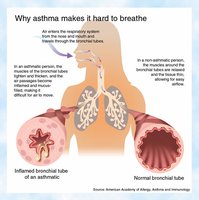
Asthma is a chronic inflammatory disorder of the airways, resulting in hyperresponsiveness and airflow obstruction.
Intrinsic Asthma: Caused by Type I hypersensitivity.
Extrinsic Asthma: Nonimmune; caused by infection, stress, inhaled irritants, drug ingestion, or exercise.
Characteristics: Chronic airway inflammation, hyperresponsive tracheobronchial tree, dyspnea, coughing, wheezing, and copious mucus secretion.
Tuberculosis
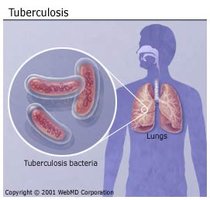
Tuberculosis is an infectious disease caused by Mycobacterium tuberculosis, affecting the lungs and potentially other organs.
Cause: Infection with Mycobacterium tuberculosis.
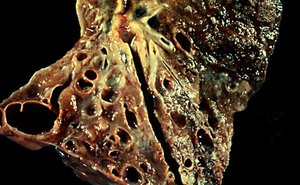
Characteristics: Reactivation or reinfection produces respiratory symptoms (chest pain, bloody sputum, granulomas, lung cavitation); can spread to skeleton, digestive viscera, adrenal glands, genitourinary tract, and heart.
Cystic Fibrosis
Cystic fibrosis is a genetic disorder affecting chloride transport in respiratory epithelial cells, leading to thick mucus and chronic respiratory and digestive issues.
Cause: Defective gene encoding Cl- transporter.
Characteristics: Mucus accumulation, chronic cough, persistent lung infections, obstructive pulmonary disease; digestive and reproductive tract involvement, malabsorption, fat-soluble vitamin deficiencies.
