 뒤로
Bone Development, Growth, Remodeling, Repair, and Disorders
스터디 가이드 - 스마트 노트
 자료에 맞춘 맞춤형 노트, 핵심 정의, 예시, 맥락을 확장해 제공합니다.
Bone Development and Ossification
Ossification (Osteogenesis)
Ossification is the process of bone tissue formation, beginning in the second month of embryonic development and continuing throughout life. It is essential for the formation, growth, and repair of bones.
Ossification: Formation of bone tissue from cartilage or fibrous membranes.
Bone remodeling: Lifelong process involving osteoclasts breaking down bone and osteoblasts building new bone.
Formation of the Bony Skeleton
There are two main types of ossification: endochondral and intramembranous.
Endochondral ossification: Bone forms by replacing hyaline cartilage. Most bones below the skull (except clavicles) are formed this way.
Intramembranous ossification: Bone develops from fibrous membranes, forming the frontal, parietal, occipital, temporal, and clavicle bones.
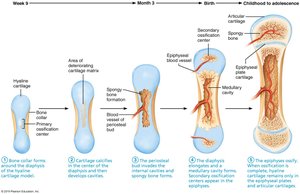
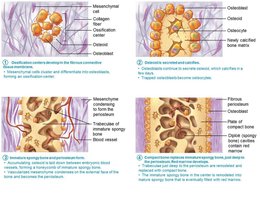
Postnatal Bone Growth
Growth in Length of Long Bones
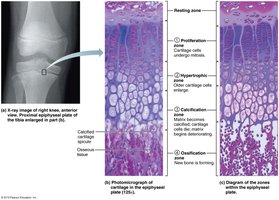
Long bones grow in length at the epiphyseal plate, which consists of five distinct zones. Growth ceases when the plate is replaced by bone during adolescence.
Resting (quiescent) zone: Inactive cartilage.
Proliferation (growth) zone: Rapidly dividing cartilage cells.
Hypertrophic zone: Older chondrocytes enlarge.
Calcification zone: Matrix calcifies, chondrocytes die.
Ossification (osteogenic) zone: Osteoblasts replace cartilage with bone.
Growth in Width (Thickness)
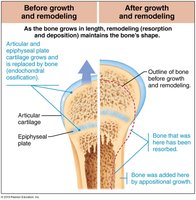
Bones increase in thickness through appositional growth, which can occur throughout life. Osteoblasts add bone matrix externally, while osteoclasts remove bone internally.
Hormonal Regulation of Bone Growth
Key Hormones
Growth hormone: Stimulates epiphyseal plate activity.
Thyroid hormone: Modulates growth hormone activity.
Sex hormones: Promote growth spurts and induce epiphyseal plate closure.
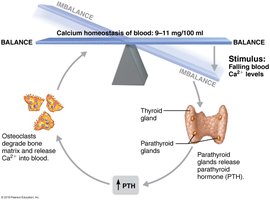
Parathyroid hormone (PTH): Regulates calcium homeostasis.
Bone Remodeling
Bone Deposit and Resorption
Bone remodeling involves both deposit (by osteoblasts) and resorption (by osteoclasts). About 5–7% of bone mass is recycled weekly.
Bone deposit: Osteoblasts lay down new matrix (osteoid seam).
Bone resorption: Osteoclasts break down bone matrix, releasing calcium.
Control of Remodeling
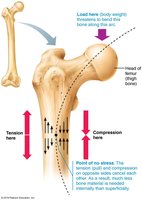
Remodeling is controlled by hormonal and mechanical factors.
Hormonal controls: PTH and calcitonin regulate blood calcium levels.
Mechanical stress: Bones adapt to stresses (Wolf’s law).
Bone Repair
Fracture Classification
Fractures are classified by position, completeness, and whether the skin is penetrated.
Nondisplaced: Ends retain normal position.
Displaced: Ends are out of alignment.
Complete: Broken all the way through.
Incomplete: Not broken all the way through.
Open (compound): Skin penetrated.
Closed (simple): Skin not penetrated.
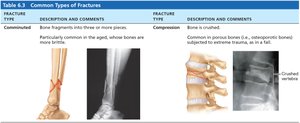
Common Types of Fractures
The following table summarizes common fracture types:
Fracture Type | Description and Comments |
|---|---|
Comminuted | Bone fragments into three or more pieces. Common in aged bones. |
Compression | Bone is crushed. Common in porous bones subjected to extreme trauma. |
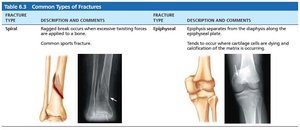
Spiral | Ragged break from excessive twisting forces. Common sports fracture. |
Epiphyseal | Epiphysis separates from diaphysis along epiphyseal plate. |
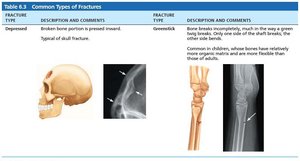
Depressed | Broken bone portion is pressed inward. Typical of skull fracture. |
Greenstick | Bone breaks incompletely, one side bends. Common in children. |
Fracture Treatment and Repair
Bone repair involves four major stages:
Hematoma formation: Blood vessels hemorrhage, forming a hematoma.
Fibrocartilaginous callus formation: Capillaries grow, fibroblasts secrete collagen, and repair tissue forms.
Bony callus formation: New trabeculae form, converting callus to spongy bone.
Bone remodeling: Excess material is removed, compact bone is laid down.
Bone Disorders
Osteomalacia and Rickets
These disorders result from poor mineralization, often due to vitamin D deficiency or insufficient calcium.
Osteomalacia: Soft, weak bones in adults.
Rickets: Osteomalacia in children, causing bone deformities.
Osteoporosis
Osteoporosis is characterized by bone resorption exceeding deposit, leading to decreased bone mass and increased fracture risk.
Risk factors: Age, postmenopausal women, petite body form, poor diet, smoking, hormone-related conditions.
Treatments: Calcium, vitamin D, exercise, hormone therapy, bisphosphonates, statins, denosumab.
Prevention: Adequate calcium intake, reduced alcohol, weight-bearing exercise.
Paget’s Disease
Paget’s disease involves excessive and disorganized bone remodeling, resulting in weak, poorly mineralized bone.
Developmental Aspects of Bone
Embryonic and Postnatal Ossification
Embryonic skeleton ossifies predictably, allowing fetal age determination. Most long bones begin ossifying by 8 weeks, with primary ossification centers developed by week 12.
Age-related Changes in Bone
Bone formation exceeds resorption in children and adolescents, balances in young adults, and declines with age. Bone mass and healing ability decrease, especially in females and whites.
Genetics: Determines bone density and risk of osteoporosis.
Electrical stimulation and ultrasound: Can hasten bone repair.
Additional info: Vitamin D is essential for calcium absorption and bone health. Sunlight exposure increases vitamin D synthesis in the skin, which is important for preventing bone disorders.
