 뒤로
Bone Disorders and Fractures: Pathology, Risk Factors, and Healing
스터디 가이드 - 스마트 노트
 자료에 맞춘 맞춤형 노트, 핵심 정의, 예시, 맥락을 확장해 제공합니다.
Bone Disorders and Fractures
Overview of Bone Disorders
Bone disorders arise from abnormal bone deposition and resorption, leading to structural and functional impairments. The most common disorders include osteomalacia, rickets, osteoporosis, and Paget’s disease. Each condition affects bone tissue differently, resulting in distinct clinical manifestations and treatment approaches.
Osteomalacia
Osteomalacia ("soft bones") refers to a group of disorders in adults where bones are poorly mineralized. Although osteoid (the organic bone matrix) is produced, calcium salts are not adequately deposited, resulting in soft and weak bones.
Key Features: Pain when weight is placed on affected bones; increased risk of fractures.
Causes: Insufficient calcium in the diet or vitamin D deficiency.
Treatment: Increasing vitamin D intake and exposure to sunlight, which stimulates endogenous vitamin D production.
Example: An adult with chronic vitamin D deficiency may experience diffuse bone pain and muscle weakness.
Rickets
Rickets is the childhood counterpart of osteomalacia, presenting with more severe symptoms due to rapid bone growth during development.
Key Features: Bowed legs, deformities of the pelvis, skull, and rib cage; widened and abnormally long ends of long bones due to failure of epiphyseal plate calcification.
Causes: Similar to osteomalacia—insufficient calcium or vitamin D.
Treatment: Vitamin D supplementation and dietary correction.
Example: A child with rickets may present with bowed legs and delayed growth milestones.
Osteoporosis
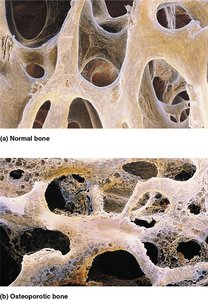
Osteoporosis is a disorder characterized by bone resorption outpacing bone deposition, leading to decreased bone mass and increased fragility. The bone matrix composition remains normal, but the overall quantity is reduced, making bones porous and light.
Key Features: Fragile bones that fracture easily, even with minor stresses such as sneezing or stepping off a curb.
Risk Factors:
Decreased sex hormones (especially postmenopausal estrogen decline in females)
Insufficient bone stress (low body weight, lack of weight-bearing exercise)
Poor diet (low in calcium, vitamin D, or protein)
Smoking (reduces estrogen and calcium absorption)
Genetic predisposition
Hormone-related conditions (e.g., diabetes mellitus, hyperthyroidism)
Alcohol consumption and certain medications (e.g., steroids, cancer drugs)
Example: An elderly woman with osteoporosis may suffer a hip fracture after a minor fall.
Paget’s Disease
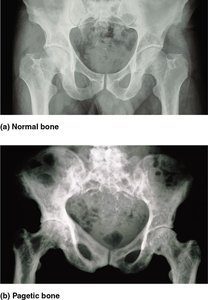
Paget’s disease is a chronic disorder involving excessive and disorganized bone remodeling. The newly formed bone, termed pagetic bone, has a high ratio of spongy to compact bone and is poorly mineralized, resulting in spotty bone weakening.
Key Features: Localized bone pain and deformities, especially in the spine, pelvis, femur, and skull; irregular bone thickenings or filling of the medullary cavity with pagetic bone.
Onset: Rare before age 40; affects about 1% of North Americans over 40.
Etiology: Unknown, but a viral trigger is suspected.
Treatment: Bisphosphonates and high doses of calcitonin to inhibit bone breakdown.
Example: Paget’s disease may be discovered incidentally on X-ray imaging performed for unrelated reasons.
Bone Fractures
Types of Bone Fractures
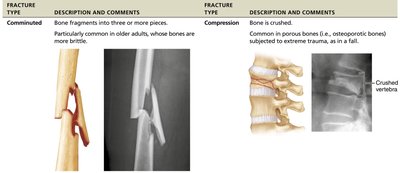
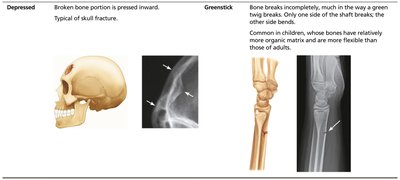
Bone fractures are classified based on the nature of the break and the forces involved. Common types include:
Fracture Type | Description and Comments |
|---|---|
Comminuted | Bone fragments into three or more pieces; common in older adults with brittle bones. |
Compression | Bone is crushed; common in porous bones (e.g., osteoporotic bones) subjected to extreme trauma. |
Depressed | Broken bone portion is pressed inward; typical of skull fractures. |
Greenstick | Bone breaks incompletely, like a green twig; common in children due to more flexible bones. |
Bone Fracture Healing
The healing of a bone fracture is a complex process involving several stages:
Hematoma Formation: Blood vessels break, forming a hematoma (clotted blood) at the fracture site.
Fibrocartilaginous (Soft) Callus Formation: New blood vessels infiltrate the hematoma, and fibroblasts and chondroblasts produce a soft callus that bridges the broken ends.
Bony Callus Formation: Osteoblasts replace the soft callus with a bony (hard) callus of spongy bone.
Bone Remodeling: The bony callus is remodeled over time to restore the bone's original shape and structure.
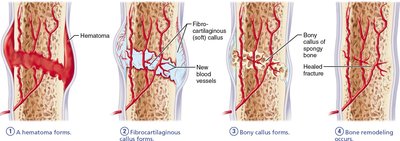
Example: After a simple fracture, the bone typically regains its original strength and shape through this healing process.
Additional info: Adequate nutrition (especially calcium and vitamin D), immobilization, and sometimes surgical intervention are important for optimal bone healing.
