 뒤로
Cell Transport Mechanisms: Anatomy & Physiology Study Guide
스터디 가이드 - 스마트 노트
 자료에 맞춘 맞춤형 노트, 핵심 정의, 예시, 맥락을 확장해 제공합니다.
Q1. What type of transport is demonstrated in Figure 1?
Background
Topic: Membrane Transport - Diffusion
This question tests your understanding of how substances move across the plasma membrane without the use of energy, specifically focusing on the process of diffusion.
Key Terms:
Diffusion: The movement of molecules from an area of higher concentration to an area of lower concentration.
Concentration Gradient: The difference in concentration of a substance across a space.
Plasma Membrane: The boundary that separates the interior of the cell from the external environment.
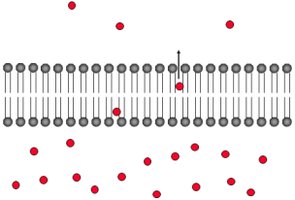
Step-by-Step Guidance
Observe the direction of movement of the red dots (representing molecules) across the membrane.
Notice that molecules are moving from an area where they are more concentrated to an area where they are less concentrated.
Recall that this type of movement does not require energy input from the cell.
Think about which transport mechanism matches these characteristics.
Try solving on your own before revealing the answer!
Final Answer: Simple Diffusion
The transport demonstrated in Figure 1 is simple diffusion, a passive process where molecules move down their concentration gradient without energy input.
Q2. This is passive/active transport?
Background
Topic: Types of Membrane Transport
This question asks you to classify the transport mechanism shown in Figure 1 as either passive or active.
Key Terms:
Passive Transport: Movement of substances across the membrane without energy input.
Active Transport: Movement of substances against their concentration gradient, requiring energy.
Step-by-Step Guidance
Recall the definition of passive transport: movement down the concentration gradient without energy.
Recall the definition of active transport: movement against the concentration gradient with energy input.
Review the direction of movement in Figure 1 and whether energy is required.
Try solving on your own before revealing the answer!
Final Answer: Passive Transport
The process shown is passive transport because it does not require energy and moves substances down their concentration gradient.
Q3. What types of substances cross the plasma membrane in this way?
Background
Topic: Selective Permeability of the Plasma Membrane
This question tests your knowledge of which molecules can move across the membrane by simple diffusion.
Key Terms:
Nonpolar Molecules: Molecules without a charge, such as oxygen and carbon dioxide.
Small Molecules: Molecules small enough to pass through the lipid bilayer.
Step-by-Step Guidance
Think about the properties of the plasma membrane (lipid bilayer) and which substances can pass through it easily.
Recall that nonpolar and small molecules can diffuse directly through the membrane.
Consider examples of such molecules (e.g., oxygen, carbon dioxide).
Try solving on your own before revealing the answer!
Final Answer: Small, nonpolar molecules (e.g., oxygen, carbon dioxide)
These substances can cross the plasma membrane by simple diffusion because they are small and nonpolar, allowing them to pass through the lipid bilayer.
Q4. What type of transport is demonstrated in Figure 2?
Background
Topic: Membrane Transport - Endocytosis
This question tests your understanding of how cells take in large particles or volumes of material by engulfing them in vesicles.
Key Terms:
Endocytosis: The process by which cells engulf external substances, forming vesicles.
Vesicle: A small membrane-bound sac used for transport within cells.
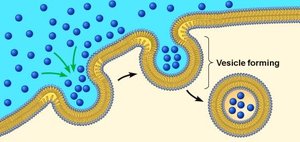
Step-by-Step Guidance
Observe the membrane wrapping around the blue particles and forming a vesicle.
Recall the process where the cell membrane surrounds material and pinches off to form a vesicle.
Think about which transport mechanism involves vesicle formation for intake of substances.
Try solving on your own before revealing the answer!
Final Answer: Endocytosis
The transport demonstrated in Figure 2 is endocytosis, where the cell engulfs material by forming a vesicle.
Q5. Is this passive/active transport?
Background
Topic: Types of Membrane Transport
This question asks you to classify endocytosis as passive or active transport.
Key Terms:
Active Transport: Requires energy (usually ATP) to move substances into or out of the cell.
Passive Transport: Does not require energy.
Step-by-Step Guidance
Recall that endocytosis involves the cell membrane changing shape and forming vesicles.
Consider whether this process requires energy input from the cell.
Think about the definition of active transport and whether endocytosis fits.
Try solving on your own before revealing the answer!
Final Answer: Active Transport
Endocytosis is an active transport process because it requires energy to form vesicles and move substances into the cell.
Q6. What type of protein is pictured here?
Background
Topic: Membrane Proteins in Transport
This question tests your knowledge of the proteins involved in endocytosis.
Key Terms:
Coat Protein: Proteins that help shape the vesicle during endocytosis.
Vesicle: Membrane-bound sac formed during endocytosis.
Step-by-Step Guidance
Recall the role of proteins in vesicle formation during endocytosis.
Think about the specific proteins that help form coated vesicles.
Consider the term used for these proteins.
Try solving on your own before revealing the answer!
Final Answer: Coat Protein (e.g., clathrin)
The protein pictured is a coat protein, which helps shape and stabilize the vesicle during endocytosis.
Q7. What types of substances cross the plasma membrane in this way?
Background
Topic: Selective Transport via Endocytosis
This question tests your understanding of what kinds of substances are taken up by endocytosis.
Key Terms:
Macromolecules: Large molecules such as proteins and polysaccharides.
Particles: Large particles, including bacteria and debris.
Step-by-Step Guidance
Recall that endocytosis is used for substances too large to pass through the membrane by diffusion or facilitated transport.
Think about examples of such substances (e.g., proteins, bacteria).
Consider the types of material that require vesicle formation for transport.
Try solving on your own before revealing the answer!
Final Answer: Large particles and macromolecules (e.g., proteins, bacteria)
Endocytosis allows the cell to take in large particles and macromolecules that cannot cross the membrane by other means.
Q8. Figure 4 shows a specific type of protein channel allowing only for the passage of water. What is the name of this protein channel?
Background
Topic: Membrane Transport - Osmosis
This question tests your knowledge of the specialized protein channels that facilitate water movement across the membrane.
Key Terms:
Osmosis: The diffusion of water across a selectively permeable membrane.
Aquaporin: A protein channel specifically for water.
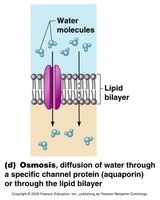
Step-by-Step Guidance
Observe the channel in the membrane that allows water molecules to pass through.
Recall the name of the protein channel that is selective for water.
Think about the term used for this water channel.
Try solving on your own before revealing the answer!
Final Answer: Aquaporin
The protein channel is called an aquaporin, which specifically facilitates the movement of water across the membrane.
Q9. Is this passive/active transport?
Background
Topic: Types of Membrane Transport
This question asks you to classify osmosis as passive or active transport.
Key Terms:
Passive Transport: Movement without energy input.
Active Transport: Movement with energy input.
Step-by-Step Guidance
Recall that osmosis is the movement of water down its concentration gradient.
Consider whether energy is required for this process.
Think about the definition of passive transport.
Try solving on your own before revealing the answer!
Final Answer: Passive Transport
Osmosis is a passive transport process because it does not require energy and moves water down its concentration gradient.
Q10. What type of transport is demonstrated in Figure 4?
Background
Topic: Membrane Transport - Osmosis
This question tests your ability to identify the transport mechanism for water across the membrane.
Key Terms:
Osmosis: Diffusion of water across a membrane.
Aquaporin: Water channel protein.
Step-by-Step Guidance
Observe the movement of water molecules through the channel.
Recall the process by which water moves across the membrane.
Think about the term for this type of transport.
Try solving on your own before revealing the answer!
Final Answer: Osmosis
The transport demonstrated is osmosis, the movement of water through a selectively permeable membrane.
Q11. Filtration is an example of passive transport. Substances are forced by H____________________ P________________________________________ through a membrane or capillary wall.
Background
Topic: Filtration in Physiology
This question tests your understanding of the mechanism by which filtration occurs in the body.
Key Terms:
Filtration: Movement of substances across a membrane due to pressure.
Hydrostatic Pressure: The force exerted by a fluid against a wall.
Step-by-Step Guidance
Recall the type of pressure that forces substances through membranes.
Think about the term used for the pressure exerted by fluids in the body.
Fill in the blanks with the correct terminology.
Try solving on your own before revealing the answer!
Final Answer: Hydrostatic Pressure
Substances are forced by hydrostatic pressure through a membrane or capillary wall during filtration.
Q12. Give an example of where filtration is used.
Background
Topic: Filtration in Human Physiology
This question tests your knowledge of physiological processes that use filtration.
Key Terms:
Kidneys: Organs that filter blood to form urine.
Capillaries: Small blood vessels where filtration occurs.
Step-by-Step Guidance
Recall organs or tissues where filtration is a key process.
Think about the role of filtration in removing waste or exchanging substances.
Consider examples such as the kidneys or capillaries.
Try solving on your own before revealing the answer!
Final Answer: Kidney glomerulus
Filtration occurs in the kidney glomerulus, where blood is filtered to form urine.
Q13. What type of transport is demonstrated in Figure 6?
Background
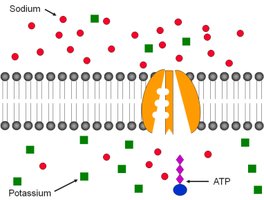
Topic: Membrane Transport - Sodium-Potassium Pump
This question tests your understanding of active transport mechanisms in cells.
Key Terms:
Active Transport: Movement of substances against their concentration gradient using energy.
Sodium-Potassium Pump: A protein that moves sodium and potassium ions across the membrane.
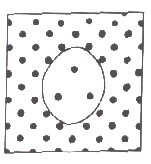
Step-by-Step Guidance
Observe the movement of sodium and potassium ions across the membrane.
Notice the involvement of ATP (energy molecule).
Recall the transport mechanism that uses energy to move ions against their gradient.
Try solving on your own before revealing the answer!
Final Answer: Active Transport (Sodium-Potassium Pump)
The transport demonstrated is active transport via the sodium-potassium pump, which uses ATP to move ions against their concentration gradients.
Q14. This is passive/active transport.
Background
Topic: Types of Membrane Transport
This question asks you to classify the sodium-potassium pump as passive or active transport.
Key Terms:
Active Transport: Requires energy (ATP).
Passive Transport: Does not require energy.
Step-by-Step Guidance
Recall the definition of active transport and the role of ATP.
Consider whether the sodium-potassium pump fits this definition.
Think about the direction of ion movement relative to their concentration gradients.
Try solving on your own before revealing the answer!
Final Answer: Active Transport
The sodium-potassium pump is an example of active transport because it uses ATP to move ions against their concentration gradients.
Q15. What type of protein is pictured here?
Background
Topic: Membrane Proteins in Active Transport
This question tests your knowledge of the protein involved in the sodium-potassium pump.
Key Terms:
Transport Protein: Protein that moves substances across the membrane.
Pump: Protein that uses energy to move substances against their gradient.
Step-by-Step Guidance
Recall the specific protein responsible for moving sodium and potassium ions.
Think about the term used for this protein.
Consider the function of this protein in active transport.
Try solving on your own before revealing the answer!
Final Answer: Sodium-Potassium Pump Protein
The protein pictured is the sodium-potassium pump, which actively transports sodium and potassium ions across the membrane.
Q16. What types of substances cross the plasma membrane in this way?
Background
Topic: Selective Transport via Pumps
This question tests your understanding of which ions are transported by the sodium-potassium pump.
Key Terms:
Sodium Ions (Na+): Moved out of the cell.
Potassium Ions (K+): Moved into the cell.
Step-by-Step Guidance
Recall the ions involved in the sodium-potassium pump.
Think about the direction each ion moves.
Consider the importance of these ions for cell function.
Try solving on your own before revealing the answer!
Final Answer: Sodium (Na+) and Potassium (K+) ions
The sodium-potassium pump transports sodium ions out of the cell and potassium ions into the cell.
Q17. What type of transport is demonstrated in Figure 7?
Background
Topic: Membrane Transport - Exocytosis
This question tests your understanding of how cells release substances by vesicle fusion with the membrane.
Key Terms:
Exocytosis: The process by which cells expel material using vesicles.
Vesicle: Membrane-bound sac used for transport.
Step-by-Step Guidance
Observe the vesicle fusing with the membrane and releasing its contents.
Recall the process where cells expel material by vesicle fusion.
Think about the term for this transport mechanism.
Try solving on your own before revealing the answer!
Final Answer: Exocytosis
The transport demonstrated is exocytosis, where cells release substances by vesicle fusion with the membrane.
Q18. This is passive/active transport.
Background
Topic: Types of Membrane Transport
This question asks you to classify exocytosis as passive or active transport.
Key Terms:
Active Transport: Requires energy (ATP).
Passive Transport: Does not require energy.
Step-by-Step Guidance
Recall the definition of active transport and the role of energy in vesicle fusion.
Consider whether exocytosis fits this definition.
Think about the cellular processes involved in exocytosis.
Try solving on your own before revealing the answer!
Final Answer: Active Transport
Exocytosis is an active transport process because it requires energy to move vesicles and expel substances from the cell.
Q19. What types of substances cross the plasma membrane in this way?
Background
Topic: Selective Transport via Exocytosis
This question tests your understanding of what kinds of substances are released by exocytosis.
Key Terms:
Proteins: Large molecules often released by cells.
Waste Products: Substances expelled from the cell.
Step-by-Step Guidance
Recall the types of substances packaged in vesicles for release.
Think about examples such as hormones, enzymes, and waste products.
Consider the importance of exocytosis for cell function.
Try solving on your own before revealing the answer!
Final Answer: Proteins, hormones, waste products
Exocytosis releases proteins, hormones, and waste products from the cell.
Q20. What type of transport is demonstrated in Figure 7?
Background
Topic: Membrane Transport - Endocytosis
This question tests your understanding of how cells take in substances by vesicle formation.
Key Terms:
Endocytosis: The process by which cells engulf material using vesicles.
Vesicle: Membrane-bound sac used for transport.
Step-by-Step Guidance
Observe the membrane wrapping around substances and forming a vesicle.
Recall the process where cells take in material by vesicle formation.
Think about the term for this transport mechanism.
Try solving on your own before revealing the answer!
Final Answer: Endocytosis
The transport demonstrated is endocytosis, where cells take in substances by forming vesicles.
Q21. This is passive/active transport.
Background
Topic: Types of Membrane Transport
This question asks you to classify endocytosis as passive or active transport.
Key Terms:
Active Transport: Requires energy (ATP).
Passive Transport: Does not require energy.
Step-by-Step Guidance
Recall the definition of active transport and the role of energy in vesicle formation.
Consider whether endocytosis fits this definition.
Think about the cellular processes involved in endocytosis.
Try solving on your own before revealing the answer!
Final Answer: Active Transport
Endocytosis is an active transport process because it requires energy to form vesicles and move substances into the cell.
Q22. What types of substances cross the plasma membrane in this way?
Background
Topic: Selective Transport via Endocytosis
This question tests your understanding of what kinds of substances are taken up by endocytosis.
Key Terms:
Macromolecules: Large molecules such as proteins and polysaccharides.
Particles: Large particles, including bacteria and debris.
Step-by-Step Guidance
Recall that endocytosis is used for substances too large to pass through the membrane by diffusion or facilitated transport.
Think about examples of such substances (e.g., proteins, bacteria).
Consider the types of material that require vesicle formation for transport.
Try solving on your own before revealing the answer!
Final Answer: Large particles and macromolecules (e.g., proteins, bacteria)
Endocytosis allows the cell to take in large particles and macromolecules that cannot cross the membrane by other means.
Q23. What type of transport is demonstrated in Figure 8?
Background
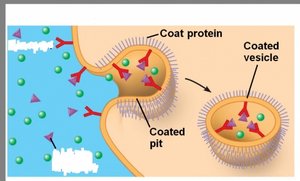
Topic: Membrane Transport - Receptor-Mediated Endocytosis
This question tests your understanding of a specialized form of endocytosis.
Key Terms:
Receptor-Mediated Endocytosis: Endocytosis triggered by specific receptors binding to target molecules.
Coated Vesicle: Vesicle formed with the help of coat proteins.
Step-by-Step Guidance
Observe the presence of receptors and coat proteins in the vesicle formation.
Recall the process where specific molecules are taken up by binding to receptors.
Think about the term for this specialized endocytosis.
Try solving on your own before revealing the answer!
Final Answer: Receptor-Mediated Endocytosis
The transport demonstrated is receptor-mediated endocytosis, where specific molecules are taken up by binding to cell surface receptors.
Q24. Is this passive/active transport?
Background
Topic: Types of Membrane Transport
This question asks you to classify receptor-mediated endocytosis as passive or active transport.
Key Terms:
Active Transport: Requires energy (ATP).
Passive Transport: Does not require energy.
Step-by-Step Guidance
Recall the definition of active transport and the role of energy in vesicle formation.
Consider whether receptor-mediated endocytosis fits this definition.
Think about the cellular processes involved in receptor-mediated endocytosis.
Try solving on your own before revealing the answer!
Final Answer: Active Transport
Receptor-mediated endocytosis is an active transport process because it requires energy to form vesicles and move substances into the cell.
Q25. What types of substances cross the plasma membrane in this way?
Background
Topic: Selective Transport via Receptor-Mediated Endocytosis
This question tests your understanding of what kinds of substances are taken up by receptor-mediated endocytosis.
Key Terms:
Ligands: Molecules that bind to receptors (e.g., hormones, cholesterol).
Macromolecules: Large molecules such as proteins.
Step-by-Step Guidance
Recall that receptor-mediated endocytosis is used for specific molecules that bind to cell surface receptors.
Think about examples such as cholesterol, hormones, and proteins.
Consider the types of material that require receptor binding for uptake.
Try solving on your own before revealing the answer!
Final Answer: Specific ligands (e.g., cholesterol, hormones, proteins)
Receptor-mediated endocytosis allows the cell to take in specific ligands that bind to cell surface receptors.
Summarize: Define passive transport. List the types of passive transport. Define active transport. List the types of active transport.
Background
Topic: Overview of Cell Transport Mechanisms
This question tests your ability to summarize and distinguish between passive and active transport mechanisms.
Key Terms:
Passive Transport: Movement of substances across the membrane without energy input.
Active Transport: Movement of substances against their concentration gradient, requiring energy.
Types of Passive Transport: Simple diffusion, facilitated diffusion, osmosis, filtration.
Types of Active Transport: Sodium-potassium pump, endocytosis, exocytosis, receptor-mediated endocytosis.
Step-by-Step Guidance
Recall the definitions of passive and active transport.
List the types of passive transport mechanisms.
List the types of active transport mechanisms.
Think about examples for each type.
Try solving on your own before revealing the answer!
Final Answer:
Passive transport is the movement of substances across the cell membrane without energy input, down their concentration gradient. Types include simple diffusion, facilitated diffusion, osmosis, and filtration.
Active transport is the movement of substances against their concentration gradient, requiring energy (usually ATP). Types include sodium-potassium pump, endocytosis, exocytosis, and receptor-mediated endocytosis.
