 뒤로
Cells and Tissues: Structure, Classification, and Function in Human Anatomy
스터디 가이드 - 스마트 노트
 자료에 맞춘 맞춤형 노트, 핵심 정의, 예시, 맥락을 확장해 제공합니다.
Cell Diversity
Overview of Cell Types
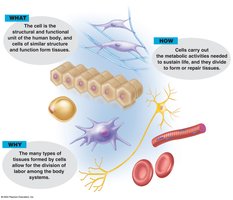
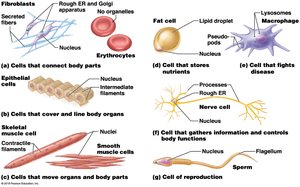
The human body contains over 200 distinct cell types, each specialized in structure and function. Cell diversity is essential for the wide range of physiological processes required for life.
Epithelial cells: Hexagonal shape, form sheets, serve as barriers.
Muscle cells: Elongated, contractile, enable movement.
Nerve cells: Branched, transmit electrical signals.
Blood cells: Round, transport gases and immune functions.
Fat cells: Store nutrients.
Macrophages: Fight disease.
Example: The hexagonal shape of epithelial cells allows tight packing, forming protective sheets.
Body Tissues
Classification of Tissues
Tissues are groups of cells with similar structure and function. The human body has four primary tissue types:
Epithelial tissue: Covers surfaces, lines cavities, forms glands.
Connective tissue: Supports, protects, binds, stores energy, provides immunity.
Muscle tissue: Generates force for movement.
Nervous tissue: Detects changes, transmits impulses, coordinates activities.
Epithelial Tissue
General Features
Epithelial tissue forms barriers and covers surfaces. It is avascular but has a nerve supply and regenerates easily.
Protection: Skin epithelium protects against pathogens and chemicals.
Absorption: Digestive tract epithelium absorbs nutrients.
Filtration: Kidney epithelium filters substances.
Secretion: Glandular epithelium produces sweat, mucus, etc.
Types of Epithelial Tissue
Surface epithelium: Covers and lines surfaces.
Glandular epithelium: Forms glands.
Classification by Layers
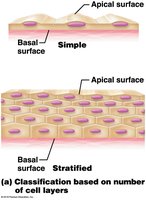
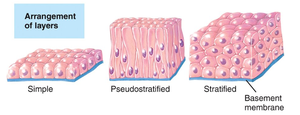
Epithelial tissues are classified by the number of cell layers:
Simple epithelium: Single layer, functions in absorption, secretion, filtration.
Stratified epithelium: Multiple layers, provides protection.
Pseudostratified epithelium: Appears layered, nuclei at different levels.
Classification by Cell Shape
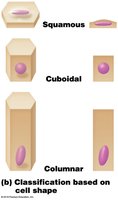
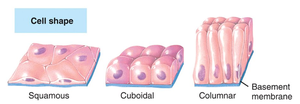
Squamous: Flattened, allow rapid passage of substances.
Cuboidal: Cube-shaped, function in secretion and absorption.
Columnar: Tall, protect tissues, specialized for secretion and absorption.
Transitional: Change shape, found in urinary organs.
Summary Table: Epithelial Types and Locations
Type | Layers | Shape | Location | Function |
|---|---|---|---|---|
Simple Squamous | 1 | Flat | Lungs, capillaries, serous membranes | Filtration, diffusion |
Simple Cuboidal | 1 | Cube | Glands, kidney tubules, ovaries | Secretion, absorption |
Simple Columnar | 1 | Tall | Digestive tract, mucous membranes | Absorption, secretion |
Pseudostratified Columnar | 1 (appears multi) | Tall | Respiratory tract | Absorption, secretion |
Stratified Squamous | 2+ | Flat (apical) | Skin, mouth, esophagus | Protection |
Transitional | 2+ | Variable | Urinary bladder | Stretching |
Connective Tissue
General Features
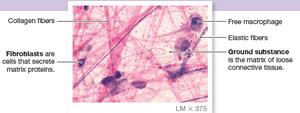
Connective tissue supports, protects, and binds other tissues. It is characterized by an extracellular matrix and variable blood supply.
Ground substance: Water, adhesion proteins, polysaccharides.
Fibers: Collagen, elastic, reticular.
Types of Connective Tissue
Bone: Hard matrix, osteocytes, protection and support.
Cartilage: Flexible, chondrocytes, types include hyaline, fibrocartilage, elastic.
Dense connective tissue: Tendons, ligaments.
Loose connective tissue: Areolar, adipose.
Blood: Fluid matrix, transport.
Areolar Tissue
Most widely distributed, soft, pliable, functions as packing tissue.
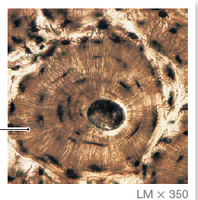
Bone Tissue
Composed of osteocytes in lacunae, hard matrix of calcium salts, collagen fibers.
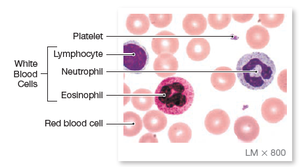
Blood Tissue
Blood cells in plasma, transport of nutrients, wastes, gases.
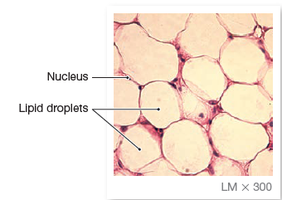
Adipose Tissue
Fat cells dominate, insulates, protects, stores energy.
Muscle Tissue
Types of Muscle Tissue
Skeletal muscle: Large, multi-nucleated, striated, voluntary movement.
Cardiac muscle: Striated, branched, mono-nucleated, involuntary, intercalated discs, found in heart.
Smooth muscle: Small, non-striated, involuntary, found in organs and blood vessels.
Nervous Tissue
Structure and Function
Nervous tissue is excitable and transmits electrical signals. It consists of neurons and neuroglia (support cells).
Neurons: Specialized for communication, have dendrites, axon, and cell body.
Neuroglia: Insulate, protect, and support neurons.
Functions: Receive and conduct impulses, detect changes, coordinate activities, maintain homeostasis.
Summary Table: Major Tissue Types
Tissue Type | Main Function | Key Characteristics | Common Locations |
|---|---|---|---|
Epithelial | Protection, absorption, filtration, secretion | Continuous sheets, avascular, regenerates | Skin, lining of organs, glands |
Connective | Support, protection, binding, transport | Extracellular matrix, variable blood supply | Bone, cartilage, blood, fat, tendons |
Muscle | Movement | Contractile fibers, excitable | Skeletal muscles, heart, organs |
Nervous | Communication, coordination | Neurons, neuroglia, excitable | Brain, spinal cord, nerves |
Additional info: The notes expand on brief lecture points to provide full academic context, including definitions, examples, and tables for classification and comparison. Images are included only when directly relevant to the explanation of cell and tissue structure and function.
