 뒤로
Chapter 8: Joints (Articulations) - Anatomy & Physiology Study Guide
스터디 가이드 - 스마트 노트
 자료에 맞춘 맞춤형 노트, 핵심 정의, 예시, 맥락을 확장해 제공합니다.
Joints (Articulations)
Introduction to Joints
Joints, also known as articulations, are the sites where two or more bones meet. They are essential for providing mobility to the skeleton and holding it together.
Articulation: The connection between bones.
Functions: Mobility and structural integrity of the skeleton.
Functional Classification of Joints
Joints are classified based on the degree of movement they allow.
Synarthroses: Immovable joints.
Amphiarthroses: Slightly movable joints.
Diarthroses: Freely movable joints.
Structural Classification of Joints
Structural classification is based on the material binding the bones and the presence or absence of a joint cavity.
Fibrous Joints: Bones joined by dense fibrous connective tissue; no joint cavity.
Cartilaginous Joints: Bones united by cartilage; no joint cavity.
Synovial Joints: Bones separated by a fluid-filled joint cavity; most movable type.
Fibrous Joints
Types of Fibrous Joints
Sutures: Rigid, interlocking joints with short connective tissue fibers. Allow growth during youth; ossify in middle age (synostoses).
Syndesmoses: Bones connected by ligaments. Can be immovable or slightly movable (e.g., distal tibiofibular joint, interosseous connection between radius and ulna).
Gomphoses: Peg-in-socket joints (e.g., teeth in alveolar sockets); fibrous connection is the periodontal ligament.
Cartilaginous Joints
Types of Cartilaginous Joints
Cartilaginous joints unite bones with cartilage and lack a joint cavity.
Synchondroses: Hyaline cartilage unites bones; all are synarthrotic (immovable).
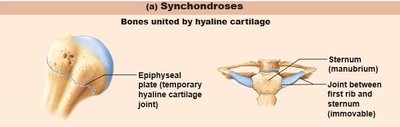
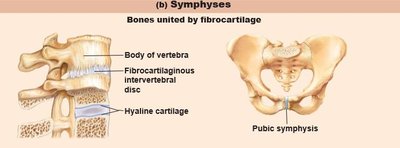
Symphyses: Hyaline cartilage covers articulating surfaces, fused to a pad of fibrocartilage; strong, flexible amphiarthroses.
Synovial Joints
General Features of Synovial Joints
Synovial joints are diarthrotic and include all limb joints.
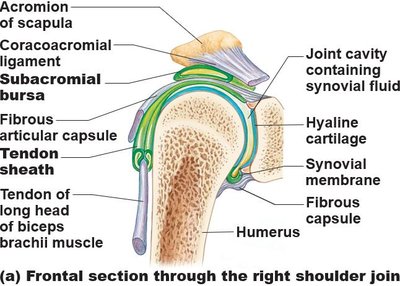
Articular Cartilage: Hyaline cartilage covers bone ends.
Joint (Articular) Cavity: Small potential space between bones.
Articular Capsule: Outer fibrous capsule (dense irregular connective tissue) and inner synovial membrane (loose connective tissue).
Synovial Fluid: Viscous, slippery filtrate of plasma and hyaluronic acid; lubricates and nourishes articular cartilage.
Reinforcing Ligaments: Capsular (intrinsic), extracapsular, and intracapsular ligaments.
Nerve and Blood Supply: Nerve fibers detect pain and monitor joint position; capillary beds produce filtrate for synovial fluid.
Friction-Reducing Structures
Bursae: Flattened, fibrous sacs lined with synovial membranes; contain synovial fluid.
Tendon Sheath: Elongated bursa that wraps around a tendon.
Stabilizing Factors at Synovial Joints
Articular Surface Shape: Minor role in stability.
Ligament Number and Location: Limited role.
Muscle Tone: Keeps tendons taut; crucial for shoulder, knee, and foot arches.
Movements at Synovial Joints
Muscle Attachments and Movement
Origin: Attachment to immovable bone.
Insertion: Attachment to movable bone.
Muscle contraction moves insertion toward origin.
Movements occur along transverse, frontal, or sagittal planes.
Range of Motion
Nonaxial: Slipping movements only.
Uniaxial: Movement in one plane.
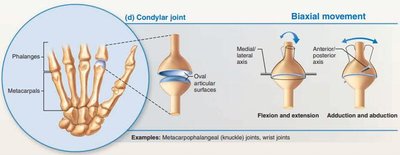
Biaxial: Movement in two planes.
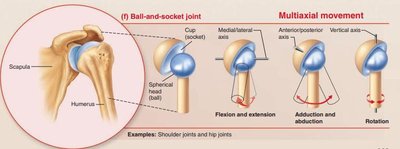
Multiaxial: Movement in or around all three planes.
Types of Movements
Gliding: Flat bone surfaces glide over each other (e.g., intercarpal joints).
Angular Movements: Occur along sagittal and frontal planes.
Angular Movements (Sagittal Plane)
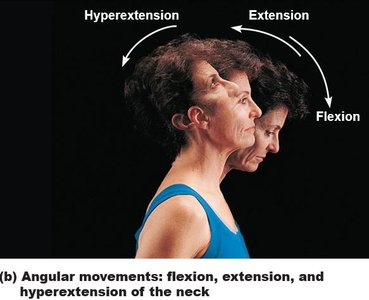
Flexion: Decreases joint angle.
Extension: Increases joint angle.
Hyperextension: Extension beyond normal range.
Angular Movements (Frontal Plane)
Abduction: Movement away from midline.
Adduction: Movement toward midline.
Circumduction: Limb moves in a cone shape.
Rotation
Rotation: Turning a bone around its own long axis (e.g., between C1 and C2 vertebrae, humerus, femur).
Special Movements
Supination: Turning forearm so palm faces forward.
Pronation: Turning forearm so palm faces backward.
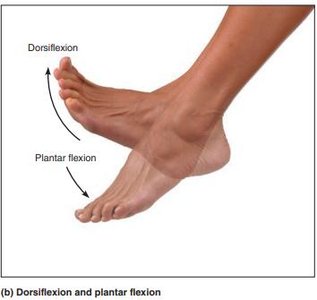
Dorsiflexion: Upward movement of the foot.
Plantar Flexion: Downward movement of the foot.
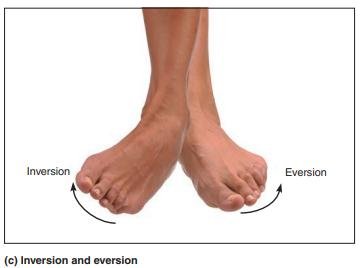
Inversion: Turning sole medially.
Eversion: Turning sole laterally.
Protraction: Anterior movement in transverse plane.
Retraction: Posterior movement in transverse plane.
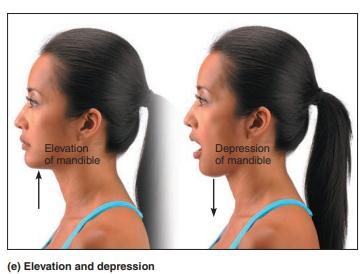
Elevation: Lifting a body part superiorly.
Depression: Moving a body part inferiorly.
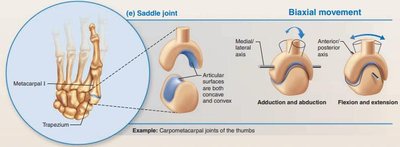
Opposition: Movement in the saddle joint so the thumb touches the tips of other fingers.
Types of Synovial Joints
Classification Based on Articular Surface Shape
Plane Joints: Nonaxial, flat surfaces, gliding movements.
Hinge Joints: Uniaxial, motion in one plane (flexion/extension).
Pivot Joints: Uniaxial, rounded end fits into ring.
Condyloid (Ellipsoidal) Joints: Biaxial, oval surfaces, permit all angular movements.
Saddle Joints: Biaxial, concave and convex surfaces, greater movement freedom.
Ball-and-Socket Joints: Multiaxial, most freely moving synovial joints.
Common Joint Injuries
Sprains
Sprain: Ligaments are stretched or torn. Partial tears repair slowly; complete ruptures require surgery.
Cartilage Tears
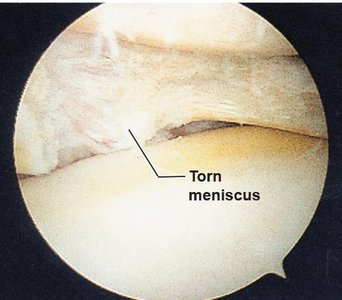
Cartilage Tear: Fragments may cause joint to lock or bind; rarely repairs itself; often treated with arthroscopic surgery.
Dislocations (Luxations)
Dislocation: Bones forced out of alignment; accompanied by sprains, inflammation, and immobilization.
Subluxation: Partial dislocation of a joint.
Inflammatory and Degenerative Conditions
Bursitis and Tendonitis
Bursitis: Inflammation of bursa, usually from blow or friction; treated with rest, ice, and anti-inflammatory drugs.
Tendonitis: Inflammation of tendon sheaths, typically from overuse; similar symptoms and treatment as bursitis.
Arthritis
Arthritis encompasses over 100 types of inflammatory or degenerative diseases that damage joints.
Symptoms: Pain, stiffness, swelling.
Acute Forms: Caused by bacteria; treated with antibiotics.
Chronic Forms: Osteoarthritis, rheumatoid arthritis, gouty arthritis.
Osteoarthritis (OA)
OA: Common, irreversible, degenerative arthritis; affects most people by age 85; more common in women.
Cartilage destruction exceeds replacement; bone ends thicken, enlarge, form spurs, restrict movement.
Treatment: Moderate activity, pain relievers, capsaicin creams, glucosamine, chondroitin sulfate.
Rheumatoid Arthritis (RA)
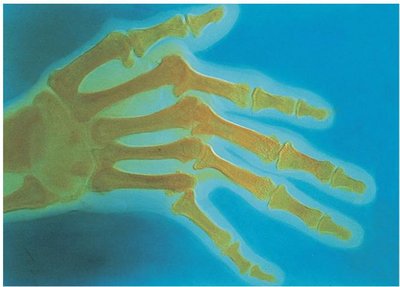
RA: Chronic, inflammatory, autoimmune disease; usually arises between ages 40-50; affects women more.
Symptoms: Joint pain and swelling (bilateral), anemia, osteoporosis, muscle weakness, cardiovascular problems.
Pathology: Synovitis, inflammatory blood cells, pannus formation, cartilage erosion, scar tissue, ankylosis.
Treatment: Aspirin, antibiotics, physical therapy, anti-inflammatory drugs, immunosuppressants, biological response modifiers.
Gouty Arthritis
Gout: Uric acid crystal deposition in joints; more common in men; typically affects base of great toe.
Untreated gout leads to bone fusion and immobilization.
Treatment: Drugs, hydration, avoidance of alcohol.
Developmental Aspects of Joints
Aging and Joint Health
Ligaments and tendons shorten and weaken with age.
Intervertebral discs more likely to herniate.
Most people in their 70s have some degree of osteoarthritis.
Exercise through full range of motion helps postpone joint problems.
