 뒤로
Digestive System: Structure, Function, and Regulation
스터디 가이드 - 스마트 노트
 자료에 맞춘 맞춤형 노트, 핵심 정의, 예시, 맥락을 확장해 제공합니다.
Digestive System Overview
General Functions
The digestive system is responsible for the breakdown and absorption of nutrients, as well as the elimination of waste. It consists of the gastrointestinal (GI) tract and accessory organs, each with specialized functions.
Ingestion: Intake of food and drink.
Motility: Movement of materials through the GI tract via muscular contractions.
Secretion: Release of enzymes, acids, bile, and other substances into the GI tract.
Digestion: Breakdown of food into smaller particles.
Mechanical digestion: Physical breakdown without altering chemical structure.
Chemical digestion: Enzymatic hydrolysis of macromolecules into monomers.
Absorption: Uptake of digested nutrients, water, and electrolytes into the blood.
Elimination: Removal of undigested material as feces.
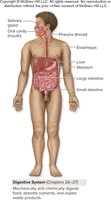
Major Organs and Their Functions
Oral cavity: Ingestion, taste, mastication, and initial chemical digestion; forms a bolus.
Pharynx: Swallows bolus.
Esophagus: Transports bolus to stomach.
Stomach: Mechanical digestion, forms chyme, limited absorption.
Small intestine: Chemical digestion and absorption of most nutrients.
Large intestine: Absorption of water/electrolytes, formation and storage of feces.
GI Tract Motility
Types of Movement
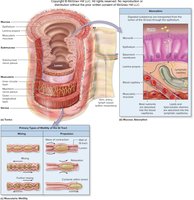
Motility in the GI tract is essential for mixing and propelling food. It is regulated by involuntary sphincters and specialized muscular movements.
Peristalsis: Sequential contraction of muscularis, moving contents in a wave-like manner.
Mixing: Non-directional kneading motion, blending food with secretions (gastric mixing in stomach, segmentation in small intestine).
GI Tract Innervation
Neural Control
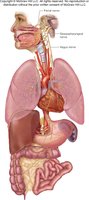
The GI tract is regulated by both intrinsic and extrinsic nervous systems.
Enteric Nervous System (ENS): Functions independently or with autonomic nervous system (ANS) input.
Submucosal plexus: Controls glands and smooth muscle in mucosa/submucosa.
Myenteric plexus: Controls smooth muscle in muscularis.
ANS:
Parasympathetic: Increases secretion and motility, relaxes sphincters.
Sympathetic: Decreases secretion and motility, contracts sphincters.
Oral Cavity: Mastication and Salivation
Mastication (Mechanical digestion)
Mastication (chewing) is a mechanical process involving teeth, cheeks, lips, tongue, and jaws. It increases surface area for enzymes, breaks cell walls, and forms a bolus for swallowing.
Controlled by the mastication center in the medulla oblongata.
Stimulates salivary secretion.
Salivation (Chemical digestion)
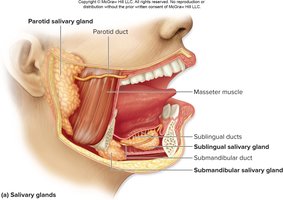
Salivary glands produce saliva, which is essential for moistening food, chemical digestion, and oral hygiene.
Parotid gland: Produces watery, serous saliva with amylase.
Submandibular gland: Produces serous and mucous secretions.
Sublingual gland: Produces serous and mucous secretions.
Saliva contains lysozyme, IgA, lingual lipase, and salivary amylase.
Deglutition (Swallowing)
Phases of Swallowing
Swallowing is a complex process involving voluntary and involuntary phases.
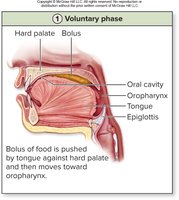
Voluntary phase: Tongue pushes bolus against hard palate toward oropharynx.
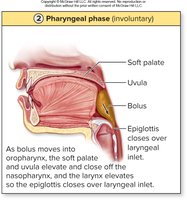
Pharyngeal phase (involuntary): Soft palate and uvula elevate, larynx elevates, epiglottis covers larynx to prevent aspiration.
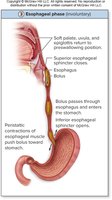
Esophageal phase (involuntary): Peristalsis moves bolus through esophagus; sphincters regulate passage.
Stomach Structure and Function
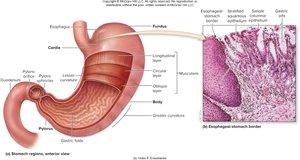
Stomach Anatomy and Secretions
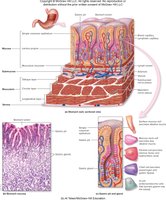
The stomach is primarily involved in mechanical digestion and the formation of chyme. It has limited absorption capabilities.
Acidic pH (2) activates enzymes, denatures proteins, breaks down connective tissue, and kills microorganisms.
Mucus protects the stomach lining from acid and enzymes.
mechanical and chemical digestion take place in stomach
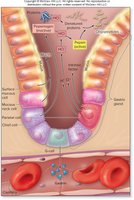
Gastric Juice Composition
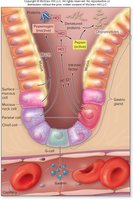
Surface mucous cell: Secretes alkaline mucus.
Mucous neck cell: Secretes less alkaline mucus.
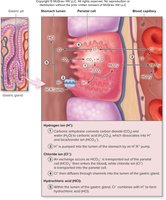
Parietal cell: Secretes HCl and intrinsic factor.
Chief cell: Secretes pepsinogen and gastric lipase.
G-cell: Secretes gastrin.
Ulcers
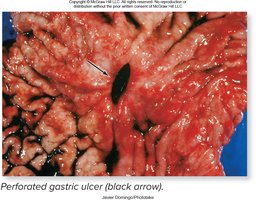
Ulcers occur when gastric juice is secreted in the absence of food, often exacerbated by Helicobacter pylori infection.
Parietal Cell Function
Secretes H+ and Cl- separately, forming HCl in the stomach lumen.
Uses H+/K+ exchange pump.
Intrinsic factor is essential for vitamin B12 absorption in the small intestine, necessary for red blood cell formation.
Chief Cells
Secrete pepsinogen (inactive), converted to pepsin by HCl for protein hydrolysis.
Secrete gastric lipase for lipid digestion.
G-Cells
Secrete gastrin, which increases gastric motility and closes the pyloric sphincter.
Ghrelin cells also present, stimulating hunger.
Stomach Motility
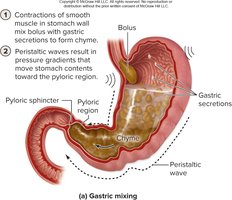
Gastric mixing: Mixes bolus with gastric juices to form chyme. (mechanical digestion)
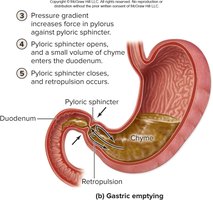
Gastric emptying: Small amounts of chyme exit through the pyloric sphincter.
Retropulsion: Remaining chyme flows back for further mixing.(mechanical digestion)
Stomach Regulation
Pacemaker cells: Spontaneously depolarize to establish peristaltic rate.
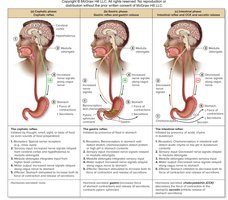
Cephalic phase: Sensory input triggers increased gastric activity via CN X.
Gastric phase: Bolus in stomach triggers gastrin release and increased motility.
Intestinal phase: Chyme in small intestine releases CCK and secretin, inhibiting gastric activity.
Small Intestine Structure and Function
Regions and Functions
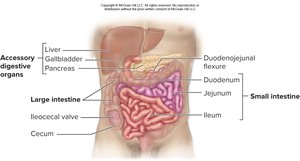
The small intestine completes chemical digestion and absorbs most nutrients.
Duodenum: Receives chyme, bile, and pancreatic juice.
Jejunum: Major site of digestion and absorption.
Ileum: Transfers chyme to large intestine.
Small Intestine Motility
Gastroileal reflex: Food in stomach triggers ileum contraction and valve opening.
Peristalsis and mixing expose chyme to enterocytes for absorption.
Absorption and Enterocytes
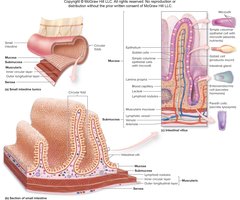
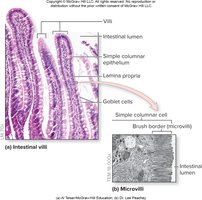
Enterocytes absorb nutrients into capillaries or lacteals.
Brush border enzymes aid in chemical digestion.
Intestinal Secretions
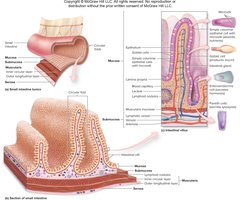
Goblet cells: Secrete mucus.
Paneth cells: Secrete lysozyme.
Enteroendocrine cells: Secrete hormones (CCK, secretin, motilin).
Large Intestine Structure and Function
Functions
Absorbs water and electrolytes.
Compacts undigested material into feces.
Intestinal bacteria produce vitamins B and K.
Goblet cells increase for lubrication.
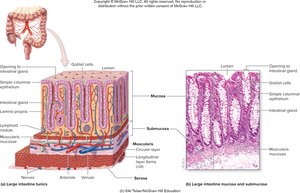
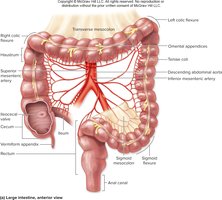
Motility
Peristalsis: Weak and slow.
Haustral churning: Mixing and movement between haustra.(mechanical digestion)
Mass movements: Powerful contractions pushing feces toward rectum, triggered by gastrocolic reflex.
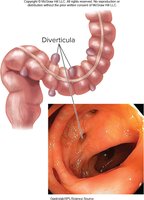
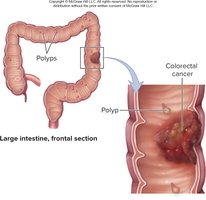
Diverticula and Colon Cancer
Diverticula: Outpouches in intestinal lining, risk increases with low fiber diet.
Diverticulitis: Inflammation due to trapped fecal matter.
Colon cancer: Often arises from polyps.
Rectum and Anus
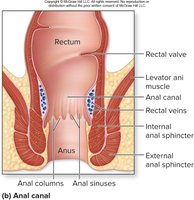
Rectum stores feces; rectal valves hold feces during gas passage.
Anal sinuses release mucus for lubrication.
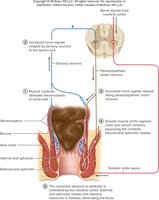
Defecation reflex relaxes internal sphincter; external sphincter is voluntarily controlled.
Valsalva maneuver aids in defecation.
Liver, Gallbladder, and Bile
Liver Functions and Bile Production
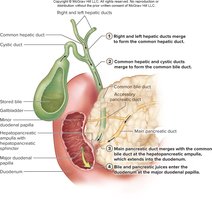
Hepatocytes produce bile for fat digestion.
Bile contains water, bile salts, bicarbonate, pigments, cholesterol, lecithin, and mucin.
Bile neutralizes acidic chyme, emulsifies fats, and eliminates bilirubin.
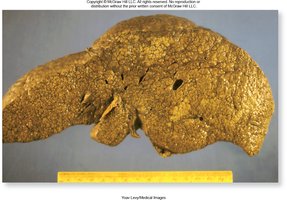
Cirrhosis
Chronic liver damage leads to jaundice, edema, ascites, itching, toxin accumulation, and hypertension.
Gallbladder
Concentrates, stores, and releases bile into duodenum.
Removal reduces bile release to small intestine.
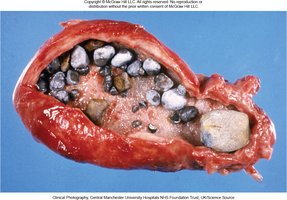
Gallstones
Formed from cholesterol or calcium and bile salts.
Pancreas
Exocrine Function
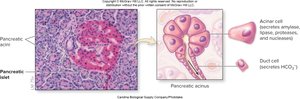
Acinar cells secrete pancreatic juice (amylase, lipase, proteases, nucleases).
Duct cells secrete bicarbonate to neutralize stomach acid.
Digestive Hormones
Hormonal Regulation
Ghrelin: Released by stomach, stimulates hunger.
Leptin: Released by adipocytes, suppresses hunger.
CCK: Suppresses hunger and regulates digestive activity.
Summary Table: Digestive Secretions and Their Sources
Substance | Source Cell/Organ | Main Function |
|---|---|---|
Saliva | Salivary glands | Moistens food, begins starch digestion |
Bile | Liver (hepatocytes) | Emulsifies fats, neutralizes chyme |
Pancreatic juice | Pancreas (acinar/duct cells) | Digests carbohydrates, proteins, lipids, nucleic acids; neutralizes acid |
Gastric juice | Stomach (parietal, chief, mucous, G-cells) | Protein digestion, activates enzymes, protects lining |
Key Equations
Hydrochloric acid formation in parietal cells: is transported separately and combines with in the stomach lumen to form .
