 뒤로
Endocrine System and Hormones: Structure, Function, and Regulation
스터디 가이드 - 스마트 노트
 자료에 맞춘 맞춤형 노트, 핵심 정의, 예시, 맥락을 확장해 제공합니다.
Endocrine System Overview
Functions of the Endocrine System
The endocrine system is a major regulatory system in the human body, responsible for maintaining homeostasis and coordinating physiological processes. It influences development, growth, metabolism, blood composition and volume, digestive processes, and reproductive activities.
Regulates development, growth, and metabolism: Hormones control cellular activities and metabolic rate.
Maintains homeostasis: Ensures stable internal conditions, such as blood glucose and calcium levels.
Controls digestive and reproductive processes: Hormones regulate enzyme secretion, motility, and gamete production.
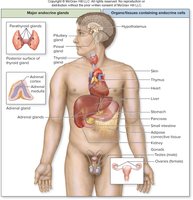
Endocrine vs. Exocrine Glands
Structural and Functional Differences
Glands are composed of clusters of simple cuboidal epithelial cells.
Exocrine glands: Secrete products into ducts or onto body surfaces (e.g., sweat, digestive enzymes).
Endocrine glands: Ductless; secrete hormones directly into the bloodstream for systemic effects.
Hormones: Chemical messengers produced by endocrine cells, circulating in blood to target distant cells.
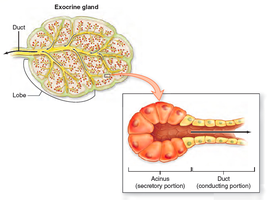
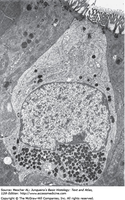
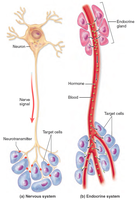
Endocrine vs. Nervous System Signaling
Comparison of Signaling Mechanisms
Both systems send signaling molecules to target cells, but differ in speed and scope.
Nervous system: Uses neurons and neurotransmitters for rapid, localized responses.
Endocrine system: Uses hormones for slower, long-lasting, systemic responses.
Hormone Reflexes and Stimulation
Types of Hormone Release
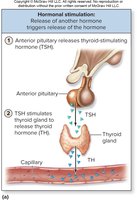
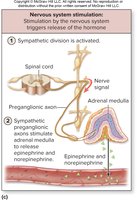
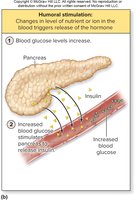
Hormone release is triggered by three main types of stimulation:
Hormonal stimulation: One hormone stimulates the release of another (e.g., TSH stimulates thyroid hormone release).
Humoral stimulation: Changes in blood levels of nutrients or ions trigger hormone release (e.g., high blood glucose stimulates insulin release).
Nervous stimulation: Nervous system directly stimulates hormone release (e.g., sympathetic nerves stimulate adrenal medulla).
Hormone Structures
Classification of Hormones
Hormones are classified based on their chemical structure:
Steroids: Lipid-soluble, derived from cholesterol (e.g., cortisol, sex hormones).
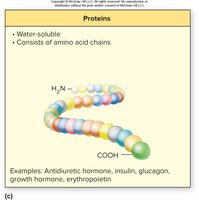
Proteins: Water-soluble, composed of amino acid chains (e.g., insulin, growth hormone).
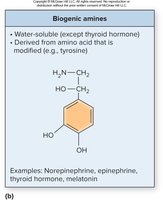
Biogenic amines: Water-soluble (except thyroid hormone), derived from modified amino acids (e.g., norepinephrine, epinephrine, melatonin).
Local Hormones: Eicosanoids
Short-Lived Signaling Molecules
Local hormones, such as eicosanoids, act near their site of production and do not circulate in the blood.
Eicosanoids: Derived from phospholipids; include thromboxanes, leukotrienes, and prostaglandins.
Functions: Vasoconstriction, pain, fever, inflammation.
Hormone Transport and Elimination
Transport Mechanisms
Lipid-soluble hormones: Require carrier proteins in blood; bound hormones act as a reserve and cannot affect target cells.
Water-soluble hormones: Dissolve directly in plasma; can bind to receptors on target cells.
Elimination and Half-Life
Hormones are degraded by the liver and eliminated by the kidneys.
Half-life: Time for half the hormone concentration to be eliminated; water-soluble hormones have the shortest half-life.
Hormone Action Mechanisms
Lipid-Soluble Hormones
Lipid-soluble hormones cross the plasma membrane and nuclear envelope, forming a hormone-receptor complex (HRC) that binds to hormone-response elements (HRE) in DNA, leading to transcription and protein synthesis.
Water-Soluble Hormones
Water-soluble hormones bind to plasma membrane receptors, initiating a signal transduction pathway via second messengers, affecting cellular activity without entering the cell.
Hormone Effects and Target Cell Response
Cellular Effects
Water-soluble hormones: Activate/inhibit enzymes, stimulate growth, release secretions, alter membrane permeability, cause muscle contraction/relaxation.
Lipid-soluble hormones: Increase protein production in target cells.
Target Cell Response
Depends on the number of receptors (up-regulation or down-regulation).
Depends on interactions with other hormones (synergistic, permissive, antagonistic).
Hormone Interactions
Types of Interactions
Synergistic: Hormones reinforce each other's activity.
Permissive: One hormone requires another to function.
Antagonistic: Hormones have opposite effects.
Hypothalamus and Pituitary Gland
Master Control of Endocrine System
The hypothalamus directly controls the posterior pituitary and adrenal medulla, and indirectly controls the anterior pituitary.
Posterior pituitary: Releases oxytocin (uterine contractions, milk letdown) and antidiuretic hormone (ADH; increases blood pressure).
Anterior pituitary: Releases tropic hormones that stimulate or inhibit other endocrine organs.
Growth Hormone (GH)
Targets and Effects
All cells: Increases growth and differentiation.
Liver: Releases insulin-like growth factors (IGFs).
Adipocytes: Increases nutrient release (diabetogenic effect).
Regulation and Disorders
Factors increasing GH: young age, sleep, high amino acids, low fatty acids/glucose, stress, exercise.
Disorders: Pituitary dwarfism (undersecretion in childhood), pituitary gigantism (oversecretion in childhood), acromegaly (oversecretion in adulthood).

Thyroid Gland
Hormones and Effects
Thyroid hormone (TH): Increases metabolism, body temperature, heart rate, and breathing rate.
Calcitonin: Lowers blood calcium by inhibiting osteoclasts and increasing calcium excretion in kidneys.
Thyroid Hormone Synthesis
Follicular cells produce thyroglobulin, which is iodinated to form T3 and T4.
T3 is the active form; T4 acts as a reserve and can be converted to T3 in cells.
Regulation and Disorders
Negative feedback: TH inhibits its own formation and TRH release.
Disorders: Hypothyroidism (weight gain, lethargy), goiter (iodine deficiency), hyperthyroidism (weight loss, hyperactivity, Graves disease).
Parathyroid Gland
Parathyroid Hormone (PTH)
Chief cells secrete PTH, the most powerful regulator of blood calcium.
PTH increases blood calcium by stimulating osteoclasts, promoting calcium absorption in the GI tract, and preventing calcium loss in the kidneys.
Adrenal Glands
Adrenal Medulla and Cortex
Adrenal medulla: Secretes catecholamines (epinephrine, norepinephrine) for short-term stress response.
Adrenal cortex: Secretes corticosteroids (mineralocorticoids, glucocorticoids, androgens) for long-term stress response.
Cortisol
Secreted in response to CRH and ACTH; highest during late sleep and stress.
Effects: Glycogenesis, gluconeogenesis, lipolysis, protein catabolism.
Imbalances: Cushing syndrome (excess), Addison's disease (deficiency).
Pancreas
Endocrine and Exocrine Functions
99% exocrine (digestive enzymes), 1% endocrine (pancreatic islets).
Alpha cells: glucagon (raises blood glucose).
Beta cells: insulin (lowers blood glucose).
Delta cells: somatostatin (inhibits GH and others).
F cells: pancreatic polypeptide (aids digestion).
Blood Sugar Regulation
Normal: 70-110 mg/dL.
Hyperglycemia (>130 mg/dL): damages vessels, kidneys, nerves.
Hypoglycemia (<60 mg/dL): lethargy, impairment, death.
Diabetes Mellitus
Type I: Insufficient or faulty insulin production (autoimmune).
Type II: Insulin resistance.
Gestational: Diabetes during pregnancy.
Pineal Gland
Melatonin and Sleep Regulation
Secretes melatonin in response to darkness, regulating sleep/wake cycles.
Melatonin affects GnRH synthesis, mood, and puberty timing.
Other Organs with Endocrine Functions
Hormones from Non-Endocrine Organs
Kidneys: erythropoietin (EPO).
Heart: atrial natriuretic peptide (ANP).
Thymus: thymic hormones.
Adipocytes: leptin, estrogens.
Skin: vitamin D3 synthesis.
Liver: IGF, angiotensinogen.
Gonads: sex hormones (estrogens, progesterone, testosterone).
Summary Table: Major Endocrine Glands and Their Hormones
Gland/Organ | Hormone(s) | Main Effects |
|---|---|---|
Hypothalamus | Releasing/inhibiting hormones | Controls pituitary gland |
Posterior Pituitary | Oxytocin, ADH | Uterine contractions, milk letdown, water retention |
Anterior Pituitary | GH, TSH, ACTH, FSH, LH, PRL | Growth, metabolism, stress, reproduction |
Thyroid | TH (T3/T4), Calcitonin | Metabolism, lowers blood Ca2+ |
Parathyroid | PTH | Raises blood Ca2+ |
Adrenal Cortex | Corticosteroids | Stress response, metabolism |
Adrenal Medulla | Epinephrine, Norepinephrine | Fight-or-flight response |
Pancreas | Insulin, Glucagon | Blood glucose regulation |
Pineal | Melatonin | Sleep/wake cycles |
Other Organs | EPO, ANP, Thymic hormones, Leptin, Sex hormones | Blood production, blood pressure, immunity, satiety, reproduction |
