 뒤로
Membrane Potential and Electrophysiology of Neurons
스터디 가이드 - 스마트 노트
 자료에 맞춘 맞춤형 노트, 핵심 정의, 예시, 맥락을 확장해 제공합니다.
Membrane Potential and Electrophysiology of Neurons
Introduction to Electrophysiology
Electrophysiology is the study of the electrical properties of biological cells and tissues, focusing on the changes in electrical potential across the plasma membrane. In neurons and muscle fibers, these electrical changes are essential for communication and function.
Excitable cells (such as neurons and muscle fibers) can respond to stimuli by generating electrical signals.
Conductivity refers to the ability of these cells to transmit electrical changes along their membranes.
Electrical changes are classified as local potentials (short distance) and action potentials (long distance).
Resting Membrane Potential
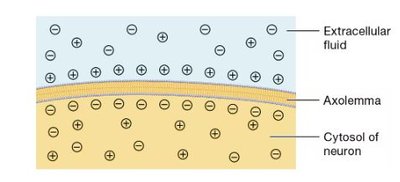
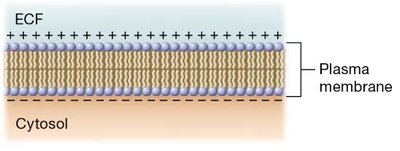
The resting membrane potential is the electrical potential difference across the plasma membrane when the cell is not actively sending a signal. For most neurons, this value is approximately -70 mV, meaning the inside of the cell is more negative compared to the outside.
Voltage is the measure of electrical potential difference between two points.
Membrane potential is the voltage across the cell membrane.
The cell is said to be polarized when there is a difference in charge across the membrane.
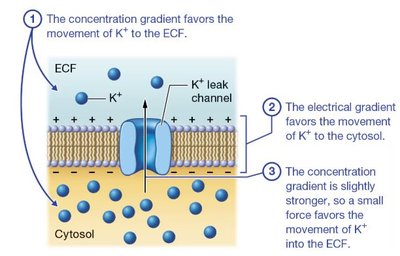
Leak channels allow potassium ions (K+) to exit the cell, making the cytosol more negative.
Ion Channels and Gradients
Ions cannot freely cross the hydrophobic core of the plasma membrane and require protein channels or pumps. The movement of ions is governed by both concentration and electrical gradients, collectively known as the electrochemical gradient.
Leak channels: Always open, allowing ions to move according to their gradients.
Gated channels: Open or close in response to specific stimuli.
Ligand-gated channels: Open in response to binding of a chemical messenger (ligand).
Voltage-gated channels: Open or close in response to changes in membrane potential.
Mechanically-gated channels: Open or close in response to mechanical forces (stretch, pressure, vibration).
Sodium-potassium pump (Na+/K+ ATPase): Actively transports 3 Na+ ions out and 2 K+ ions into the cell, maintaining the resting membrane potential.
Changes in Membrane Potential
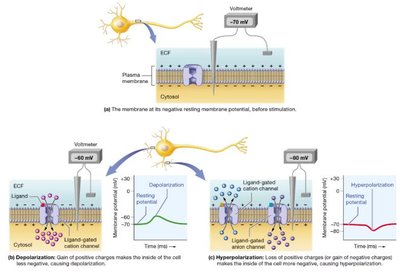
Membrane potential can change in response to the opening or closing of ion channels, leading to depolarization or hyperpolarization.
Depolarization: The membrane potential becomes less negative (closer to zero) due to the influx of positive ions.
Hyperpolarization: The membrane potential becomes more negative than the resting state, often due to the efflux of positive ions or influx of negative ions.
Local Potentials and Graded Potentials
Local potentials are small, localized changes in membrane potential that occur in response to a stimulus. They are also called graded potentials because their size varies with the strength of the stimulus.
Can result in either depolarization or hyperpolarization.
The degree of change depends on:
Length of stimulation
Number of ion channels opened
Type of ion channels involved
Local potentials are reversible and only travel short distances.
Electrical and Electrochemical Gradients
The movement of ions across the membrane is determined by both their concentration gradient and the electrical gradient. The combination of these two forces is the electrochemical gradient.
Electrical potential: Separation of charges across the membrane, a source of potential energy.
Concentration gradient: Difference in the concentration of ions across the membrane.
Electrochemical gradient: The sum of the electrical and concentration gradients acting on an ion.
Generation of the Resting Membrane Potential
The resting membrane potential is established by the differential permeability of the membrane to K+ and Na+ ions and the activity of the sodium-potassium pump.
K+ ions diffuse out of the cell more easily than Na+ ions can enter, making the inside of the cell more negative.
The sodium-potassium pump maintains the gradients by moving Na+ out and K+ in.
At rest, the membrane is more permeable to K+ than to Na+.
Clinical Application: Local Anesthetic Drugs
Local anesthetics are drugs that block voltage-gated sodium channels in neurons, preventing depolarization and the generation of action potentials. This blocks the transmission of pain signals to the central nervous system, resulting in temporary numbness in the targeted area.
May also cause temporary muscle weakness or paralysis in the affected region.
Pressure may still be felt, but pain is not transmitted to the brain.
Key Terms and Definitions
Excitable: Capable of responding to stimuli by generating electrical changes.
Conductivity: Ability to transmit electrical changes along the membrane.
Electrophysiology: Study of electrical properties of cells.
Resting membrane potential: The steady-state voltage across the membrane of a resting cell.
Ion channels: Proteins that allow specific ions to cross the membrane.
Leak channels: Always open, allowing passive ion movement.
Gated channels: Open/close in response to stimuli (ligand, voltage, mechanical).
Sodium-potassium pump: Maintains ion gradients using ATP.
Depolarization: Membrane potential becomes less negative.
Hyperpolarization: Membrane potential becomes more negative.
Local/graded potential: Small, variable changes in membrane potential.
Electrochemical gradient: Combined effect of concentration and electrical gradients on ion movement.
Summary Table: Types of Ion Channels
Channel Type | Stimulus for Opening | Example Location |
|---|---|---|
Leak Channel | Always open | Throughout neuron membrane |
Ligand-Gated Channel | Binding of a chemical (ligand) | Dendrites, cell body |
Voltage-Gated Channel | Change in membrane potential | Axon, axon hillock |
Mechanically-Gated Channel | Mechanical deformation (stretch, pressure) | Sensory receptors |
Key Equations
Nernst Equation (for equilibrium potential of an ion):
Goldman-Hodgkin-Katz Equation (for membrane potential considering multiple ions):
Additional info: The above equations are fundamental for understanding how ion concentrations and membrane permeability determine the resting membrane potential.
