 뒤로
Muscle Contraction and Muscle Tissue: Structure, Function, and Adaptation
스터디 가이드 - 스마트 노트
 자료에 맞춘 맞춤형 노트, 핵심 정의, 예시, 맥락을 확장해 제공합니다.
Whole Muscle Contraction
Principles of Muscle Contraction
Muscle contraction follows the same principles whether it involves a single muscle fiber or an entire muscle. Muscle tension is the force exerted by a contracting muscle, while load is the opposing force exerted by the object’s weight. Contraction may or may not result in muscle shortening, depending on the type of contraction.
Isometric contraction: Muscle tension occurs without shortening; the load is not moved.
Isotonic contraction: Muscle shortens and moves the load; tension exceeds the load.
Example: Lifting a car (isometric), picking up a 5lb weight (isotonic).
Motor Units and Neuromuscular Junctions
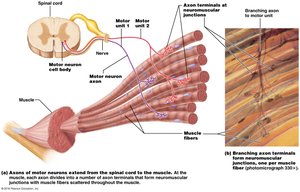
A motor unit consists of a motor neuron and all the muscle fibers it innervates. Each muscle is served by at least one motor nerve, which contains axons of many motor neurons. As axons enter the muscle, they branch into terminals, each forming a neuromuscular junction with a single muscle fiber.
Smaller motor units allow for fine control.
Larger motor units provide less precision but greater force.
Muscle fibers from a motor unit are distributed throughout the muscle, causing only weak contraction when a single unit is stimulated.
Muscle Twitch and Myogram
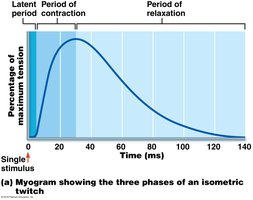
A muscle twitch is the response of a motor unit to a single action potential. It consists of three phases:
Latent period: Excitation-contraction coupling occurs; no tension is seen.
Period of contraction: Cross bridges are active; tension increases.
Period of relaxation: Ca2+ reentry into the sarcoplasmic reticulum; tension declines.
Muscle contracts faster than it relaxes.
Variation in Muscle Twitch
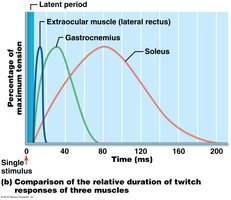
Muscles differ in strength and duration of twitches. Eye muscles contract rapidly and briefly, while larger muscles (e.g., calf) contract more slowly and sustain contraction longer.
Graded Muscle Responses
Changing Frequency of Stimulation
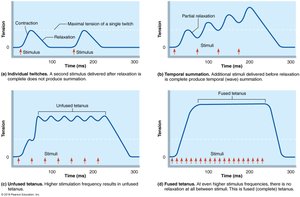
Muscle contraction strength can be graded by altering the frequency of stimulation:
Single stimulus: Single twitch.
Wave (temporal) summation: Rapid stimuli result in stronger second twitch; twitches increase in force.
Unfused (incomplete) tetanus: Sustained, quivering contraction.
Fused (complete) tetanus: Maximum tension; contractions fuse into a smooth plateau.
Changing Strength of Stimulation
Recruitment (multiple motor unit summation) controls contraction force. The greater the voltage, the more muscle fibers are recruited.
Subthreshold stimulus: Not strong enough for observable contraction.
Threshold stimulus: First observable contraction.
Maximal stimulus: All motor units recruited; maximum force.
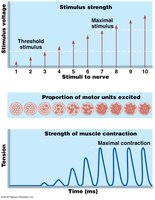
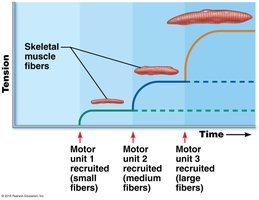
Size Principle of Recruitment
Recruitment follows the size principle: small motor units are recruited first, followed by larger units as stimulus intensity increases. Motor units contract asynchronously to prevent fatigue.
Muscle Tone
Muscle tone is a constant, slightly contracted state of all muscles. It stabilizes joints and maintains posture without producing active movement.
Types of Muscle Contractions
Isotonic Contractions
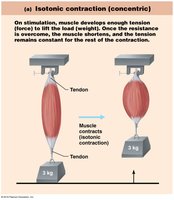
Isotonic contractions involve muscle changing length and moving a load. Tension remains constant throughout the contraction.
Concentric: Muscle shortens and does work (e.g., picking up a book).
Eccentric: Muscle lengthens while generating force (e.g., lowering a book, walking uphill).
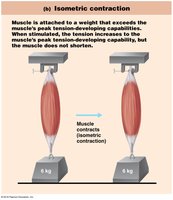
Isometric Contractions
Isometric contractions occur when muscle attempts to move a load greater than its maximum force. Tension builds, but muscle does not change length.
Helps maintain posture or hold joints stationary.
Electrochemical and Mechanical Events
Both isotonic and isometric contractions involve similar electrochemical and mechanical events, but only isotonic contractions result in movement.
Generating ATP for Muscle Contraction
ATP Supply and Regeneration
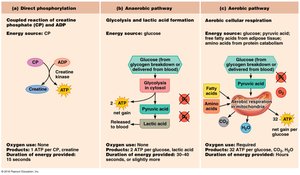
ATP is essential for muscle contraction, powering cross bridge movement, calcium pumping, and ion transport. Muscle stores of ATP are depleted quickly and must be regenerated by three mechanisms:
Direct phosphorylation by creatine phosphate (CP)
Anaerobic pathway (glycolysis and lactic acid formation)
Aerobic respiration
Direct Phosphorylation
Creatine phosphate donates a phosphate to ADP to form ATP, catalyzed by creatine kinase. This process powers muscle for about 15 seconds.
Anaerobic Pathway
Glycolysis breaks down glucose into pyruvic acid, generating 2 ATP per glucose. In low oxygen, pyruvic acid is converted to lactic acid, which diffuses into the bloodstream and can be used as fuel or converted back to glucose.
Aerobic Respiration
Aerobic respiration occurs in mitochondria and requires oxygen, breaking glucose into CO2, H2O, and producing up to 32 ATP. Fatty acids become the main fuel after 30 minutes of exercise.
Energy Sources During Exercise
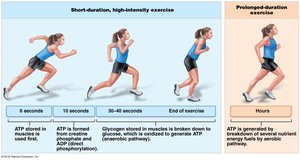
Muscle uses different energy sources depending on exercise duration and intensity:
Short-duration, high-intensity: ATP, creatine phosphate, anaerobic glycolysis.
Prolonged-duration: Aerobic respiration.
Muscle Fatigue and Recovery
Muscle fatigue is the inability to contract despite stimulation, often due to ionic imbalances, increased inorganic phosphate, decreased ATP, or damage to the sarcoplasmic reticulum. Recovery requires replenishing oxygen, converting lactic acid, restoring glycogen, and resynthesizing ATP and CP, a process called excess postexercise oxygen consumption (EPOC).
Factors Affecting Muscle Contraction
Determinants of Contractile Force
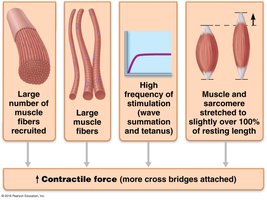
The force of contraction depends on:
Frequency of stimulation
Number of muscle fibers stimulated (recruitment)
Relative size of fibers (hypertrophy increases force)
Degree of muscle stretch (length-tension relationship)
Length-Tension Relationship
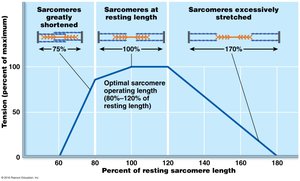
Muscle tension varies with the length of the muscle. Optimal tension is generated when sarcomeres are at 80–120% of their resting length. Too much or too little overlap reduces force.
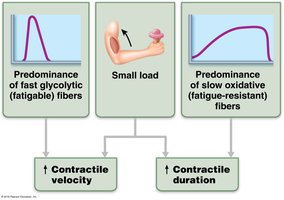
Velocity and Duration of Contraction
Muscle Fiber Types
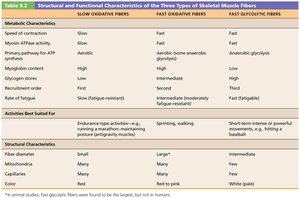
Muscle fibers are classified by speed of contraction and ATP synthesis pathway:
Slow oxidative fibers: Low-intensity, endurance activities
Fast oxidative fibers: Medium-intensity activities
Fast glycolytic fibers: Short-term, intense movements
Characteristic | Slow Oxidative Fibers | Fast Oxidative Fibers | Fast Glycolytic Fibers |
|---|---|---|---|
Speed of contraction | Slow | Fast | Fast |
ATP pathway | Aerobic | Aerobic (some anaerobic) | Anaerobic glycolysis |
Fatigue resistance | High | Intermediate | Low |
Best suited for | Endurance (marathon) | Sprinting, walking | Short, intense (baseball) |
Color | Red | Pink | White |
Load and Recruitment
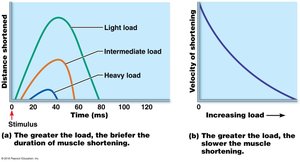
Muscles contract fastest with no load. Greater load shortens contraction duration and slows contraction. More motor units recruited increases speed and duration.
Muscle Response to Exercise
Adaptation to Exercise
Active or strenuous use of muscles increases strength, size, and efficiency. Overloading muscles is necessary for continued improvement; inactivity leads to weakness and atrophy.
Aerobic (Endurance) Exercise
Increases capillaries, mitochondria, and myoglobin in muscle fibers, especially slow oxidative fibers. Results in greater endurance, strength, and fatigue resistance. May convert fast glycolytic fibers to fast oxidative fibers.
Resistance Exercise
Leads to muscle hypertrophy (increase in fiber size), increased mitochondria, myofilaments, glycogen, and connective tissue. Results in increased strength and size. Can convert fast oxidative fibers to fast glycolytic fibers, but changes revert if exercise ceases.
Homeostatic Imbalance
Muscles must be active to remain healthy. Disuse atrophy occurs with immobilization or loss of neural stimulation, leading to rapid decline in strength and replacement of muscle tissue with fibrous connective tissue.
